
Venetian terrazzo (terrazzo alla veneziana) and its revered artisanal predecessor seminato are historical seamless composite flooring systems developed in the Republic of Venice between the 15th and 18th centuries. Engineered to accommodate the continuous structural micro-movements of palazzi resting on wooden lagoon pilings, authentic terrazzo combines a flexible slaked lime and pozzolanic cocciopesto binder with hand-scattered chips (semina) of precious Italian marbles (Verona Red, Carrara, Istrian stone), compacted with heavy granite rollers and hand-polished to a radiant satin luster.
At a Glance: Key Takeaways
- Origins & Guild: Venetian Republic (Arte dei Terrazzieri guild founded in 1582)
- Structural Substrate: Underfloor timber joists with flexible lime-rubble screed (sottofondo)
- Matrix Formulation: Aged slaked fat lime putty (grassello di calce) + crushed ceramic dust (cocciopesto)
- Marble Varieties: Rosso Verona, Giallo Reale, Nero Portoro, and white Carrara marble aggregate
In-Depth Guides in this Directory
Explore specialized subtopic blueprints, technical dimensions, and execution checklists:
Marble Aggregate Grading: The Seminato Hand-Scattering Technique and Grain Spacing
Technical artisan guide to Venetian seminato: marble aggregate sizing grades, hand-scattering casting kinematics, and aggregate density distribution.
Slaked Lime Putty Matrix: Cocciopesto Pozzolans and Heavy Stone Roller Compaction
Engineering guide to Venetian terrazzo mechanics: aging grassello di calce putty, cocciopesto pozzolanic reactions, and 150kg musso roller compaction.
Traditional Stone Block Hand Grinding: Linseed Oil Saturation and Beeswax Burnishing
Master artisan finishing guide to Venetian terrazzo: abrasive orsa hand-stone grinding, pumice polishing, boiled linseed oil sealing, and beeswax burnishing.
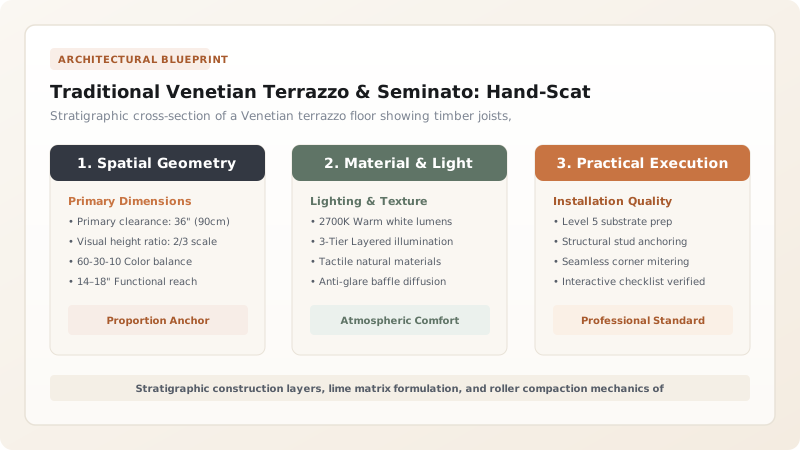
The Lagoon Dilemma: Engineering Floors on Sunken Timber Pilings
In the floating city of Venice, constructing rigid stone-flagged floors in noble palazzi was structurally impossible. Palaces rested upon millions of alder and oak pilings driven into waterlogged lagoon mud; as tidal waters rose and retreated, building foundations underwent continuous micro-settlement and structural flexure.
Rigid Roman cement or thick stone paving cracked under these dynamic deflections. In response, the Venetian masters of the Arte dei Terrazzieri guild engineered a flexible, jointless composite floor that could flex like leather without cracking, while weighing substantially less than solid marble ashlar slabs.
The Slaked Lime-Cocciopesto Matrix: Ductility and Breathability
Unlike contemporary 20th-century terrazzo that utilizes rigid, brittle Portland cement or epoxy resins, classical Venetian terrazzo is bound by high-calcium slaked lime putty (grassello di calce) aged for at least two years. To grant the lime hydraulic setting properties in damp lagoon air, artisans blended in cocciopesto—finely pulverized terracotta brick and clay roof tile dust.
The reactive amorphous silica and alumina in the brick dust react chemically with the free calcium hydroxide of the lime, forming water-resistant calcium aluminosilicate hydrates. This matrix remains slightly ductile for centuries, absorbing timber floor vibrations while allowing subterranean ground moisture to vaporize harmlessly.
The Seminato Technique: The Art of Hand-Scattering
While utilitarian terrazzo mixed small marble gravel directly into the wet paste, luxury palazzi commissioned seminato (literally 'sown' or seeded). The master craftsman spread a bed of tinted lime paste, then cast graded chips of rare Italian marbles across the surface by hand from wooden trays.
Using a graceful sweeping motion of the arm, the artisan sowed larger marble fragments (graniglia) of Rosso Verona, Botticino, and Bardiglio across the surface, achieving a breathtakingly dense 75% to 85% surface aggregate concentration. Smaller marble gravels were then sifted between the larger chips to lock the mosaic field into solid stone-on-stone compressive contact.
Compaction by Musso Roller and Hand-Stone Grinding
Once sown, the aggregate was driven deep into the lime bed using the musso—a colossal cylindrical granite or iron roller weighing over 150 kilograms. Guided by long wooden handles, apprentices rolled the floor repeatedly in crosswise passes to squeeze out microscopic air pockets and force marble facets into flat planar alignment.
After initial carbonation, craftsmen smoothed the floor using the orsa—a heavy curved abrasive stone (traditionally volcanic pumice or Istrian sandstone) mounted on a long wooden broom handle. Lubricated with water, the artisan ground the floor in sweeping arcs until all marble facets stood flush, finishing with repeated saturations of cold-pressed boiled linseed oil (olio di lino cotto) and hand-buffed beeswax.
Flooring Systems: Classical Venetian Lime Terrazzo vs Modern Epoxy Terrazzo
Use this reference table to calculate exact physical dimensions, ratios, and specifications before purchasing:
| Performance Parameter | Traditional Venetian Lime-Pozzolan Terrazzo | Modern Thin-Set Epoxy Terrazzo |
|---|---|---|
| Binder Chemistry | Slaked lime putty (CL-90) + pulverized cocciopesto | Petrochemical two-part epoxy or polyurethane resin |
| Substrate Flexibility | High ductility; accommodates timber floor deflection | Rigid; requires concrete slab substrate with crack isolation |
| Vapor Permeability | 100% breathable; allows moisture vapor evaporation | Completely impermeable vapor barrier; traps hydrostatic water |
| Visual & Tactile Depth | Warm, organic, velvety patina; softens with decades | High-gloss plastic sheen; shows scratch hazing under foot traffic |
| Historical Lifespan | Centuries of continuous use with simple beeswax care | Subject to resin yellowing and debonding within 25–35 years |
Practical Constraints
Every successful decoration project must account for physical and environmental constraints:
Long curing and carbonation cycle required before grinding (4 to 8 weeks)
Unlike modern fast-setting resins that can be ground within 24 hours, traditional lime-cocciopesto terrazzo requires weeks of damp hydration before it can bear heavy abrasive grinding. Mitigation: Incorporate low-temperature thermal curing blankets and plan floor installation during the earliest phase of interior restoration to accommodate natural carbonation.
Sensitivity of natural marble aggregate to acidic spills (wine, vinegar, citrus)
Calcium carbonate marble chips and lime binders etch and dull upon contact with acidic liquids, leaving matte stains on polished surfaces. Mitigation: Maintain a robust sacrificial beeswax barrier that repels spills and educate homeowners to wipe acidic liquids immediately using pH-neutral Castile soap.
Execution Blueprint & Craftsmanship Sequence
Execute this professional sequence to achieve flawless results without backtracking:
Subfloor Timber Preparation and Reed Mat Underlayment
Inspect underlying wooden floor joists for structural rigidity. Lay overlapping layers of split marsh reed mats (canniccio) or coarse linen fabric over timber planking to decouple the floor from wood joist expansion.
Laying the Sottofondo Coarse Screed Bed
Apply a 40 mm thick screed bed composed of hydraulic lime, coarse gravel, and crushed ceramic rubble. Screed flat and compact with heavy wooden tampers (mazzapicchio).
Formulating the Lime-Cocciopesto Paste Matrix
Mix aged slaked fat lime putty (grassello) with fine terracotta dust (cocciopesto) and iron oxide mineral pigments. Apply a uniform 20 mm thick bedding coat across the cured underlayer.
The Seminato Hand-Sowing of Marble Aggregates
Scatter graded marble chips (Rosso Verona, Carrara, Nero Portoro) across the wet paste by hand, sowing larger size 4–5 chips first, followed by smaller size 1–2 filler granules to achieve 80% surface coverage.
Stone Roller Compaction with the Musso
Roll the floor continuously with a 150 kg granite cylinder roller (musso) in orthogonal crosswise passes, pressing marble chips flush into the matrix until excess lime paste flushes to the top.
Damp Carbonation Curing
Cover the compacted floor with wet burlap and maintain damp conditions for 30 to 45 days, allowing the lime-pozzolan matrix to slowly hydrate and carbonize without shrinkage cracks.
Coarse to Fine Hand Grinding with the Orsa Stone
Grind the floor with abrasive pumice and sandstone blocks mounted on weighted poles (orsa), progressing through coarse, medium, and fine grits lubricated with water and fine stone slurry.
Linseed Oil Saturation and Beeswax Buffing
Allow floor to dry. Apply warm boiled linseed oil diluted with citrus turpentine to saturate the lime matrix. Finish with three coats of Venetian beeswax buffed by hand with wool pads.
Common Mistakes & Countermeasures
Avoid these costly errors that compromise aesthetics, ergonomics, and budget:
Adding Portland cement to the lime matrix to accelerate setting time
Sealing a classical lime terrazzo floor with modern polyurethane or epoxy clear coats
Project Execution Checklist
Track your physical progress. Checkboxes persist automatically on this device:
Frequently Asked Questions
What is the historical origin of the Arte dei Terrazzieri guild?
The Arte dei Terrazzieri was officially chartered by the Venetian Senate in 1582 to regulate the trade of terrazzo and seminato flooring. The guild enforced strict material standards, mandatory seven-year apprenticeships, and secret formulas for lime-cocciopesto mixtures, ensuring that every palazzo floor met supreme standards of durability and beauty.
What is the difference between regular terrazzo and seminato?
In basic terrazzo, smaller graded marble gravel is pre-mixed directly into the lime mortar before troweling. In seminato ('seeded'), the lime paste is laid down first, and larger, selected, hand-sorted marble chips are individually cast across the wet surface by hand, creating a denser, more artistic, and visually opulent mosaic texture.
Why does Venetian terrazzo look warmer than modern commercial terrazzo?
Modern commercial terrazzo uses grey industrial Portland cement or synthetic plastic resin binders ground with diamond discs, resulting in a cold, glassy, reflective surface. Historic Venetian terrazzo uses soft, ivory-toned slaked lime putty and warm pink cocciopesto dust, hand-polished with stones and linseed oil to produce a deep, glowing, candlelit satin luminescence.
Can authentic lime-pozzolan terrazzo be installed in modern residences?
Yes. Specialized artisanal flooring studios in Italy and worldwide continue to install authentic lime-and-marble seminato floors for high-end residential estates, luxury hotels, and historic restorations. It is completely VOC-free, hypoallergenic, compatible with modern hydronic underfloor heating, and lasts for centuries.


