
Irish dry stone walling is defined by two contrasting geological formations: the rugged, crystalline Galway Granite of Connemara and the horizontal, jointed Carboniferous Limestone of The Burren and Aran Islands. Slaters and wallers select stones based on natural cleavage planes, using heavy stone sledgehammers and pitching chisels to shape blocks that seat firmly on three contact points.
At a Glance: Key Takeaways
- Granite Formation: Caledonian Galway Granite (Connemara) — dense, igneous, rounded glacial erratics
- Limestone Formation: Viséan Carboniferous Karst Limestone (The Burren & Aran Islands) — tabular slabs
- Splitting Technique: Plug-and-feathers wedges, stone sledgehammers (*máil*), and pitching chisels
- Three-Point Contact: Every stone must rest unconditionally on three solid points without wobbling
- Granite Density: 2,650–2,750 kg/m³ (massive gravity ballast)
- Limestone Density: 2,600–2,700 kg/m³ (high compressive bed planes)
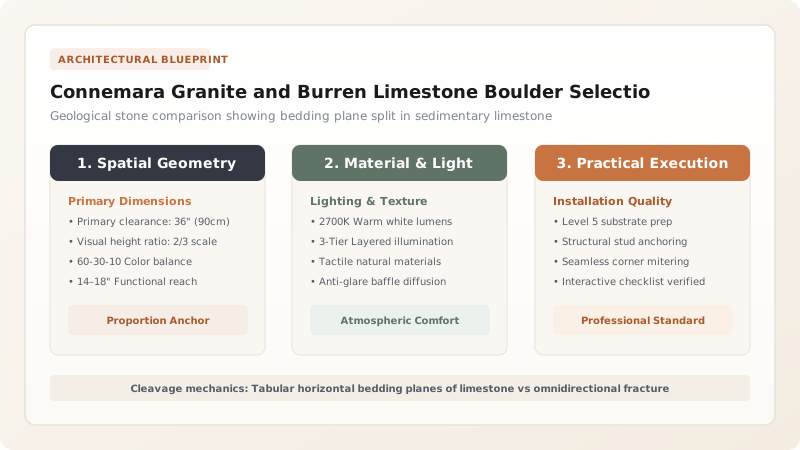
Connemara Galway Granite and Glacial Boulder Sourcing
In western County Galway, the landscape is sculpted by the Caledonian Galway Granite batholith, formed over 400 million years ago. During the last Ice Age, retreating glaciers scraped the mountain summits, leaving millions of massive, rounded granite boulders (glacial erratics) strewn across peat bogs and coastal pastures.
Connemara granite is an igneous rock composed of coarse quartz, pink orthoclase feldspar, and black biotite mica. Because glacial erratics have rounded, weathered edges and lack flat sedimentary bedding planes, building with Connemara granite requires extraordinary spatial intuition. Wallers must select stones that nestle together like giant puzzle pieces, utilizing the heavy deadweight of the stone (over 2.7 tons per cubic meter) to lock irregular surfaces into stable three-dimensional contact.
The Burren Karst Carboniferous Limestone and Tabular Slabs
South of Galway Bay, in County Clare and the Aran Islands, the geology transforms into the haunting karst limestone pavements of The Burren. Sourced from the Carboniferous Viséan epoch, Burren limestone was deposited in ancient warm tropical seas as thick horizontal marine sedimentary beds.
Natural weathering along vertical joints (grykes) and horizontal bedding planes (clints) fractures the rock into flat, tabular slabs measuring 100 to 200 mm thick. This sedimentary geometry allows dry stone wallers to construct regular, horizontal coursed masonry with razor-sharp horizontal lines, ideal for both tightly packed double walls and wind-shedding open lace walls.
Connemara Granite and Burren Limestone Boulder Selection in Ireland Architectural Decision Matrix
Use this reference table to calculate exact physical dimensions, ratios, and specifications before purchasing:
| Geological Material | Petrographic Classification | Stone Morphology | Masonry Style Produced | Tooling Required |
|---|---|---|---|---|
| Galway Granite | Coarse-grained igneous batholith | Rounded glacial erratics & boulders | Polygonal cyclopean boulder walls | Heavy sledgehammer & plug-and-feathers |
| Burren Limestone | Pure sedimentary calcium carbonate | Flat, tabular rectilinear slabs | Regular coursed & lace walls | Pitching tool & stone hammer |
| Mourne Granite | Micro-granite with feldspar phenocrysts | Angular split blocks | Coursed double mountain walls | Spalling hammer & stone wedges |
| Sandstone / Gritstone | Siliceous sedimentary sandstone | Irregular blocks with rough texture | Rough field boundaries (Cork/Kerry) | Club hammer & cold chisels |
Practical Constraints
Every successful decoration project must account for physical and environmental constraints:
Extremely Heavy Manual Lifting Hazard
Burren National Park Preservation
Selecting, Splitting, and Dressing Field Boulders
Execute this professional sequence to achieve flawless results without backtracking:
Field Sourcing & Survey
Walk the field to identify stones with natural flat seating facets and straight cleavage lines; avoid crumbly weathered surface rinds.
Cleavage Line Scoring
Identify the natural grain or rift (bedding plane); score a continuous straight line across the boulder with a cold chisel.
Plug and Feathers Splitting
Drill 20mm holes every 150mm along the score line; insert steel feathers; drive tapered center plugs progressively until the rock splits cleanly.
Face Pitching (Afeiçoamento)
Knock off protruding bumps and acute sharp horns using an 8-pound spalling hammer to establish a flush outer wall face.
Three-Point Contact Test
Place the stone in position on the wall; test with body weight; verify zero rock or wobble before proceeding to the next stone.
Common Mistakes & Countermeasures
Avoid these costly errors that compromise aesthetics, ergonomics, and budget:
Placing stones so they rock or pivot on two points
Laying sedimentary limestone with bedding planes oriented vertically
Using soft, porous tufa or weathered mudstone
Project Execution Checklist
Track your physical progress. Checkboxes persist automatically on this device:
Frequently Asked Questions
What is the 'three-point contact rule' in dry stone walling?
In geometry, three points define a plane. A stone resting on only two points will always rock and pivot, while four points can become unstable if ground settles. A stone firmly seated on three distinct solid contact points is mathematically locked and cannot wobble, even under dynamic animal pressure.
Why did Irish farmers historically build so many stone walls?
Western Ireland's soil was heavily choked with glacial boulders. To plant small patches of potatoes or oats, farmers had to pry thousands of tons of stone out of the earth. Building thick stone walls around tiny field plots (often less than half an acre) was the only practical way to dispose of the cleared rocks while creating windbreaks.


