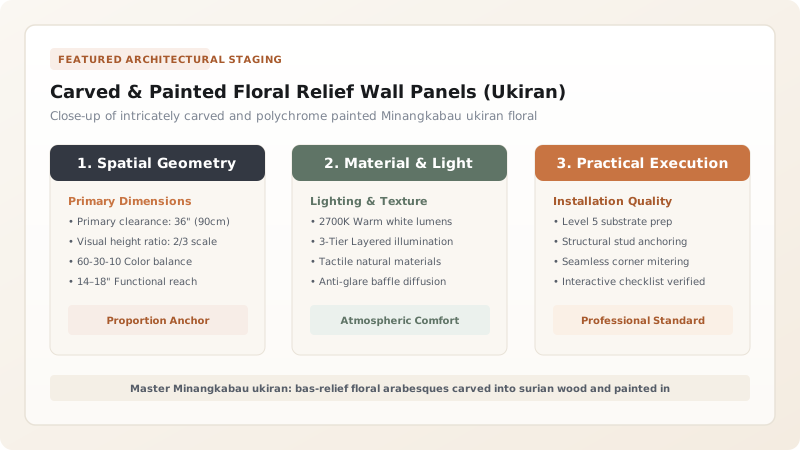
Ukiran woodcarving is the profound visual language that cloaks the exterior timber facades of the Minangkabau Rumah Gadang. Carved directly into seasoned surian cedar or teak planks, these bas-reliefs translate the philosophy of "alam takambang jadi guru" (nature as teacher) into intricate, repeating botanical and geometric patterns. Master carvers execute iconic motifs like daun sirih (betel leaf), itiak pulang petang (ducks returning at dusk), and pucuk rebung (bamboo shoots) using hand-forged gouges, finishing the wood with natural mineral pigments—red ochre, turmeric yellow, carbon black, and lime white—to create a vibrant, weather-resistant facade.
At a Glance: Key Takeaways
- Artisan Tradition: Minangkabau Ukiran (Bas-relief architectural woodcarving)
- Guiding Philosophy: Alam takambang jadi guru (Nature unfolding is our teacher)
- Primary Motifs: Itiak pulang petang, daun sirih, pucuk rebung, kuciang lalok
- Carving Substrates: Seasoned surian (Toona sinensis), teak (Tectona grandis), cempaka
- Pigment Chemistry: Red ochre, pulverized turmeric root, lampblack carbon, slaked lime white
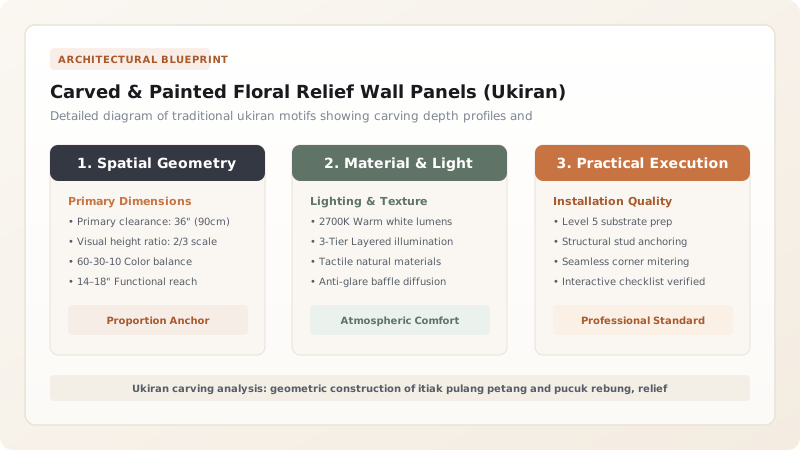
Alam Takambang Jadi Guru: Nature as the Supreme Teacher
The exterior of the Minangkabau Rumah Gadang is celebrated as one of the most densely ornamented architectural surfaces in Southeast Asia. Yet, this ornamentation is never merely decorative; it is a sacred codex of customary law (adat). The artistic ethos of the Minangkabau woodcarver is anchored in the foundational cultural aphorism: "Panakik pisau sirawik, ambil galah batang lintabung, silodang jadikan niru; satitiak jadikan lauik, sakapa jadikan gunuang, alam takambang jadi guru" ("Carve with the curved knife, take a pole of lintabung wood, make a winnowing tray from the sheath; let a drop become a sea, a fistful become a mountain, let nature unfolding be your teacher").
Following the peaceful adoption of Islam in West Sumatra during the 16th century, Minangkabau artisans strictly observed the theological prohibition against depicting figurative human or animal forms. In response, master carvers developed an extraordinary language of botanical and geometric abstraction. Every natural phenomenon observed in the fertile highland landscape—unfolding fern fronds, curling morning glory vines, flowing mountain streams, and the rhythmic movements of animals—was stylized into symmetrical, interlaced bas-reliefs that communicate moral instruction and philosophical wisdom to every passing generation.
Iconographic Motifs: Itiak Pulang Petang & Pucuk Rebung
The repertoire of Minangkabau ukiran encompasses more than ninety distinct named motifs, each assigned to specific architectural zones across the longhouse facade. Foremost among these is itiak pulang petang ("ducks returning home at dusk"). Carved as an undulating, rhythmic horizontal frieze directly beneath the window sills, the motif depicts stylized ducks walking in orderly, disciplined single file after a day in the flooded rice paddies. In Minangkabau society, where village governance is based on consensus through deliberation (musyawarah dan mufakat), the motif reminds clan members of the virtues of harmonious cooperation, respect for leadership, and the rejection of chaotic individual egoism.
Another paramount motif is pucuk rebung ("the bamboo shoot"), which occupies the triangular gable apexes and vertical corner posts. The design features sharp, tiered triangular chevrons filled with delicate floral arabesques. It symbolizes the life cycle and civic utility of the human being in traditional society: when young, the tender bamboo shoot (rebung) is edible and nourishes the family; as it grows, it becomes pliable and can be woven into baskets and mats; and when fully mature, the dense bamboo pole becomes a strong structural beam that supports the clan's house. The motif teaches that an individual must be of service to their community at every stage of existence.
Tooling, Wood Selection & Chisel Techniques
Executing the dense reliefs of ukiran requires seasoned wood of exceptional dimensional stability. Minangkabau carvers favor surian (Toona sinensis), an indigenous highland hardwood belonging to the mahogany family. Surian possesses a fine, even grain that cuts cleanly without splintering across annual rings, while its natural cedar-like aromatic oils confer permanent resistance to subterranean termites and fungal spores. For high-wear door portals and window frames, dense old-growth teak (Tectona grandis) or cempaka is selected.
The carver’s tool kit relies upon traditional hand-forged steel chisels. The craftsman begins by outlining the transferred pattern using a pahat kuku—a narrow curved gouge driven by light taps of a wooden mallet. The chisel is held at a steep 75-degree angle, scoring the perimeter to a depth of 2 to 3 millimeters to isolate the delicate botanical contours. Next, the negative background space is excavated to a uniform depth of 8 to 12 millimeters using flat firmer chisels (pahat lurus), creating a clean, recessed floor. Finally, using curved gouges and fine skew chisels, the carver rounds the leaf margins, hollows out the central veins, and undercuts overlapping vine tendrils, leaving crisp, razor-sharp facets that catch light and cast deep, vibrant shadow lines.
Pigment Alchemy: Natural Minerals, Plant Gums & Lime Washes
The visual drama of ukiran reaches its climax in its polychrome finish. In authentic practice, modern synthetic paints and high-gloss polyurethanes are strictly avoided: they form an impermeable plastic skin that traps tropical humidity inside the wood cells, causing blistering, peeling, and rot within two seasons. Instead, traditional artisans compound natural mineral and botanical paints that breathe with the timber.
The color palette is strictly governed by adat symbolism: red (merah), yellow or gold (kuning), black (hitam), and white (putih). Red is derived from crushed mineral red ochre (iron oxide); brilliant yellow is extracted by boiling crushed turmeric root (kunyit) with slaked lime; deep black is collected from the carbon soot of coconut-oil lamps; and pure white is made from finely ground calcined limestone (calcium carbonate). These dry pigments are bound using natural tree gums (such as dammar resin or acacia gum) dissolved in water. The artisan paints the deeply excavated background in matte carbon black, creating an infinite, shadowed void from which the raised floral motifs—resplendent in scarlet, gold, and white—appear to emerge in three-dimensional relief, glowing under the equatorial sun and celebrating the unyielding vitality of the matrilineal lineage.
Iconography, Motifs & Placement of Minangkabau Ukiran Carvings
Use this reference table to calculate exact physical dimensions, ratios, and specifications before purchasing:
| Motif Name | Literal Translation | Symbolic Adat Meaning | Architectural Placement | Carving Technique |
|---|---|---|---|---|
| Itiak Pulang Petang | Ducks returning home at dusk | Orderly consensus, community solidarity, humility | Continuous horizontal friezes beneath windows | Rhythmic wave-like repeating bas-relief (8 mm deep) |
| Pucuk Rebung | Sprouting bamboo shoot | Perseverance, utility to society at all life stages | Vertical corner posts and gable triangles | Triangular chevron diaper patterns with floral tips |
| Daun Sirih | Betel nut leaf | Hospitality, ritual greeting, medicinal wisdom | Window frames and door surrounds | Overlapping leaf scrolls with raised center veins |
| Kuciang Lalok | Sleeping cat | Quiet vigilance, thinking before speaking | Lower base panels beneath the living floor | Curled circular medallion carvings (10 mm relief) |
| Akar Barayun | Swinging jungle vines | Adaptability, familial continuity across generations | Eave facias and bargeboards (listplang) | Continuous undulating vine arabesques with tendrils |
Practical Constraints
Every successful decoration project must account for physical and environmental constraints:
Intense tropical sun and torrential rains causing rapid pigment fading and fungal discoloration
Vibrant exterior painted facades can turn dull and weather-stained within two to three years. Mitigation: Re-coat carvings every three years with natural pigment washes containing antifungal neem leaf extracts.
Time-intensive nature of hand-carving hundreds of individual exterior wall panels
Modern builders often substitute flat plywood or plain planks due to high labor costs. Mitigation: Establish community carving cooperatives (gotong royong) where clan youth learn carving from master artisans.
Execution Blueprint & Craftsmanship Sequence
Execute this professional sequence to achieve flawless results without backtracking:
Surian Wood Selection & Planing
Select straight-grained, slow-growth surian cedar planks, planing both faces to a smooth 25 mm thickness and squaring edges for tongue-and-groove joints.
Adat Cartoon Layout & Scribing
Draw full-scale geometric patterns according to traditional adat placement rules, transferring lines onto the wood using carbon paper or charcoal pouncing.
Perimeter Scoring (Pahat Kuku)
Score around all floral leaves, stems, and geometric borders with a narrow V-parting chisel or curved gouge, cutting 3 mm deep to prevent surface tearout.
Background Relief Excavation
Chisel away the negative background space to a uniform depth of 8 to 12 mm using flat firmer chisels, creating a flat, clean recess.
Three-Dimensional Floral Modeling
Model the convex surfaces of leaves, overlapping betel foliage, and bamboo shoots with curved gouges, carving delicate vein striations.
Natural Pigment Grinding & Formulation
Grind red ochre, turmeric root, and lampblack with water and tree-gum binders on a stone slab to produce thick, opaque, lightfast paints.
Polychrome Painting Execution
Paint the excavated background in deep carbon black, followed by applying vibrant red ochre to stems, golden yellow to flowers, and white to borders.
Floating Wall Panel Assembly
Slide the carved and painted planks horizontally into the grooved uprights of the timber wall frame, allowing 3 mm expansion clearance at ends.
Common Mistakes & Countermeasures
Avoid these costly errors that compromise aesthetics, ergonomics, and budget:
Using modern synthetic oil paints or polyurethane varnishes over outdoor ukiran carvings
Carving motifs indiscriminately across facade panels without adhering to adat placement rules
Carving unseasoned green wood with high moisture content
Project Execution Checklist
Track your physical progress. Checkboxes persist automatically on this device:
Frequently Asked Questions
What is the cultural philosophy behind Minangkabau ukiran woodcarving?
Minangkabau ukiran is governed by the philosophical principle "alam takambang jadi guru" (nature unfolding is our teacher). Traditional carvers do not depict human or animal figures, adhering to Islamic prohibitions against idolatry. Instead, they abstract the natural world—plants, vines, water birds, and celestial bodies—into repeating geometric rhythms. Every motif carries a moral lesson regarding social harmony, matrilineal responsibility, humility, and community consensus.
Why is surian wood (Toona sinensis) preferred for exterior carved panels?
Surian (often called Indonesian red cedar) is the premier wood for ukiran. It is a medium-density hardwood that is soft enough to yield cleanly to fine carving gouges across and with the grain, yet dense enough to hold crisp, razor-sharp details. Crucially, surian contains natural aromatic resins and oils that repel termites and woodborers, while exhibiting minimal shrinkage and warping under extreme tropical humidity cycles.
What are the four primary traditional colors of Minangkabau architecture and what do they signify?
The four traditional colors are red, yellow (gold), black, and white. Red (merah) symbolizes courage, vitality, and the executive leadership of the clan; yellow or gold (kuning) represents the sovereign majesty of the adat law and the dignity of the matrilineal matriarchs; black (hitam) symbolizes wisdom, steadfastness, and the ancestral foundation; and white (putih) represents spiritual purity and religious devotion to Islam.