
The pinnacle of Thikri artistry is achieved in the Sheesh Mahal (Palace of Mirrors) and projecting royal balconies (*Jharokhas*). In these spaces, thousands of convex glass shards are arranged in radial Persian star tessellations (*Shamsah*), flowing vase-and-vine arabesques (*Guldasta*), and jeweled floral bouquets, creating dynamic architectural light amplifiers that respond dramatically to changing daylight and flickering lanterns.
At a Glance: Key Takeaways
- Signature Spaces: Sheesh Mahal (Palace of Mirrors), Diwan-i-Khas, Zenana Jharokhas
- Iconic Compositions: Guldasta (vase of flowers), Buta (paisley/cypress), Shamsah (radial sun star)
- Architectural Features: Foliated cusped arches, fluted columns, vaulted squinches, and domes
- Light Scattering Range: Full 360-degree ambient spherical dispersion across vaulted ceilings
- Color Variations: Silvered mirrors accented with ruby, emerald, and cobalt Belgian stained glass
- Thermal Insulation: Lime gesso layer provides 20mm of dense mineral thermal buffering
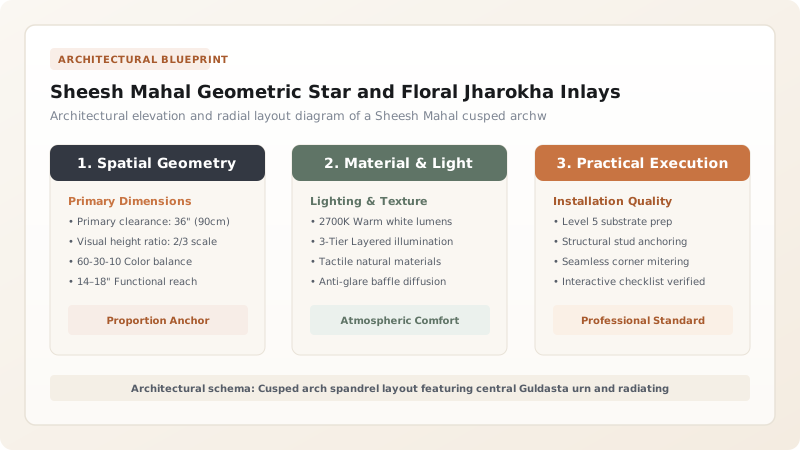
Architectural Programs and Spatial Experience of the Sheesh Mahal
In royal Rajput palace complexes—such as Amer Fort, Udaipur's City Palace, and Mehrangarh in Jodhpur—the Sheesh Mahal occupied the most private, prestigious domestic quarters (the Zenana and winter royal bedrooms). Built with thick sandstone walls and intimate proportions, these pavilions were designed to capture and amplify every flicker of candlelight during nocturnal royal audiences and intimate musical soirees.
The surfaces were completely enveloped in mirror inlay: fluted marble pillars featured spiraling glass bands; cusped arch spandrels bloomed with mirror peacocks; and domed ceilings were crowned with monumental radiating sunbursts (Shamsah). At night, with heavy silk curtains drawn, the motion of a single dancing oil lamp created the ethereal optical illusion that the solid stone ceiling had dissolved into an infinite starry firmament.
Jharokha Balconies and Dynamic Daylight Dynamics
Beyond nocturnal candlelit chambers, Thikri was applied with stunning effect to exterior projecting cantilevered balconies (Jharokhas). In Rajput palaces, Jharokhas allowed royal women to observe court processions and city life while remaining concealed behind stone lattice screens (jalis):
- Morning Sun Capture: As early morning sunlight struck the faceted convex mirrors on the balcony vault, beams of light were deflected and scattered down into the shadowed interior room.
- Color Accents: In addition to pure silver mirrors, master ustas integrated vibrant jewels of colored glass—Venetian cobalt blue, Bohemian ruby red, and emerald green—into the centers of lotus blossoms and peacock tails, casting dazzling pools of colored light across white marble floors.
- Thermal Mass Performance: The 20mm layer of dense lime-marble gesso backing acted as a thermal buffer, dampening heat transfer through the thin cantilevered stone floor plates of the balcony.
Sheesh Mahal Geometric Star and Floral Jharokha Inlays in Thikri Art Architectural Decision Matrix
Use this reference table to calculate exact physical dimensions, ratios, and specifications before purchasing:
| Architectural Zone | Primary Design Motif | Mirror Type | Lighting Dynamic | Spatial Emotion |
|---|---|---|---|---|
| Central Dome Apex | Shamsah (Radial 16-point Sun) | Convex silver mirrors | Overhead candle reflection | Celestial transcendence |
| Arch Spandrels | Peacocks & Flowering Cypress | Silver + emerald/ruby glass | Raking wall-sconce light | Verdant royal paradise |
| Cusped Niche (Taq) | Guldasta (Vase with bouquet) | Micro-convex mirror petals | Direct oil-lamp flame | Intimate contemplative focus |
| Jharokha Vault | Interlocking Diamond Lattice | Curved silver glass shards | Morning exterior daylight | Airy, sparkling radiance |
Practical Constraints
Every successful decoration project must account for physical and environmental constraints:
Ceiling Ergonomics and Inverted Setting
Vibration Protection
Laying Out and Executing a Dome Shamsah Medallion
Execute this professional sequence to achieve flawless results without backtracking:
Dome Center Scribing
Locate true geometric center of dome vault; strike concentric reference rings using a radius beam tram line.
Radial Division
Divide circumference into 16 or 32 equal radial rays using iron dividing calipers; snap chalk radial lines.
Gach Plaster Application
Apply 6mm lime-marble gesso along the radial rays, building raised bas-relief framing borders for each star segment.
Convex Glass Petal Insetting
Embed pre-cut convex mirror petals into the wet gesso along concentric tiers, working outward from center apex to perimeter.
Gemstone Glass Accentuation
Set faceted ruby and cobalt glass lozenges at the intersections of radial star arms to anchor geometric nodes.
Gesso Burnishing & Cleansing
Burnish exposed white plaster bezels with an agate stone; polish mirror faces with silk cloth and alcohol swabs.
Common Mistakes & Countermeasures
Avoid these costly errors that compromise aesthetics, ergonomics, and budget:
Setting mirror petals at identical planar angles
Using thick Portland cement pointing around mirrors
Allowing cleaning water to pool behind ceiling mirrors
Project Execution Checklist
Track your physical progress. Checkboxes persist automatically on this device:
Frequently Asked Questions
What is the symbolic meaning of the Guldasta (vase of flowers) in Thikri panels?
The Guldasta (or urn of life) is a classical Mughal-Persian symbol representing eternal paradise, abundance, and divine blessing. In the arid Thar desert, images of lush flowering plants set in sparkling mirrors evoked a heavenly, cool oasis inside the royal residence.
How are damaged Thikri panels restored in heritage palaces?
Conservators photograph and map missing shards, carefully extract decayed modern plaster patches, source historically accurate mouth-blown glass with matching curvature, silver the shards, and bed them into traditional lime-marble Gach gesso using identical organic formulas.


