
The sparkling magic of royal Thikri comes from hand-blown convex glass globes silvered internally with tin-mercury amalgam. Imported historically from Belgian and Venetian glasshouses or blown in northern India, these thin, curved glass spheres are carefully shattered into shards and hand-sheared under water into minute diamonds, petals, and stars with specialized forged shears.
At a Glance: Key Takeaways
- Glass Form: Free-blown spherical glass bulbs (100–250mm diameter, 0.6–1.0mm thickness)
- Reflective Layer: Tin foil (Stannum) dissolved in liquid mercury (Quicksilver) or chemical silver
- Curvature Function: Convex focal scattering generating thousands of micro-highlights
- Cutting Method: Underwater shear cutting using hand-forged steel pliers (*katani*)
- Shape Taxonomy: Badam (almond), Patti (leaf), Sitara (star), Meen (fish-scale), Mor (peacock eye)
- Edge Beveling: Smooth chamfering on natural stone hone to eliminate sharp razor edges
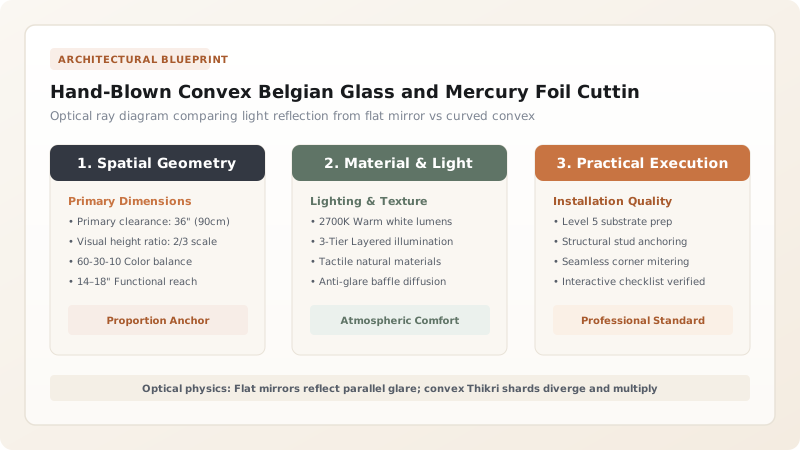
Mercury-Amalgam Chemistry and Spherical Optics
Historically, flat silvered mirrors were fragile and difficult to transport across ancient trade routes from Europe to India. Glassmakers developed a technique of blowing thin spherical glass globes. Before the hot glass bulb cooled, a mixture of melted tin, lead, bismuth, and metallic mercury (quicksilver) was introduced inside.
As the artisan rotated the bulb rapidly, the metallic liquid coated the entire interior wall, crystallizing upon cooling into a brilliant, mirror-like specular amalgam. Because the reflective film was applied on the concave interior of the glass, the exterior convex face protected the delicate metal foil from atmospheric oxidation and mechanical abrasion.
Underwater Shear Cutting Mechanics and Tooling
Cutting thin, curved glass without a diamond glass cutter is physically impossible in open air—the shock waves from a scissor blade cause the brittle glass to fracture unpredictably into dust. Indian craftsmen devised the technique of underwater shear cutting:
When glass is submerged in water, surface water molecules penetrate microscopic surface flaws in the silica network through stress corrosion mechanisms. The surrounding water acts as a fluid mechanical damper, absorbing destructive acoustic shock waves. The craftsman uses custom forged curved-blade iron shears (katani), slicing through the curved glass cleanly and effortlessly like stiff paper.
Hand-Blown Convex Belgian Glass and Mercury Foil Cutting in Thikri Architectural Decision Matrix
Use this reference table to calculate exact physical dimensions, ratios, and specifications before purchasing:
| Motif Shape | Hindustani Name | Typical Dimension | Placement Zone | Cutting Difficulty |
|---|---|---|---|---|
| Almond / Oval | Badam | 8 x 15 mm | Floral petals & lotus blossoms | Moderate |
| Leaf / Tear | Patti | 5 x 12 mm | Vines, tendrils, and tree foliage | Low |
| Eight-Point Star | Hasht-Koni Sitara | 12 x 12 mm | Ceiling vault medallions | Very High |
| Fish Scale | Meen-Chhal | 10 x 10 mm | Peacock breast & fish motifs | High |
| Diamond Rhombus | Heera | 6 x 6 mm | Border friezes and geometric bands | Moderate |
Practical Constraints
Every successful decoration project must account for physical and environmental constraints:
Toxicity of Historic Quicksilver
Hand Fatigue and Cramping
Underwater Glass Cutting and Tessera Preparation
Execute this professional sequence to achieve flawless results without backtracking:
Bulb Cracking
Score the neck of the silvered blown bulb; tap lightly to crack into curved shards roughly 50mm across.
Water Pan Setup
Fill a shallow, wide brass basin with clean water at room temperature; rest hands comfortably on basin rim.
Submerged Roughing
Submerge the glass shard completely; trim away jagged perimeter edges using forged katani shears held at 90 degrees.
Pattern Shaping
Follow paper pattern templates; snip glass into precise almond petals (badam) and diamond stars with continuous gentle snips.
Edge Dressing
Rub the perimeter of the cut glass shard across a fine carborundum or water stone to eliminate sharp cutting burrs.
Shellac Sealing
Paint the back of cut pieces with thin natural button shellac to protect the exposed metal foil edges from lime moisture.
Common Mistakes & Countermeasures
Avoid these costly errors that compromise aesthetics, ergonomics, and budget:
Lifting shears out of water during cut
Using thick window glass (>2mm)
Leaving metallic backing unsealed at cut edges
Project Execution Checklist
Track your physical progress. Checkboxes persist automatically on this device:
Frequently Asked Questions
Can modern mirrors be cut under water with ordinary kitchen scissors?
Yes, but only if the glass is very thin (under 1.2mm). Thick modern 3mm or 4mm float glass is too stiff and will simply shatter. The technique requires ultra-thin glass where scissor shearing forces exceed the flexural tensile strength before catastrophic fracture occurs.
Where does contemporary restoration get authentic convex blown glass?
Traditional glassblowers in Firozabad (Uttar Pradesh) still mouth-blow thin glass globes for heritage conservation projects across Rajasthan, which are then silvered using modern non-toxic silver nitrate solutions.


