
Thikri (also known as Aina-Kari or mirror mosaic) is a classical Indian architectural embellishment originating in the royal courts of Rajasthan and Mughal North India. Master craftsmen (*ustas*) hand-cut convex Belgian or local blown glass coated with mercury-tin foil into minute polygons and petals using iron calipers and diamond scribes, embedding them into wet Aravali lime-plaster gesso (*chuna gach*) relief to transform interior palace halls into radiant, light-amplifying Sheesh Mahals.
At a Glance: Key Takeaways
- Royal Centers: Amer Fort, City Palace Udaipur, Samode Palace, Mehrangarh (Rajasthan)
- Primary Material: Hand-blown convex glass spheres silvered with mercury-tin amalgam
- Bedding Substrate: Aravali slaked fat lime, marble dust (*safeda*), and organic jaggery-methi gesso
- Cutting Tool: Custom curved iron diamond scissors (*katani*) and stone abrasives
- Signature Spaces: Sheesh Mahal (Palace of Mirrors), Jharokhas, and prayer niches
- Optical Effect: Specular 3D reflections scattering a single candle's flame into a thousand stars
In-Depth Guides in this Directory
Explore specialized subtopic blueprints, technical dimensions, and execution checklists:
Hand-Blown Convex Belgian Glass and Mercury Foil Cutting in Thikri
Historical glassblowing, mercury-amalgam silvering, underwater shear cutting mechanics, and glass shard grading for royal Thikri mosaics.
Aravali Lime Putty Gesso, Surkhi, and Organic Additives in Thikri Relief
Formulation of Aravali slaked lime putty, Makrana marble gesso (Gach), surkhi brick dust, and organic biopolymers in royal Rajasthani mirror inlay.
Sheesh Mahal Geometric Star and Floral Jharokha Inlays in Thikri Art
Architectural typology, radial star geometry, floral urn compositions, and cantilevered Jharokha embellishment in royal Indian Sheesh Mahals.
Historical Genesis and the Mughal-Rajput Court Synthesis
The art of Thikri mirror inlay represents a magnificent cross-cultural synthesis of Persian mirrored mosaic traditions (Aina-Kari) and ancient Rajput decorative stonework. Popularized during the reign of Mughal Emperor Shah Jahan and eagerly embraced by the Maharajas of Jaipur, Udaipur, and Jodhpur during the 17th and 18th centuries, Thikri became the hallmark of royal residential architecture.
In the arid, scorching climate of Rajasthan, palace apartments featured small, screened marble windows (jalis) to exclude midday heat. These darkened interior chambers required innovative lighting strategies. By cladding barrel vaults, niches, and ceilings in thousands of tiny, multifaceted convex mirrors, a single oil lamp or beeswax candle placed at the center of the room would refract and bounce infinitely across the room, mimicking the twinkling night sky of the Thar desert.
Convex Glass Chemistry and Mercury-Tin Amalgam Silvering
Unlike flat, mass-produced modern float mirrors that produce harsh, planar reflections, authentic Thikri utilizes hand-blown convex glass pieces:
- Blown Glass Spheres: Glassblowers in Aleppo, Venice, and later regional glass centers like Firozabad blew thin globes of potash glass (0.5 to 1.0 mm wall thickness).
- Mercury Silvering: While the glass bulb was still warm, molten tin-mercury amalgam or lead-antimony alloy was poured through the blowpipe and swirled continuously to coat the interior curvature with an ultra-bright specular metallic reflective film.
- Curved Refraction: When the bulb was cooled and broken into shards (thikris), each individual curved piece possessed a focal point that bent and concentrated reflected light rays, creating a three-dimensional, jewel-like shimmer impossible with flat glass.
Gach Plaster Relief and Setting Mechanics
The setting bed for Thikri is not modern glue or cement, but Gach—a specialized Indian gesso relief plaster formulated from slaked Aravali lime putty aged for two years. Milled Makrana marble dust (safeda), ground roasted lentils (urad dal), fenugreek seed extract (methi), and dark jaggery molasses (gur) were whipped into the lime.
The artisan models this gesso into delicate bas-relief arabesques, flowering trees, and urns. While the gesso is still damp and pliable, the craftsman presses the pre-cut glass shards into the relief recesses at precise angles. As the lime carbonates and recrystallizes into solid marble-like calcite, it permanently locks the mirrored tesserae without requiring mechanical fastenings.
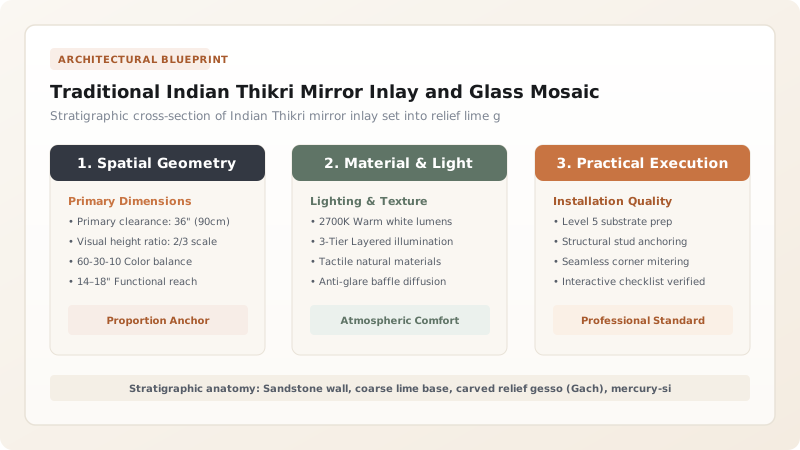
Traditional Indian Thikri Mirror Inlay and Glass Mosaic: Heritage & Craft Techniques Architectural Decision Matrix
Use this reference table to calculate exact physical dimensions, ratios, and specifications before purchasing:
| Plaster / Component | Raw Ingredients | Function in Assembly | Curing Mechanism | Durability |
|---|---|---|---|---|
| Coarse Base Render | Hydrated slaked lime + Surkhi (brick dust) | Consolidates sandstone wall | Slow carbonation & pozzolanic set | Permanent (Centuries) |
| Gach Modeling Gesso | Lime putty + marble powder + gum arabica | Sculpts bas-relief floral contours | Hygroscopic carbonation | High tensile bond |
| Convex Glass Tesserae | Thin blown glass with mercury-tin backing | Primary light refraction element | Non-reactive in alkaline lime | Specular permanent sheen |
| Organic Binding Broth | Boiled jaggery + fenugreek + urad dal | Retards setting & increases plasticity | Biomineral crystallization template | Water-resistant once cured |
Practical Constraints
Every successful decoration project must account for physical and environmental constraints:
Mercury Health & Safety Regulations
Ambient Setting Temperature
Master Craft Execution of a Thikri Mirror Inlay Panel
Execute this professional sequence to achieve flawless results without backtracking:
Substrate Wetting
Soak the carved sandstone or brick wall with spring water; apply a 10mm leveling coat of lime and crushed brick mortar (surkhi).
Gach Relief Modeling
Trowel the aged lime-marble gesso onto the wall; sculpt raised outlines of peacocks, cypress trees, and flowering vases with boxwood spatulas.
Glass Shard Grading
Sort silvered convex glass bulbs into dimensional curves; clamp shards between leather fingers to prevent flaking the mercury backing.
Freehand Scissor Cutting
Submerge glass shards in a shallow pan of water; trim into leaves and rhomboids using hand-forged iron shears (*katani*) to prevent shattering.
Bedding and Angling
Press glass pieces firmly into the soft gesso beds; tilt alternating facets by 2–5 degrees to maximize dynamic light scatter.
Burnishing and Sealing
Gently clean glass faces with dry muslin; burnish exposed lime borders with an agate stone to polish gesso bezels to a marble-like sheen.
Common Mistakes & Countermeasures
Avoid these costly errors that compromise aesthetics, ergonomics, and budget:
Setting mirrors with modern synthetic silicones or epoxy
Using modern flat 3mm float glass mirrors
Cutting dry glass with heavy shears
Project Execution Checklist
Track your physical progress. Checkboxes persist automatically on this device:
Frequently Asked Questions
Why are glass pieces cut under water in traditional Thikri?
Water acts as a hydraulic damper and lubricant. Cutting thin glass submerged in water dampens the high-frequency vibration shocks from the shears, preventing micro-cracks from running across the brittle glass and peeling the delicate silver foil.
How do Sheesh Mahal ceilings survive Rajasthan's extreme heat without glass falling out?
Because the lime gesso expands and contracts at virtually the exact same thermal rate as soda-lime glass, the glass tesserae never suffer shear detachment during 45°C summer peaks or cold 5°C winter desert nights.


