
Mythological narrative friezes and lime-surkhi bedding represent the artistic and structural integration of Bengal terracotta temple architecture. Arranged across curved Chala and Ratna temple facades according to a strict cosmological hierarchy, thousands of interlocking relief tiles depict epic narratives—including the Ramayana war, Mahabharata battles, Krishna's pastoral youth, and contemporary social scenes of royal hunts and European maritime armadas. These sculpted panels are bedded into the exterior brickwork using traditional lime-surkhi mortar—a hydraulic bio-composite of calcined shell lime, pulverized terracotta brick dust (surkhi), and organic additives such as jaggery (molasses) and bael fruit juice. This breathable mortar absorbs structural building movements, breathes out tropical monsoon moisture, and prevents destructive salt efflorescence.
At a Glance: Key Takeaways
- Cosmological Narrative Hierarchy: Terrestrial base plinth -> epic mythological mid-register -> divine celestial crown frieze.
- Ramayana & Krishna Lila Cycles: Detailed multi-panel friezes of Rama's battle with ten-headed Ravana and the circular Rasa dance.
- Contemporary Social Chronicling: Meticulous carvings of Portuguese armed galleons, Malla royal hunts, and noble court pageantry.
- Curved Chala Cornice Geometry: Dynamic curved cornices (dhanuk-banga) requiring custom trapezoidal terracotta architrave tiles.
- Hydraulic Lime-Surkhi Mortar: Non-hydraulic shell lime putty + pozzolanic brick dust (surkhi) forming water-resistant hydraulic set.
- Organic Ayurvedic Plasticizers: Jaggery molasses, sticky bael fruit gum, and curdled milk enhancing mortar elasticity and bonding.
- Efflorescence Immunity: Zero Portland cement content, protecting historic low-fired clay panels from salt-shattering.
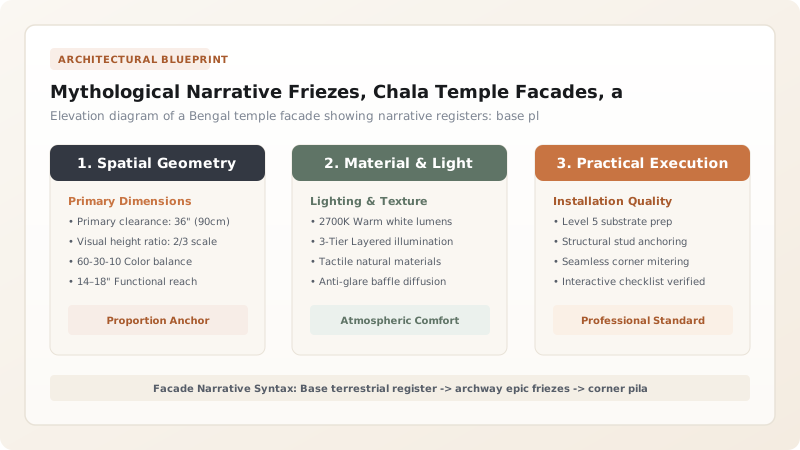
1. Facade Narrative Syntax: The Cosmological Vertical Hierarchy
The exterior of a Bengal terracotta temple functions as an open-air theological and historical book. Master sutradhars organized the thousands of relief panels across the facade in a rigorous three-tiered vertical hierarchy:
- Lower Plinth (The Terrestrial Realm): Running along the base of the temple, panels chronicle contemporary mundane and military life. Here, sculptors depicted Malla royal armies, cavalry squadrons, hunting expeditions with falconers, and foreign European merchants in 17th-century doublets and hats sailing on Portuguese war ketches.
- Central Registers & Spandrels (The Epic Realm): Framing the triple-arched sanctum entrance, expansive multi-tile compositions depict the great Sanskrit epics. The central spandrel typically showcases the climactic battle of Lanka: Lord Rama firing arrows from his chariot opposite the ten-headed demon king Ravana, surrounded by armies of vanaras and rakshasas.
- Upper Cornice & Parapet (The Divine Celestial Realm): Beneath the sweeping curved eaves, the friezes dissolve into the ecstatic spirituality of Gaudiya Vaishnavism. Circular medallions (Rasa Mandala) depict Lord Krishna dancing simultaneously with dozens of gopis in a celestial ring, framed by intertwining lotus vines (padma-lata).
2. Curved Chala Eaves and Custom Trapezoidal Terracotta Tiles
A defining hallmark of Bengal architecture is the curved cornice (known as dhanuk-banga, 'bent like a bow'). Originating from the natural droop of elastic bamboo poles in rural village huts, this sweeping curve sheds torrential monsoon rains rapidly from the roof.
Cladding this curved masonry wall required complex geometrical coordination. Masons could not use standard rectangular tiles along the curved cornice without creating gaping, wedge-shaped joints. Master sutradhars custom-molded dozens of unique, tapered trapezoidal tiles and curved voussoirs. When bedded along the architrave, these custom tiles follow the parabolic curve of the roof with tight, uniform 2mm joints, ensuring continuous water shedding and structural harmony.
3. The Science of Lime-Surkhi Bedding and Traditional Organic Additives
Installing porous terracotta tiles in a region that receives over 2,000mm of annual monsoon precipitation requires an extraordinary mortar bed. Portland cement fails catastrophically in this application: it traps moisture, cracks under heat, and releases destructive alkali salts.
Traditional lime-surkhi mortar is an ancient pozzolanic bio-composite:
- Shell Lime Putty: Slaked from calcined freshwater river snail shells (jhinuk), providing an ultra-pure, non-hydraulic calcium hydroxide binder.
- Surkhi (Burnt Clay Pozzolan): Terracotta bricks ground to fine flour. The reactive silica and alumina in the burnt clay react with calcium hydroxide in the presence of water, forming hydraulic calcium silicate hydrates that cure and harden even in humid monsoon conditions.
- Organic Ayurvedic Additives: The mixing water was boiled with traditional bio-plasticizers: jaggery (raw unrefined cane molasses, acting as a set retarder and crystal modifier), bael fruit pulp (Aegle marmelos, providing mucilaginous polysaccharide sticky adhesion), and methi water (boiled fenugreek seeds, imparting water-repellent hydrophobicity).
Traditional Lime-Surkhi Mortar Formulations and Additive Specifications
Use this reference table to calculate exact physical dimensions, ratios, and specifications before purchasing:
| Mortar Layer | Binder : Aggregate Ratio | Surkhi Fineness | Organic Additive Formulation | Performance Role |
|---|---|---|---|---|
| Substrate Leveling Screed | 1 Part Shell Lime : 2.5 Parts Surkhi | Medium-coarse (0.5–2.0 mm) | 1% Jaggery molasses water | Breathable, flexible backing over core bricks |
| Tile Bedding Mortar | 1 Part Shell Lime : 2.0 Parts Surkhi | Fine sifted (< 1.0 mm) | 2% Bael fruit pulp + 1% Jaggery | High tack adhesion holding vertical relief tiles |
| Joint Pointing Paste | 1 Part Lime : 1.0 Part Surkhi | Micro-pulverized brick flour | 0.5% Methi (fenugreek) decoction | Water-repellent, matching terracotta color |
| Fillet Capping Mastic | Pure aged shell lime putty | Fine surkhi + marble dust | Mustard oil traces + egg white | Airtight seal along upper cornice curve |
| Emergency Void Injection | Hydraulic NHL 2 or shell lime slip | Superfine clay flour (< 75 microns) | 0.5% Jaggery solution | Deep void consolidation behind loose tiles |
Practical Constraints
Every successful decoration project must account for physical and environmental constraints:
Intense Monsoon Erosion Exposure
Complex Narrative Puzzle Coordination
Conservation and Setting Protocol for Mythological Relief Panels
Execute this professional sequence to achieve flawless results without backtracking:
Brick Substrate Cleaning and Joint Raking
Rake back decayed core brick joints to 20mm depth; brush away loose powder; wash wall with clean potable water to relieve capillary suction.
Preparation of Ayurvedic Additive Water
Boil raw jaggery cane sugar and ripe bael fruit pulp in water for 2 hours; strain mucilage through burlap; cool to ambient temperature.
Blending Lime-Surkhi Bedding Mortar
Mix pure aged shell lime putty with fine pulverized red surkhi (1:2 ratio); gauge with organic additive water until buttery and cohesive.
Tile De-Dusting and Pre-Soak Saturation
Immerse fired terracotta relief panels in clean water for 30 minutes until bubbling ceases, ensuring tiles do not rob water from mortar bed.
Back-Buttering and Setting Relief Tiles
Apply a 6mm layer of lime-surkhi mortar to tile reverse; press firmly onto brick substrate, tapping corners with wooden mallet handles.
Panel Alignment and Joint Shimming
Align multi-tile narrative figures using laser levels; insert thin 2mm wooden shims to maintain uniform joint gaps across registers.
Surkhi-Matching Joint Pointing
Force fine lime-surkhi paste into joints using 2mm brass pointing irons; sponge tile surfaces clean with damp cotton rags before carbonation.
Moist Curing under Damp Jute Blankets
Drape damp jute burlap over the installed panels for 14 days, misting with water daily to ensure complete hydraulic lime carbonation.
Common Mistakes & Countermeasures
Avoid these costly errors that compromise aesthetics, ergonomics, and budget:
Setting historic terracotta relief tiles with modern Portland cement or chemical tile adhesives
Setting dry, thirsty terracotta tiles directly onto wet lime-surkhi mortar without pre-soaking
Using modern sand with high saline or sea-salt contamination in the surkhi mortar mix
Project Execution Checklist
Track your physical progress. Checkboxes persist automatically on this device:
Frequently Asked Questions
Why are the cornices of Bengal terracotta temples curved like an archer's bow?
The curved cornice (dhanuk-banga) mimics the natural bending of bamboo roof poles in vernacular Bengali village huts. In Bengal's tropical climate with torrential monsoon downpours, a curved roof sheds water significantly faster than a flat horizontal roof, preventing standing water from soaking through the masonry.
How does lime-surkhi mortar compare in strength to modern cement?
Modern cement cures with high compressive strength (20–30 MPa) and extreme rigidity. Lime-surkhi cures to a moderate strength (3–6 MPa) with high flexibility and high vapor permeability. In historic brick and terracotta architecture, high flexibility is essential: it allows the building to breathe and move without cracking the fragile historic bricks.
What is Gaudiya Vaishnavism and why did it influence Bengal temple art?
Gaudiya Vaishnavism was a 16th-century devotional movement founded by Sri Chaitanya Mahaprabhu in Bengal, focusing on intense emotional devotion (bhakti) to Radha and Krishna. Under the Malla kings, this movement inspired artists to cover temple walls with intimate, joyful scenes of Krishna's life, music, and celestial dance rather than intimidating martial monuments.


