
Bengal terracotta temples represent one of the most distinctive vernacular architectural movements in South Asian history, flourishing across Bishnupur, Bankura, Hooghly, and Burdwan from the 16th to 19th centuries under Malla royal patronage. In the stoneless deltaic floodplains of the Ganges and Damodar rivers, master artisans (sutradhars) substituted stone with fine Gangetic alluvial silt clay (poli mati). Artisans pressed and hand-carved intricate narrative relief panels depicting the Ramayana, Mahabharata, and Krishna Lila into wooden and terracotta dies. Fired in traditional wood-and-straw clamp kilns (pajha) to achieve rich, iron-red ceramic durability, hundreds of thousands of individual terracotta tiles were bedded into curved hut-style brick temples (Chala and Ratna styles) using breathable hydraulic lime-surkhi mortars, forming an enduring, weather-resistant sculptural armor against torrential monsoon deluges.
At a Glance: Key Takeaways
- Deltaic Material Provenance: Harvested from alluvial Gangetic and Damodar river silt (poli mati) rich in iron and fine silica.
- Chala & Ratna Temple Typology: Inspired by traditional thatched bamboo huts with curved eaves (Do-Chala, Char-Chala, At-Chala).
- Wooden Die-Pressing & Hand Modeling: High-relief sculptural friezes combining repetitive stamped borders with freehand figurative detailing.
- Clamp Kiln (Pajha) Firing: Wood-and-rice-straw firing reaching 850°C–950°C, producing intense terracotta red and orange-ochre hues.
- Mythological Narrative Registers: Stratified friezes depicting naval armadas, royal court life, Ramayana epics, and floral arabesques.
- Lime-Surkhi Bedding Mortar: Slaked shell lime blended with brick dust (surkhi) and organic jaggery plasticizers ensuring monsoon breathability.
In-Depth Guides in this Directory
Explore specialized subtopic blueprints, technical dimensions, and execution checklists:
Gangetic Alluvial Silt Tempering, Open Wooden Die Pressing, and Sun-Curing
Technical field manual on processing Gangetic alluvial silt clay, organic tempering with rice husk ash, carving wooden negative dies, and controlled shade curing.
Traditional Clamp Kilns (Pajha), Wood-Straw Firing, and Red Ochre Chemistry
Technical thermal guide to firing Bengal temple terracotta in wood-straw clamp kilns (pajha), iron oxide conversion, and red ochre color chemistry.
Mythological Narrative Friezes, Chala Temple Facades, and Lime-Surkhi Bedding
Architectural guide to mythological narrative friezes on Bengal Chala temple facades, iconographic hierarchy, and breathable lime-surkhi bedding mortar.
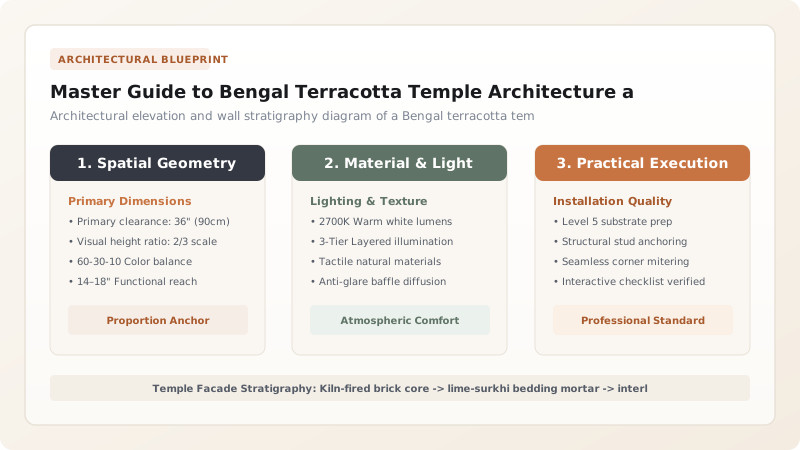
1. Deltaic Geology and Royal Patronage: The Genesis of Clay Architecture
The Bengal delta is a vast alluvial basin formed by the confluence of the Ganges, Brahmaputra, and Meghna river networks. For hundreds of miles inland, the landscape is entirely devoid of rock or building stone. While northern and southern Indian empires constructed monumental temples of sandstone, granite, or marble, Bengal builders turned to the inexhaustible resource beneath their feet: fine riverine clay (poli mati).
Under the Malla dynasty of Bishnupur (Bankura district) in the 17th and 18th centuries, Gaudiya Vaishnavism sparked a magnificent cultural renaissance. The Malla kings commissioned master guilds of artists, known as sutradhars (traditional woodcarvers, masons, and sculptors), to translate Bengal’s vernacular bamboo thatched-roof huts into permanent brick and terracotta monuments. The result was a dramatic synthesis: the curved rooflines of bamboo huts (bangla chala) rendered in structural brick, completely clad in relief-sculpted terracotta panels.
2. Artisanal Fabrication: Wooden Dies, Hand-Modeling, and Kiln Chemistry
The fabrication of Bengal terracotta panels combined modular mass production with bespoke sculptural mastery:
- Clay Tempering: Fine alluvial silt was sieved to remove vegetable roots and coarse sand, then kneaded with fine cow dung ash, rice husk, and mustard oil to enhance cohesion and reduce shrinkage.
- Wooden Die-Pressing: For repeating floral borders (padma-lata), geometric friezes, and battle scenes, artisans carved intricate negative matrices into seasoned hardwood (such as neem or sal). Damp clay slabs were pressed into the oiled dies with wooden mallets.
- Freehand Undercutting: While the clay remained leather-hard, sculptors used iron and bamboo spatulas to deeply undercut limbs, eyes, jewelry, and drapery, creating dramatic three-dimensional shadow relief that catches raking sunlight.
- Clamp Firing (Pajha): Tiles were slowly dried in shade for 30 days, then stacked inside wood-and-straw clamp kilns. Fired to approximately 900°C in an oxidizing atmosphere, iron minerals in the clay fully converted into ferric oxide, producing the intense, glowing red terracotta color.
3. Narrative Syntax and Lime-Surkhi Architectural Bedding
Bengal temple facades follow a strict vertical decorative hierarchy:
The base plinth depicts terrestrial, contemporary life—European Portuguese warships with cannons, royal hunting cavalcades with elephants and horses, and dancing courtesans. Above the plinth, the narrative ascends toward the divine: central archways and spandrels depict the great epics—the battle of Kurukshetra, Rama slaying Ravana, and the celestial circular dance of Krishna (Rasa Mandala)—surrounded by swirling vegetation.
To secure these panels against heavy monsoon rainfalls, masons bedded tiles in lime-surkhi mortar. Slaked shell lime (derived from calcined river snail shells) was mixed with finely ground brick dust (surkhi), coarse river sand, and organic plasticizers—including jaggery (molasses), bael fruit mucilage (Aegle marmelos), and lentil gum. This hydraulic mortar formed a flexible, vapor-permeable, self-healing bed that accommodated seasonal thermal shifts without spalling the terracotta tiles.
Bengal Terracotta Temple Styles, Panel Types, and Mortar Formulations
Use this reference table to calculate exact physical dimensions, ratios, and specifications before purchasing:
| Temple Architectural Style | Prominent Regional Center | Dominant Panel Themes | Average Tile Thickness | Mortar Bedding Chemistry |
|---|---|---|---|---|
| Ek-Chala (Single Roof) | Burdwan and Hooghly | Floral scrolls, lotus paterae, dvarapalas | 35–45 mm thick | Shell lime + surkhi (1:2) + bael resin |
| Jor-Bangla (Twin Hut) | Bishnupur (Bankura) | Battle epics, Ramayana, Portuguese ships | 45–60 mm deep relief | Shell lime + fine surkhi (1:2.5) + jaggery |
| Char-Chala (Four-Segment) | Midnapore and Jessore | Krishna Lila, musicians, royal hunters | 40–50 mm relief | Hydraulic lime + brick flour + fenugreek water |
| At-Chala (Eight-Segment) | Kalna and Nadia | Rasa Mandala, mythological avatars | 35–50 mm relief | Shell lime + surkhi (1:2) + mustard oil traces |
| Pancha-Ratna (Five-Tower) | Bishnupur (Shyamrai Temple) | Comprehensive cosmological epics | 50–70 mm high undercut | Aged shell lime putty + river sand + surkhi |
Practical Constraints
Every successful decoration project must account for physical and environmental constraints:
Monsoon Humidity and Biological Growth
Loss of Traditional Sutradhar Guild Knowledge
Traditional Atelier Fabrication and Installation Sequence for Bengal Terracotta Panels
Execute this professional sequence to achieve flawless results without backtracking:
Alluvial Silt Harvesting and Sieving
Extract fine riverbank silt (poli mati) during dry pre-monsoon season; screen through fine brass sieves to remove organic debris and coarse silica pebbles.
Pugging and Fiber-Ash Tempering
Knead silt in clay troughs with fine rice husk ash, sifted cow dung fiber, and potable river water to achieve a cohesive, bubble-free plastic paste.
Die-Pressing in Seasoned Sal Molds
Press 50mm clay slabs into carved hardwood negative dies lubricated with mustard oil; tamp firmly with wooden pestles to capture microscopic details.
Demolding and Leather-Hard Undercutting
Carefully demold clay blank onto flat bamboo trays; using steel gouges, undercut figurative contours, eyes, weapons, and floral drapery at leather-hard state.
Extended Shade Drying
Air-dry relief panels inside thatched drying sheds for 21 to 30 days away from direct sun to prevent curling and differential drying shrinkage cracks.
Clamp Kiln (Pajha) Stacking and Firing
Interstack dry tiles with firewood and rice straw layers in a domed earthen clamp; fire over 48 hours to 900°C under oxidizing drafts to produce deep iron-red terracotta.
Lime-Surkhi Bedding Mortar Mixing
Slake river snail shells to form pure white lime putty; blend with pulverized terracotta brick dust (surkhi) and jaggery molasses water (1:2 ratio).
Panel Setting and Archival Pointing
Pre-soak fired tiles in water; bed firmly into wet lime-surkhi mortar over brick temple facade; tool 2mm joints flush with matching lime-surkhi pointing paste.
Common Mistakes & Countermeasures
Avoid these costly errors that compromise aesthetics, ergonomics, and budget:
Using modern grey Portland cement mortar to restore or repoint historic Bengal terracotta temples
Drying raw relief tiles under direct, blazing midday sun instead of shaded sheds
Cleaning biological moss and lichens off historic terracotta with high-pressure power washers or wire brushes
Project Execution Checklist
Track your physical progress. Checkboxes persist automatically on this device:
Frequently Asked Questions
Why did Bengal architects build temples from clay and terracotta instead of stone?
Bengal is located on a massive river delta composed entirely of soft silt, sand, and clay. Building stone was hundreds of miles away, making transportation virtually impossible. Master builders adapted by transforming local river silt into kiln-fired bricks and sculpted terracotta tiles, creating one of the world's greatest brick temple traditions.
What is 'Surkhi' and why is it used in traditional Indian mortar?
Surkhi is finely ground, pulverized burnt terracotta brick dust. When mixed with slaked lime and water, the amorphous silicates and aluminates in the burnt clay react with calcium hydroxide (a pozzolanic reaction) to form calcium silicate hydrates. This gives lime mortar the ability to set underwater and withstand heavy monsoon rains.
Why are Portuguese ships and European soldiers depicted on Hindu terracotta temples in Bengal?
During the 17th and 18th centuries, Portuguese, Dutch, French, and British traders sailed armed caravels up the Hooghly and Rupnarayan rivers. Bengali artisans recorded contemporary historical events on the lower temple plinths, depicting foreign musketeers, European warships, and court costumes alongside traditional sacred epics.


