
Araish (also known as Ghutai) is Rajasthan's premier traditional polished plaster technique. Prepared from high-purity shell lime (Sankh Chuna) aged underwater for up to two years and blended with superfine Makrana marble dust, the mortar is applied in whisper-thin coats. Burnished continuously with smooth agate stones (mohra) lubricated with curd and coconut soap water, the plaster undergoes intense compaction, producing an impermeable, mirror-smooth crystalline surface.
At a Glance: Key Takeaways
- Burnishing Tool: Hand-held polished river agate / nephrite jade stones (Mohra)
- Lime Source: Sankh Chuna (Calcined river mollusk shell lime)
- Lubricating Emulsion: Diluted sour milk curd + virgin coconut-oil soap
- Marble Aggregate: Makrana white marble dust (sifted through 200-mesh silk)
Shell Lime (Sankh Chuna) Sourcing, Calcining, and Wet Maturation
While mountain limestone lime is acceptable for rough masonry, master muralists insisted on Sankh Chuna—lime produced by calcining freshwater mollusk shells harvested from riverbeds. Shell lime possesses an exceptionally high calcium carbonate purity (>98% CaCO3) with almost zero magnesium or silica contaminants.
The shells are burned in small wood-fired kilns and immediately drowned in water-filled subterranean stone pits. Artisans maintain the lime submerged beneath standing water for 12 to 24 months. Over this extended maturation, calcium hydroxide crystals subdivide into ultra-fine sub-micron colloidal platelets, producing a silky, grease-like putty of unparalleled plasticity.
Makrana Marble Flour: Aggregate Grading and Sifting
The aggregate for the Araish finishing ground must match the chemical purity of the lime binder. Masons utilize waste chips from the famed white marble quarries of Makrana (the same marble used in the Taj Mahal). The chips are crushed in heavy stone querns and dry-ground into flour.
The marble dust is sifted through multiple fine brass sieves, concluding with a pass through 200-mesh fine silk cloth. Only the finest dust particles (between 10 and 50 microns) are retained. When mixed with shell lime in exact 1:1 volume ratios, the calcite marble grains pack into a dense aggregate matrix that eliminates shrinkage micro-cracking.
Traditional Organic Additives: Curd, Jaggery, and Methi Water
Rajasthani lime recipes incorporate complex biological chemistry. Fresh milk curd (dahi) is folded into the final lime putty batch. The lactic acid and casein proteins in curd react with calcium hydroxide to form calcium caseinate—a natural water-insoluble, hydrophobic biopolymer that acts as a natural water-repellent.
For base coats, water infused with boiled fenugreek seeds (methi) and unrefined cane sugar (gur or jaggery) is introduced. The polysaccharide sugars retard setting time, allowing masons to work large wall panels in the desert heat, while the plant mucilage dramatically improves trowel slip and cohesive elasticity.
The Ghutai Process: Agate Stones and Crystalline Compaction
The signature mirror finish is created through Ghutai—the rigorous, rhythmic hand-burnishing of the setting plaster. Craftsmen utilize smooth, rounded river agates, chalcedony, or jade stones known as mohra.
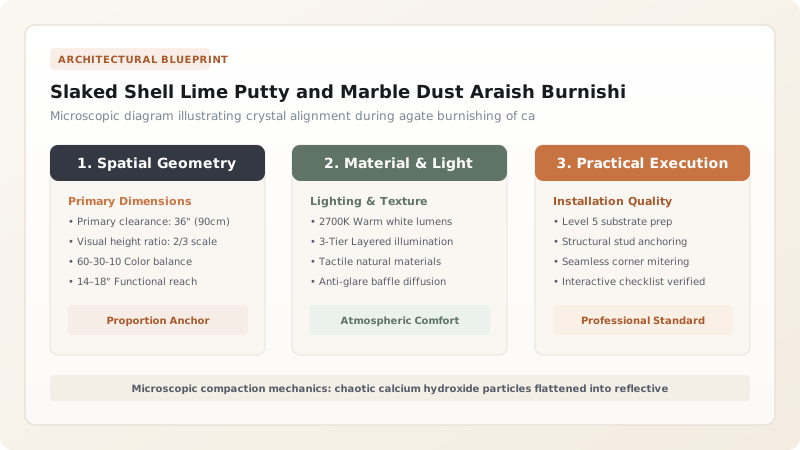
As the Araish layer begins to firm, the mason rubs the surface in circular motions, lubricating the contact zone with a soapy solution of grated coconut-oil soap and water. The extreme point-load pressure of the hard agate crushes superficial surface voids, aligns the microscopic calcium carbonate crystals parallel to the wall plane, and brings a translucent, mirror-like gloss to the lime without any synthetic waxes or sealers.
Araish Layer Formulation & Burnishing Stages
Use this reference table to calculate exact physical dimensions, ratios, and specifications before purchasing:
| Plaster Stage | Binder Formulation | Aggregate Ratio | Working Tool | Surface Quality |
|---|---|---|---|---|
| Preparation Coat (Pachara) | Matured shell lime putty | Fine river sand (1:1.5) | Wooden float scour | Level, uniform suction |
| First Araish Coat | Curd-slaked shell lime | 100-mesh Makrana marble (1:1) | Steel trowel compression | Smooth, dense white ground |
| Second Araish Coat (Finishing) | Triple-strained shell lime | 200-mesh silk-sifted marble (1:1) | Flexible leaf spatula | Micro-leveled plaster skin |
| Agate Burnishing (Ghutai) | None (moisture from plaster) | None | Polished agate stone (Mohra) | Mirror-smooth crystalline gloss |
Practical Constraints
Every successful decoration project must account for physical and environmental constraints:
Extremely High Physical Labor Intensity of Hand Burnishing
A single skilled master artisan can burnish only 2 to 3 square meters of authentic Araish per working day.
Scarcity of Experienced Traditional Araish Masters
The oral knowledge of curd ratios and agate pressure is held by only a few surviving elder craft families in Jaipur and Shekhawati.
Execution Blueprint & Craftsmanship Sequence
Execute this professional sequence to achieve flawless results without backtracking:
Shell Lime Washing and Straining
Extract mature Sankh Chuna from slaking pits; pass through fine muslin cloth three times to remove any unslaked grit or organic contaminants.
Marble Dust Compounding
Blend equal parts strained shell lime putty and 200-mesh Makrana marble flour; knead thoroughly on stone slabs until achieving a buttery consistency.
Organic Casein Enrichment
Fold in fresh milk curd (50g per kg of lime putty), beating the mixture with wooden paddles to distribute natural casein polymers uniformly.
Thin-Layer Steel Troweling
Apply a 1mm uniform coat over the pre-moistened arriccio base; compress firmly with flexible stainless steel plastering blades.
Initial Wooden Float Compaction
Consolidate the layer using flat boxwood floats, bringing fine lime cream to the surface while driving out any microscopic air pockets.
Agate Stone Burnishing (Ghutai)
Burnish the setting plaster with an agate stone lubricated with light coconut-soap wash, rubbing continuously until a glassy, reflective sheen emerges.
Common Mistakes & Countermeasures
Avoid these costly errors that compromise aesthetics, ergonomics, and budget:
Using Agate Stones with Scratched or Chipped Edges
Applying Araish Coats Thicker Than 2mm
Project Execution Checklist
Track your physical progress. Checkboxes persist automatically on this device:
Frequently Asked Questions
Can Araish plaster be washed with water after it has cured?
Yes. Once fully carbonized, the combination of compacted calcium carbonate and calcium caseinate creates a waterproof, hydrophobic surface that can be wiped clean with damp cloths without dissolving.
Why is Makrana marble preferred over calcite or dolomite powders?
Makrana marble is a 99% pure metamorphic calcite with interlocking rhombohedral crystals. It exhibits optical translucency that imparts a deep, luminous glow beneath burnished lime that dolomite cannot match.


