
Preserving Shekhawati haveli frescoes against rising damp, salt efflorescence, bat guano, and neglect requires rigorous scientific conservation. Conservators stabilize hollow, detached plaster using micro-injections of low-density natural hydraulic lime grouts. Sub-surface soluble salts are extracted using Japanese tissue and sepiolite clay poultices. Surface soot is cleaned with non-ionic chelating sponges, and losses are integrated using reversible, conservation-grade mineral watercolors.
At a Glance: Key Takeaways
- Desalination Media: Sepiolite clay + Arbocel cellulose paper pulp poultices
- Diagnostic Method: Acoustic hammer tapping & Infrared thermography
- Grouting Consolidant: Ultra-fine natural hydraulic lime (NHL 1) + Pozzolan micro-grout
- Retouching Standard: Tratteggio / Rigatino reversible vertical watercolor hatching
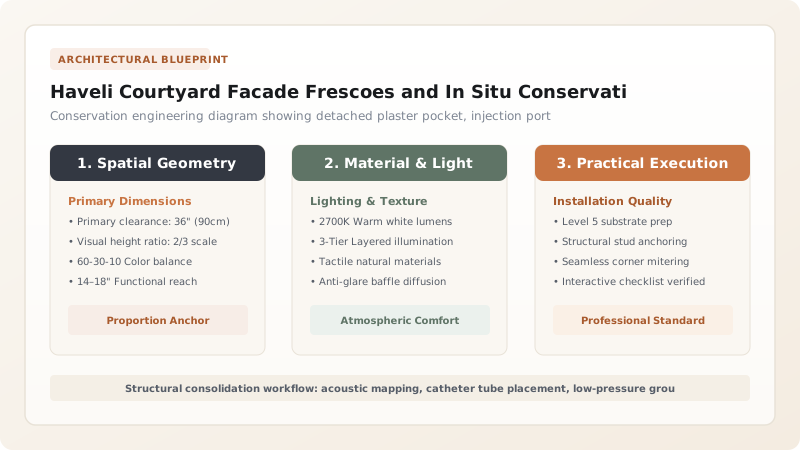
Pathology Mapping: Salt Cryptoflorescence, Bat Guano, and Delamination
Haveli frescoes in Rajasthan face multi-factor degradation mechanisms. Ground moisture drawn upward through historic brick foundations via capillary action carries dissolved sodium chlorides, sulfates, and nitrates. As water evaporates through the fresco skin, sub-surface cryptoflorescence generates crystal growth pressures up to 100 MPa—far exceeding the tensile strength of historic lime plaster.
Furthermore, decades of abandonment allow microchiropteran bats to roost in upper ceiling bays. Bat urine and guano contain concentrated uric and phosphoric acids that react chemically with calcium carbonate, transforming the hard araish fresco skin into friable, crumbling calcium phosphate minerals.
Non-Destructive Desalination: Sepiolite and Cellulose Poulticing
Traditional aggressive washing with water merely pushes soluble salts deeper into the brick wall, causing worse destruction when they dry. Scientific conservation relies on desalination poultices composed of deionized water, pure cellulose fibers (Arbocel), and sepiolite clay.
A barrier layer of fine Japanese tissue paper (kozo) is applied across the fresco to prevent clay fibers from sticking into pigment pores. The moist poultice is plastered over the tissue. As the poultice dries over 48 hours, capillary forces draw moisture and dissolved salts outward from the brick wall, trapping the salts permanently inside the disposable poultice crust.
Structural Re-Anchoring: Low-Pressure Hydraulic Lime Micro-Grouting
Thermal cycling and foundation settling frequently cause the thin araish intonaco and arriccio plaster layers to detach from the underlying brick masonry, creating hollow, bulging pockets ready to collapse under their own deadweight.
Conservators map these voids using acoustic tapping and ultrasonic velocity testing. Small 2mm injection ports are drilled through non-decorative seams. After pre-wetting the cavity with ethanol-water solutions to reduce surface tension, low-viscosity natural hydraulic lime micro-grout (containing hollow glass microspheres to reduce weight) is injected at ultra-low pressure (<0.5 bar) to permanently re-bond the plaster to the brick wall.
Aesthetic Reintegration: Tratteggio and Conservation Ethics
International conservation charters (such as the Venice Charter and ICOMOS standards) strictly prohibit repainting or 'inventing' missing artwork on historic monuments. Any modern intervention must be distinguishable from the original and completely reversible.
In Shekhawati restoration, losses and abrasions are integrated using the Tratteggio (Rigatino) technique. Using pure mineral watercolors on fine pointed brushes, the conservator reconstructs the overall tone and geometry using fine vertical parallel lines. From a normal viewing distance, the eye blends the lines into a unified composition, but close inspection reveals the modern hand, preserving historical integrity.
Haveli Fresco Conservation Intervention Protocol
Use this reference table to calculate exact physical dimensions, ratios, and specifications before purchasing:
| Pathology / Defect | Diagnostic Method | Conservation Treatment | Chemical / Material Agent | Reversibility Standard |
|---|---|---|---|---|
| Hollow Plaster Detachment | Acoustic hammer tapping | Low-pressure micro-injection grouting | NHL 1.0 + Hollow glass spheres | Permanent structural consolidation |
| Sub-Surface Salt Efflorescence | Conductivity / Anion test strips | Multi-cycle cellulose poulticing | Arbocel BWW40 + Sepiolite clay | Completely removable poultice |
| Soot and Candle Crusts | Microscopic visual inspection | Chelating sponge cleaning | Triammonium citrate (pH 7.2) | Non-residue distilled rinse |
| Abraded Paint Losses | High-res photogrammetry | Tratteggio watercolor in-painting | Windsor & Newton mineral watercolors | 100% reversible in warm water |
Practical Constraints
Every successful decoration project must account for physical and environmental constraints:
Lack of Continuous Roof Waterproofing Maintenance
Consolidating wall frescoes is futile if monsoon rains continue to pour down inside haveli parapets; roof repair must precede wall conservation.
High Cost of Multi-Year Scientific Restorations
Conserving a large 50-room merchant haveli requires substantial funding, often demanding non-profit trust or public-private heritage partnerships.
Execution Blueprint & Craftsmanship Sequence
Execute this professional sequence to achieve flawless results without backtracking:
Comprehensive Photogrammetric and Salt Survey
Survey the haveli facade with raking light and thermal imaging; sample salt efflorescence to identify nitrate, chloride, and sulfate concentrations.
Temporary Surface Facing (Velatura)
Secure friable, flaking paint flakes by applying Japanese mulberry tissue faced with a 3% solution of reversible Klucel G in ethanol.
Cavity Pre-Wetting and Grout Injection
Drill 2mm micro-ports into hollow plaster voids; pre-wet with 50/50 water-ethanol, and inject low-viscosity hydraulic lime micro-grout.
Controlled Clamp Cushioning
Support bulging plaster with padded timber shores lined with closed-cell foam, maintaining light uniform pressure for 72 hours while grout cures.
Cellulose Desalination Poulticing
Apply Arbocel paper pulp poultices over Japanese tissue; allow 48 hours for slow capillary extraction of salts, peeling away when dry.
Tratteggio Color Reintegration
In-paint plaster fills using vertical hatched watercolor strokes (Tratteggio), matching surrounding chromatic values without mimicking original brushwork.
Common Mistakes & Countermeasures
Avoid these costly errors that compromise aesthetics, ergonomics, and budget:
Overpainting Historic Murals with Bright Modern Enamel Paint
Injecting Cement-Based Grouts into Plaster Voids
Project Execution Checklist
Track your physical progress. Checkboxes persist automatically on this device:
Frequently Asked Questions
What is the 'Tratteggio' technique used in fresco restoration?
Tratteggio is a scientific method of chromatic restoration where losses are filled with tiny vertical parallel watercolor hatch marks. From a distance, the eye blends the colors, but up close, the restoration is clearly distinguishable from original artwork.
Why can't bat urine stains simply be scrubbed off with detergent?
Uric acid chemically alters the calcium carbonate into calcium phosphate, bonding deep within the stone. Scrubbing with detergent will dissolve the surrounding soft lime plaster, stripping the artwork away. Conservators use buffered chelating compresses to lift stains safely.


