
In Shekhawati fresco buono, mural longevity depends entirely on alkali-resistant natural pigments. Because fresh lime plaster has a high caustic pH (approx. 12.5), acid-sensitive or synthetic pigments discolour or fade within weeks. Master chiteras used a disciplined palette of ground mineral ores (red and yellow ochres, green copper malachite/terra verde, lapis lazuli) and specialized botanical dyes (indigo, madder) ground finely in pure rainwater and brushed directly onto the wet lime intonaco.
At a Glance: Key Takeaways
- Alkaline Resistance: 100% stable at pH 12.5 (fresh calcium hydroxide)
- Grinding Medium: Pure deionized rainwater on granite grinding slabs (Sil-Batta)
- Primary Mineral Ores: Hirmich (Red Ochre), Peori (Yellow Ochre), Sang-e-Sabz (Green Earth)
- Vegetal & Carbon Dyes: Neel (Indigofera tinctoria), Kajal (Mustard-oil soot)
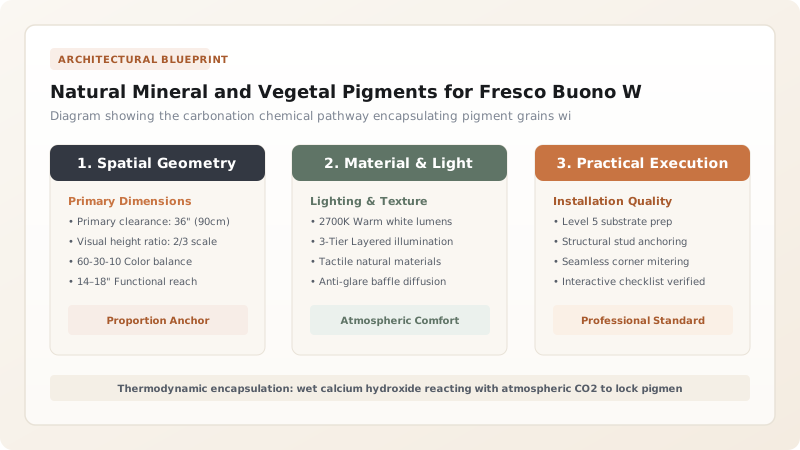
Alkali Chemistry and the Imperative of Pigment Stability
Painting in true fresco (fresco buono) presents severe chemical constraints. Freshly applied lime plaster contains high concentrations of free calcium hydroxide (Ca(OH)2), creating a strongly caustic alkaline micro-environment with a pH between 12.0 and 13.0.
Many popular artistic pigments (such as Prussian blue, lead white, and gamboge) decompose, turn brown, or bleach completely under strong alkali exposure. Master chiteras strictly vetted their palette, using only mineral ores, stable calcined oxides, and select botanical resins that resist alkali hydrolysis indefinitely.
The Mineral Palette: Hirmich, Peori, and Sang-e-Sabz
The core earth tones were harvested from local Rajasthani and Deccan mineral deposits. Red tones were derived from Hirmich (natural iron oxide hematite from Gwalior) and Geru (red ochre). Yellows came from Peori (yellow goethite clay) and Hartal (natural orpiment).
For greens, artists utilized Sang-e-Sabz (terra verde / celadonite clay ore from the Deccan basalt traps) and ground malachite. Black outlines—the defining graphic armature of Shekhawati figures—were painted using Kajal, an ultra-fine carbon black harvested by burning pure mustard oil or clarified butter (ghee) beneath inverted earthen pots.
Indigo (Neel), Lapis Lazuli, and 19th-Century European Pigments
Blues in early 19th-century murals were dominated by Neel (natural indigo extract from Indigofera tinctoria), grown in nearby Bayana. Processed into hard dry cakes, indigo was ground with lime water to create soft turquoise-cerulean hues that bonded gracefully with the lime matrix.
By the late 19th century, wealthy Marwari merchants began importing European synthetic pigments via Bombay ports. Pigments like synthetic ultramarine blue (French ultramarine) and copper-arsenic Schweinfurt green (emerald green) were enthusiastically adopted for their blazing chromatic intensity, though emerald green often proved less durable under harsh desert monsoon cycles than ancient mineral malachite.
Application Technique: Levigation, Water Grinding, and Brushwork
Dry mineral lumps were crushed and levigated in large earthen water vats to float away heavy silts and coarse silica. The clean mineral sediment was ground for hours on flat granite grinding stones (sil-batta) with pure rainwater until reduced to an impalpable sub-5-micron powder.
The painter loaded natural camel-hair, squirrel-hair, or goat-tail brushes with pure watery pigment suspension without any glue or oil binder. As the brush stroked the wet Araish ground, capillary suction pulled the pigment grains into the pore structure of the wet lime. Within minutes, the curing lime drew the pigment into its growing crystalline mesh, producing lightfast, permanent art.
Historical Shekhawati Mural Pigment Catalog
Use this reference table to calculate exact physical dimensions, ratios, and specifications before purchasing:
| Color Name | Vernacular Name | Raw Material Source | Alkaline pH Stability | Lightfastness Rating |
|---|---|---|---|---|
| Brick Red / Crimson | Hirmich / Geru | Natural Hematite / Red Ochre | Completely stable (pH 14) | Class 1 (Permanent / 500+ yrs) |
| Golden Ochre | Peori / Ramraj | Natural Goethite Hydrated Iron | Completely stable | Class 1 (Permanent) |
| Emerald / Olive Green | Sang-e-Sabz | Celadonite / Glauconite Clay | Completely stable | Class 1 (Permanent) |
| Velvet Outlining Black | Kajal | Mustard-oil soot / Carbon black | Completely stable | Class 1 (Permanent) |
| Deep Indigo Blue | Neel | Indigofera tinctoria fermented leaf | Moderately stable in wet lime | Class 2 (Fades in direct desert UV) |
| Late 19th-C Ultramarine | Vilayati Neel | Synthetic Ultramarine (Imported) | High alkali stability | Class 1 (Brilliant deep royal blue) |
Practical Constraints
Every successful decoration project must account for physical and environmental constraints:
Rapid Evaporation of Mixing Water in Desert Climates
Artists must paint inside shaded courtyard corridors or maintain damp burlap curtains to prevent colors drying before chemical bonding occurs.
Scarcity of Traditional Hand-Prepared Mineral Pigments
Modern restoration requires specialized conservation suppliers to provide chemically verified, unadulterated mineral oxides.
Execution Blueprint & Craftsmanship Sequence
Execute this professional sequence to achieve flawless results without backtracking:
Raw Mineral Sorting and Crushing
Inspect raw mineral ore chunks (hematite, celadonite, yellow goethite); crush in cast-iron mortars into coarse 1mm grit.
Water Levigation and Decantation
Stir crushed ore into large clay jars filled with rainwater; allow heavy sand to settle for 2 minutes, decanting the suspended pigment slurry into drying bowls.
Sil-Batta Fine Grinding
Grind the dried pigment sediment on a granite slab with water for 4 hours until the paste feels completely smooth with zero grittiness between fingertips.
Dilution and Viscosity Testing
Dilute pigment paste with pure distilled rainwater; test brush flow and opacity on a damp test plaster tile to verify adhesion.
Application Over Wet Intonaco
Apply color washes with pointed squirrel-hair brushes within the 4-hour open working window while the lime plaster remains damp and receptive.
Final Agate Compaction
Gently pass a flat agate stone over painted zones to compress the mineral pigments flush with the lime surface before final drying.
Common Mistakes & Countermeasures
Avoid these costly errors that compromise aesthetics, ergonomics, and budget:
Using Synthetic Acrylic or Enamel Paints on Fresh Lime
Painting on Plaster That Has Already Begun to Dry and Form a Crust
Project Execution Checklist
Track your physical progress. Checkboxes persist automatically on this device:
Frequently Asked Questions
Why didn't traditional Indian fresco painters use oil binders like linseed oil?
Linseed oil undergoes saponification when in contact with fresh, highly alkaline lime plaster, decomposing into a sticky, discolored soap that ruins the painting and destroys the plaster bond.
Can indigo blue withstand exterior Rajasthani monsoon weathering?
Indigo is an organic vegetal dye rather than a mineral oxide. While it survives exceptionally well in covered courtyard verandahs, exterior wall sections exposed to continuous intense UV radiation and driving monsoon rain fade faster than mineral iron ochres.


