Sculpting the ornate perimeter of a Jaipur chhatri involves carving multi-foil cusped arches (typically 9 or 11 foils) and serpentine cantilever brackets (toranas) from solid Makrana marble or Dholpur sandstone, combined with perforated marble lattice screens (jali). While cusped arches and brackets distribute upper dome deadweight outward into column capitals, perforated jali panels in spandrels and balustrades filter intense desert glare and accelerate ambient airflow via the Venturi effect.
At a Glance: Key Takeaways
- Arch Typology: Multi-Foil Cusped Arch (Nau-dhar / 9-foil or 11-foil)
- Cantilever Bracket: Serpentine S-curve Torana Bracket with makara dragon heads
- Screen Material: Single-Slab Makrana Calcitic White Marble (30–45 mm thick)
- Carving Technique: Hand drilling, fret-sawing, and steel chisel undercutting
- Microclimatic Role: Venturi cooling airflow acceleration and solar glare filtration
The Aesthetic and Structural Synthesis of the Cusped Arch
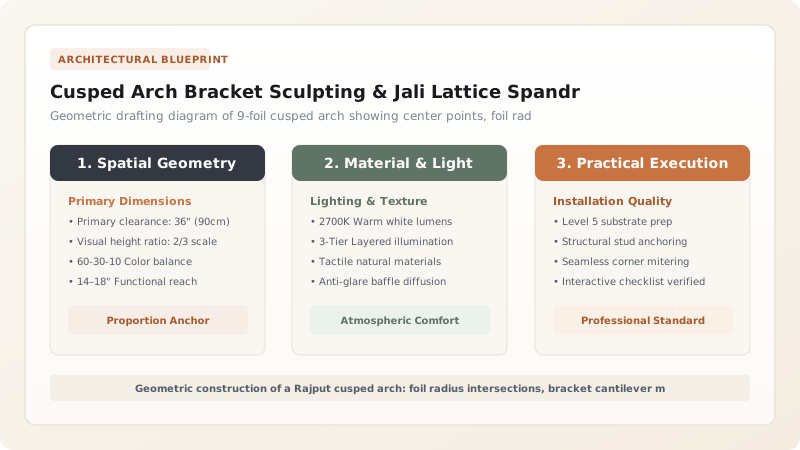
Few architectural elements are as universally recognized in royal Indian architecture as the cusped arch (also called the multi-foil, scalloped, or poly-lobed arch). Originating during the reign of Mughal Emperor Shah Jahan and enthusiastically adopted and elaborated by Rajput masters in Jaipur, Amber, and Udaipur, the cusped arch is not a true structural arch. Rather, it is a decorative beam or corbel lintel sculpted into a series of intersecting semicircular foils.
In a Jaipur chhatri, arches typically feature nine foils (nau-dhar) or eleven foils. Each cusp terminates in a stylized carved lotus bud or drop pendant. Beyond their undulating beauty, the cusps reduce the self-weight of the horizontal stone lintel by over 30% while retaining full compressive beam depth at the critical support nodes above the columns.
Torana Serpentine Brackets: The Cantilevered Spine
Directly beneath the outer ends of the cusped lintels, the load is received by massive serpentine cantilever brackets known as Torana-gandas. Carved from monolithic stone blocks, these brackets project outward at a 45-degree angle from the pillar shaft.
Sculpted into an elegant double-ogee 'S-curve', torana brackets frequently feature the mythical Makara (a composite aquatic creature symbolizing the life-giving waters of the Ganges) at their lower terminus, with rampant elephants, lions (Yali), or floral scrolls cascading along their flanks. Structurally, these brackets dramatically reduce the effective clear span of the lintel beam, cutting bending moments by up to 50% and transferring loads smoothly into the thickest section of the fluted column shafts.
The Physics of the Jali: Geometric Ventilation and Glare Control
Where chhatri pavilions feature enclosed spandrels, low balustrades (vedika), or arched screen openings, the space is filled with Jali (perforated stone latticework). Hand-carved from single slabs of 35-mm thick Makrana marble, jalis display mesmerizing geometric girih strapwork, eight-pointed stars, or winding floral jaal motifs.
The jali is an ingenious passive microclimatic cooling device. In hot, arid climates like Rajasthan, the small perforations compress passing breezes, accelerating airflow velocity into the pavilion via the Venturi effect. This increased air velocity enhances convective cooling over the skin of visitors. Simultaneously, the angled marble apertures filter out 80% of blinding desert solar glare while casting intricate geometric shadow patterns that move across the marble floor throughout the day.
Carving Technique: Bow Drills, Piercing, and Undercutting
Creating a lace-like marble jali is among the most demanding disciplines in stonemasonry. The process begins by drafting the geometric pattern onto the polished marble face using red vermilion ink and compasses. Master carvers follow a rigorous three-step piercing regime:
- Pilot Perforation: Hand-turned bow drills (barma) fitted with hardened steel bits drill relief holes through the center of every geometric void.
- Web Removal: Wire piercing saws or narrow flat chisels (tanki) chip away the stone web between drill holes down to layout boundaries.
- 3D Undercutting: Curved riffler files and miniature gouges chamfer the aperture edges at 45° angles, creating knife-sharp geometric bevels that capture light and optimize aerodynamic airflow.
Architectural Screen Systems: Carved Jali vs Turned Pinjrakari vs Cast Metal Grille
Use this reference table to calculate exact physical dimensions, ratios, and specifications before purchasing:
| Screen System | Material | Thermal Mass / Coolness | Acoustic / Wind Performance | Expected Lifespan |
|---|---|---|---|---|
| Marble Jali (Jaipur Standard) | Solid Makrana Calcitic Marble (35 mm) | Exceptional; remains cool to touch under sun | Venturi acceleration; blocks dust and glare | 800+ years; immune to rot and rust |
| Sandstone Jali (Red Dholpur) | Quartzitic Fine-Grained Sandstone (40 mm) | High; warm tactile red glow in sunsets | Excellent airflow; good wind dissipation | 500+ years; occasional surface weathering |
| Timber Pinjrakari (Kashmir) | Deodar Cedar mortise lattice slats (10 mm) | Zero; warm organic timber texture | Moderate air buffering; susceptible to rain rot | 80 to 120 years; requires periodic oiling |
| Cast Brass Grille (Mughal Royal) | Lost-wax cast leaded brass / bronze | Low; heats up rapidly under direct sun | High strength; zero aerodynamic compression | 400+ years; develops green verdigris patina |
Practical Constraints
Every successful decoration project must account for physical and environmental constraints:
Extreme Fragility of Carved Marble Jalis During Transport
A fully pierced 1.5-meter marble jali weighs ~80 kg but can snap along grain lines if handled flat Mitigation: Transport pierced jalis vertically clamped inside rigid padded wooden crates with cross-diagonal bracing
Cleaning Dust and Bird Deposits from Intricate Lattice Voids
Blowing desert sand and birds accumulate inside deep carved perforations Mitigation: Incorporate generous 45° chamfers on both interior and exterior jali faces to shed dust naturally during rains
Execution Blueprint & Craftsmanship Sequence
Execute this professional sequence to achieve flawless results without backtracking:
Lintel Block Sizing and Template Scribing
Dress a Makrana marble lintel block to finished dimensions. Scribe 9-foil cusped arch profiles onto both faces using zinc layout stencils.
Rough Cusp Waste Hollowing
Drill series of relief holes along the concave cusp scallops using a drill press or bow drill. Chip away waste stone with flat masonry chisels.
Fine Cusp Profiling and Lotus Bud Sculpting
Refine the multi-foil curves with fine gouges, carving delicate projecting lotus buds at every intersecting cusp vertex.
Serpentine Torana Bracket Carving
Sculpt monolithic S-curve brackets from high-density marble blocks, carving makara head terminals and fluted scroll moldings along outer faces.
Mortise and Tenon Bracket Anchorage
Cut deep tenons on bracket heels. Bed brackets into column capital mortise pockets using pure lime putty and lead setting shims.
Jali Marble Slab Thickness Calibration
Lap a 40-mm thick Makrana marble slab flat on waterstones. Scribe geometric star or floral jaal grids directly onto polished face.
Bow Drill Piercing and Fret Channelling
Drill pilot holes through every geometric void. Saw and chisel away interior voids, maintaining strict verticality of internal walls.
Aperture Chamfering and Water-Float Honing
Chamfer internal aperture rims at 45° using curved diamond rifflers. Hone all carved surfaces with wet waterstones to a silky matte sheen.
Common Mistakes & Countermeasures
Avoid these costly errors that compromise aesthetics, ergonomics, and budget:
Carving jali lattice walls thinner than 6 mm between adjacent perforations
Using power impact hammer drills to pierce marble jalis
Setting stone brackets with rigid cement without lead shims
Project Execution Checklist
Track your physical progress. Checkboxes persist automatically on this device:
Frequently Asked Questions
How long does it take an artisan to hand-carve a single marble jali screen?
For a standard 1.0 m × 1.5 m panel with intricate 8-pointed geometric stars, a master stone carver in Jaipur requires approximately 200 to 300 hours of painstaking hand drilling, piercing, and diamond riffler filing.
Can broken cusps or bracket tips be repaired in heritage chhatris?
Yes. Conservation stonemasons execute a 'piecing-in' (indented Dutchman repair): the fractured stone is squared off cleanly, a matching block of Makrana marble is carved to replicate the missing profile, and the new piece is secured with a threaded stainless steel dowel and reversible structural epoxy.
What is the difference between a 9-foil and 11-foil arch?
A 9-foil arch (nau-dhar) has four cusps on each side and one central peak cusp, creating a wider, more relaxed horizontal profile common in pavilions with wide pillar spacing. An 11-foil arch has five cusps per side, creating a more vertical, soaring silhouette favored in tall royal cenotaphs.
Why do jalis keep pavilions cooler than open openings?
An open opening allows unobstructed solar heat radiation and hot desert winds to flood the space. A jali blocks direct radiant sunlight, reflects exterior heat off its white marble surface, and constricts incoming wind through thousands of small apertures, cooling the air via expansion thermodynamics.