Miniature skamnakia low chairs, stools, and carved cypress sofas are the iconic furnishings of traditional Skyrian interiors. Deliberately scaled to micro-dimensions—with chair seat heights measuring just 20 to 25 centimeters above the floor and backrests reaching 45 to 60 centimeters—these diminutive seats were engineered to optimize spatial efficiency in compact single-room island dwellings. Handcrafted from fragrant wild Mediterranean cypress (kiparissi) using pegged mortise-and-tenon joinery, the chairs feature backs intricately carved with Byzantine double-headed eagles, maritime ships, and floral rosettes. The seats are hand-woven in an envelope pattern using natural twisted freshwater marsh rush (vourlo) or sea sedge (psathi), offering lightweight, ergonomic, and durable seating.
At a Glance: Key Takeaways
- Furniture Classification: Miniature low seating: skamnakia (chairs), skamnia (stools), and kanapedes (sofas)
- Seat Height Range: 200 mm to 250 mm above floor level (micro-ergonomic scale)
- Timber Material: Wild Mediterranean cypress heartwood (Cupressus sempervirens)
- Seat Weaving Fiber: Twisted marsh rush (vourlo) or sea sedge (psathi) envelope weave
- Joinery System: Through mortise-and-tenon locked with wooden pins (karfobelones)
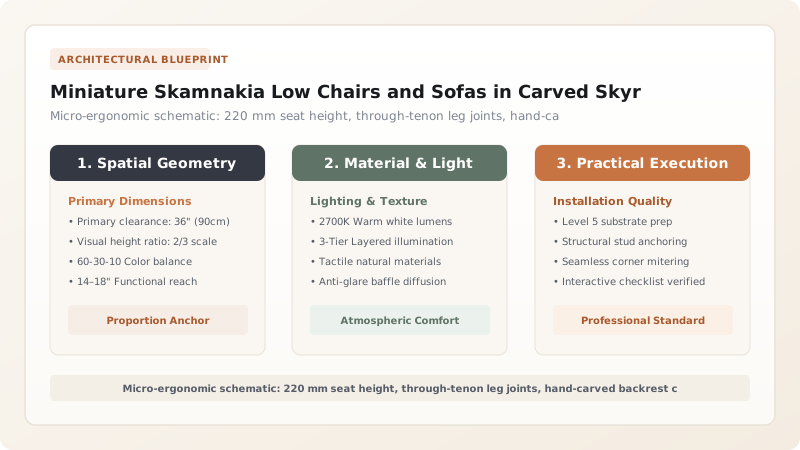
Micro-Ergonomics: The Architecture of Low-Slung Living
To enter a traditional Skyrian domestic interior is to experience an immediate and profound visual recalibration of scale. While Western European furniture design historically emphasized monumental height—with formal high-backed chairs designed to elevate the sitter above the floor plane—Skyrian furniture took the opposite trajectory. Every piece of seating in the Skyriano spiti was engineered to an intimate, miniature scale: stools (skamnia) and chairs (skamnakia) have seat heights ranging from just 20 to 25 centimeters above the stone floor, while overall backrest heights rarely exceed 50 to 60 centimeters.
This micro-ergonomic system was not a decorative quirk; it was an ingenious architectural solution to severe spatial constraints. In a traditional home measuring only five meters across, standard European furniture with 45-centimeter seat heights would fill the volume, making the room feel cluttered and claustrophobic. By dropping the functional furniture plane down to within a foot of the floor, the open vertical air space between the seating and the high whitewashed ceiling remained clear and expansive. Furthermore, low seating accommodated the traditional Mediterranean lifestyle: family members and guests gathered comfortably around the low central copper hearth (tzaki) or dining table (sini), warmed by radiant coals while remaining below the layer of rising smoke.
Woodcraft & Anatomy: The Pedigree of Cypress Joinery
Despite their diminutive proportions, Skyrian skamnakia are built with uncompromising structural durability. Unlike modern decorative miniatures that are glued or nailed together as ornamental dollhouse novelties, a true skamnaki is an authentic load-bearing timber frame designed to carry adult human weight for decades. The components are hewn from dense, slow-growth heartwood of wild Mediterranean cypress (Cupressus sempervirens).
The structural joinery employs precision blind and through mortise-and-tenon connections. The four legs are turned on hand lathes or hand-planed into gentle octagons, tapering subtly toward the ground. Horizontal stretchers (traversines) are fitted into mortises chiseled into the legs, with their tenon shoulders cut at subtle inward angles to give the chair a stable, outward-flaring stance (splay). The joints are locked with small wooden pins (karfobelones)—typically carved from dense olivewood or mastic wood—driven through pre-drilled holes. Because cypress is naturally resilient and rich in protective resins, the joinery flexes slightly under dynamic movement without loosening or squeaking, creating a lightweight chair that can be lifted with a single finger yet withstand generations of vigorous domestic use.
The Sculpted Back: Heraldic Icons in High Relief
The crowning glory of the skamnaki is its elaborately carved backrest (the rahi or crest rail). Here, the master woodcarver (xyloglyptis) displayed the full breadth of his technical virtuosity. Using narrow gouges (gougies) and fine V-shaped parting tools, the artisan carved complex narrative scenes and heraldic symbols directly into the solid cypress board.
The central medallion almost universally features the Dikefalos Aetos (the Byzantine double-headed eagle), carved with wings outstretched, talons gripping royal scepters, and crowns adorning both heads. In the master armchairs (polythrones) reserved for village elders or honoured wedding guests, the crest rail is expanded into an expansive triptych: the central eagle is flanked by full-rigged Aegean brigantines under billowing sail, leaping dolphins, and crowned sirens (Gorgones) holding intertwined serpents. The background wood is recessed using fine punch tools (pounsonia) to create a stippled, matte texture that contrasts dramatically with the polished, burnished high-relief foreground figures.
The Envelope Weave: Marsh Rush & Sea Sedge Seats
A carved skamnaki is never upholstered in fabric or leather; its seat is an organic marvel of hand-woven botanical fibers. The weaving material of choice is freshwater marsh rush (vourlo, Juncus acutus) harvested from island coastal wetlands during midsummer, or tough sea sedge grass (psathi). The cut rushes are sun-bleached on stone threshing floors until they achieve a pale golden-straw hue, then soaked in freshwater immediately before weaving to restore cellular elasticity.
The artisan sits with the chair frame clamped between the knees, taking three to four rush stems and twisting them into a continuous, supple cord. The weaver executes an authentic 'envelope weave': the cord is wrapped continuously over the four horizontal wooden stretchers, moving inward from the corners in four converging triangles. As the weave progresses toward the center, the artisan packs the hollow cavity between the upper and lower layers of cord with dry rush cuttings and straw. This internal padding creates a firm, resilient, convex cushion that conforms comfortably to the human body, breathes freely in the hot Aegean summer, and releases a sweet, meadow-like fragrance whenever seated upon.
Skyrian Low Seating Typologies & Dimensions
Use this reference table to calculate exact physical dimensions, ratios, and specifications before purchasing:
| Seating Type | Seat Height | Overall Height | Backrest Carving Motif | Traditional Social Context |
|---|---|---|---|---|
| Skamnaki (Low Chair) | 220–240 mm | 500–580 mm | Double-headed eagle, siren (Gorgona), rosettes | Standard family hearthside seating and casual dining |
| Skamni (Backless Stool) | 200–220 mm | 200–220 mm | No backrest; chip-carved stretcher skirts | Utility kitchen stool, footrest, children's seat |
| Polythrona (Low Armchair) | 240–260 mm | 650–750 mm | Three-masted sailing ship, twin cypress trees | Reserved for the patriarch (noikokiris) or priest |
| Kanapes (Low Sofa / Bench) | 230–250 mm | 600–700 mm | Continuous arched crest with scrolling foliage | Formal guest reception bench along the main wall |
| Trapezaki (Low Table) | 300–350 mm | 300–350 mm | Circular carved top (sini) with star polygons | Low dining table paired with skamnakia chairs |
Practical Constraints
Every successful decoration project must account for physical and environmental constraints:
Modern ergonomics where taller contemporary users find low 22 cm seating challenging for prolonged use
In modern luxury residential decor, skamnakia are often treated as sculptural art rather than primary dining chairs. Mitigation: Incorporate skamnakia as accent statement pieces, hearthside loungers, or luxury nursery furniture.
Drying and brittleness of natural rush cordage in arid, centrally heated modern interiors
Unconditioned rush seats can dry out and snap under heavy static point loads. Mitigation: Mist rush seats lightly with water once or twice a year to maintain natural cellulose fiber elasticity.
Execution Blueprint & Craftsmanship Sequence
Execute this professional sequence to achieve flawless results without backtracking:
Stock Dimensioning & Grain Alignment
Crosscut seasoned wild cypress heartwood into miniature component blanks: 40x40 mm legs, 20x40 mm stretchers, and 20x150 mm crest boards.
Leg Mortising & Tenoning
Cut blind mortises into the four legs at seat level (220 mm) and bottom stretcher level (60 mm), cutting matching tenons on the side rails.
Crest Board Curve Bandsawing & Relief Layout
Saw the arched outline of the chair backrest, drawing the traditional double-headed eagle and scrolling vine design onto the front face.
Xyloglyptiki Hand Relief Carving
Carve the design using hand gouges and V-parting chisels, sinking the background by 4 mm to leave the eagle and rosettes standing in bold relief.
Frame Dry-Fit & Pinned Assembly
Assemble the chair frame dry, check squareness, drill 6 mm holes through the tenon joints, and drive seasoned wooden pins (karfobelones).
Rush Conditioning & Cord Twisting
Soak dried freshwater marsh rushes (vourlo) in warm water for 30 minutes until pliant, twisting multiple strands into a continuous strong cord.
Envelope Seat Weaving
Weave the rush cord continuously around the four seat stretchers from outer corners toward the center, forming four intersecting diagonal triangles.
Internal Stuffing & Beeswax Finishing
Pack dry rush trimmings into the hollow core between top and bottom weaves for firmness, and buff the carved cypress with warm beeswax polish.
Common Mistakes & Countermeasures
Avoid these costly errors that compromise aesthetics, ergonomics, and budget:
Increasing the seat height to modern standard chair dimensions (450 mm)
Using synthetic nylon or plastic cordage to weave the chair seat
Project Execution Checklist
Track your physical progress. Checkboxes persist automatically on this device:
Frequently Asked Questions
Why are Skyrian chairs so extraordinarily low to the ground?
The low height (20–25 cm seat height) evolved directly from the micro-spatial architecture of the traditional Skyrian home. In a compact single-room dwelling of only 30 square meters, full-sized European furniture would visually choke the room and obstruct circulation. By keeping all furniture low, the vertical volume of the room remained open, making the whitewashed ceiling feel loftier. Furthermore, sitting close to the floor kept family members out of rising hearth smoke and fostered intimate domestic circle gatherings.
What is the difference between a skamnaki and a standard Greek tavern chair?
A standard Greek kafeneio or tavern chair has a seat height of 45 cm, straight uncarved dowel construction, and is painted bright blue or green. In contrast, a Skyrian skamnaki is an aristocratic miniature art piece: it stands only half as tall, is hand-carved from fragrant raw cypress with deep mythological relief, and is never painted, celebrated instead for its rich natural honey-amber wax patina.
How long does an authentic rush-woven skamnaki seat last?
When woven tightly from authentic marsh rush (vourlo) and protected from direct soaking, a Skyrian rush seat easily lasts 20 to 30 years under daily domestic use. If a rush strand eventually wears through, traditional village weavers can re-seat the solid cypress frame in an afternoon without affecting the carved woodwork.