Traditional Greek Skyrian carved wood and ceramic decor represents one of the most distinctive island interior decorative traditions in the Aegean Sea, originating on the isolated Sporades island of Skyros. Developed within the compact single-room cube of the traditional Skyrian house (Skyriano spiti), this craft is characterized by unique micro-scaled furniture carved from local wild cypress wood (kiparissi), including diminutive low chairs (skamnakia) and stools woven with rush cordage. The interior is defined by an elevated wooden sleeping mezzanine (sfas) concealing deep dowry storage drawers below, while every vertical wall surface is lined with tiered carved plate racks (piatothikes) displaying precious maritime heirloom ceramics—Italian Maiolica, Dutch Delftware, Ottoman Iznik, and local Skyrian folk faience—alongside hammered pewter charger rails.
At a Glance: Key Takeaways
- Geographic Epicenter: Skyros Island, Northern Sporades, Aegean Sea, Greece
- Architectural Context: Single-room cubic Skyrian domestic house (Skyriano spiti)
- Primary Timber: Aromatic wild Mediterranean cypress (Cupressus sempervirens)
- Signature Furniture: Miniature low chairs (skamnakia), stools, and elevated sfas platform
- Decorative Accessories: Apokreas folk faience, tiered piatothiki racks, and hammered pewter plates
In-Depth Guides in this Directory
Explore specialized subtopic blueprints, technical dimensions, and execution checklists:
Miniature Skamnakia Low Chairs and Sofas in Carved Skyrian Cypress
Comprehensive guide to traditional Skyrian miniature skamnakia low chairs and carved cypress sofas. Discover scale proportions, joinery, and rush weaving.
Apokreas Folk Faience Plate Racks and Pewter Mantel Rails in Skyrian Homes
Master guide to Skyrian apokreas ceramic displays, carved wooden plate racks (piatothikes), and pewter mantel rails (baffia) in traditional Aegean homes.
Elevated Sfas Wooden Sleeping Platform with Storage Drawers on Skyros
Comprehensive guide to the traditional Skyrian elevated sfas wooden sleeping platform (krevatosfas). Explore mezzanine framing, storage ambaria, and balustrades.
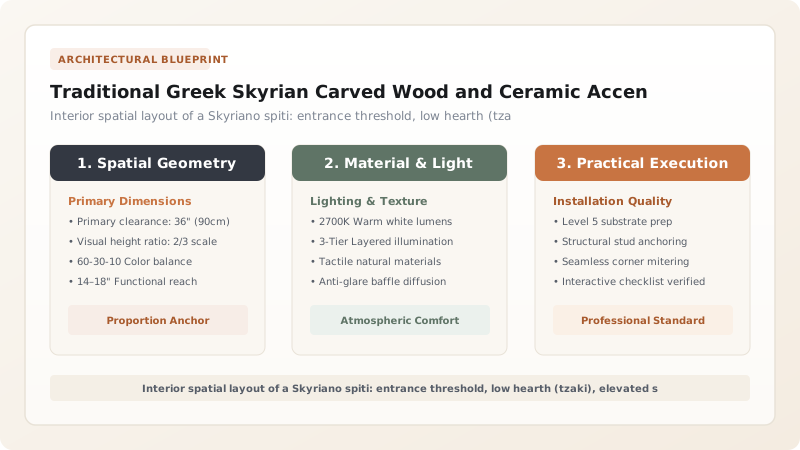
The Skyrian House (Skyriano Spiti): An Aegean Domestic Sanctum
Nestled upon a precipitous, amphitheater-like marble rock crowned by a Byzantine-Venetian kastro in the Northern Sporades archipelago, the town of Skyros represents one of the most remarkable intact vernacular environments in Greece. Because the island was constantly vulnerable to marauding Saracen, Venetian, and Ottoman pirate raids throughout the Middle Ages, Skyrians built dense, contiguous, flat-roofed stone houses clustered tightly together behind high defensive perimeter walls. This defensive imperative forced domestic architecture into an intensely compressed footprint: the traditional Skyrian dwelling (Skyriano spiti) consists of a single, un-partitioned square room typically measuring no more than five by six meters.
Faced with this extreme spatial confinement, the islanders developed an extraordinary interior decorative culture that transformed the humble stone cube into a palace of folk art. Rather than subdividing the room with solid stone walls, Skyrian builders developed a three-dimensional vertical spatial hierarchy. High ceilings were exploited to construct built-in wooden platforms, while every square inch of vertical wall plane was utilized for functional and prestige storage. The white-washed plaster walls—painted with pure lime—served as a brilliant, reflective backdrop against which dark, aromatic carved cypress timber and dazzling ceramic glazes created an atmosphere of rich, jewel-box luxury.
Xyloglyptiki: The Secret of Wild Mediterranean Cypress
The core material of Skyrian decorative woodwork (xyloglyptiki) is wild Mediterranean cypress (Cupressus sempervirens, known in Greek as kiparissi). Historically harvested from the rugged, wind-sculpted mountain ravines in the southern half of the island, wild cypress was revered by master woodcarvers for its unique physical and chemical properties. Unlike soft plantation conifers, slow-growth mountain cypress possesses a dense, fine-grained heartwood naturally saturated with aromatic resins and ethereal essential oils.
These natural cypress oils act as a permanent, lifetime insecticide: termites, wood-boring deathwatch beetles, and moths cannot infest cypress wood, making it the ideal material for dowry chests and food storage bins. Furthermore, the wood yields with buttery precision under the carver's sharp gouges without chipping or tearing across the grain. When smoothed and hand-buffed with pure unbleached beeswax, the wood does not yellow or darken abruptly; instead, it develops a deep, golden-amber honey patina that retains its crisp carving relief and releases a subtle, evergreen balsamic fragrance whenever the room warms with seasonal sunshine.
The Visual Lexicon: Byzantine Heraldry & Maritime Myth
The iconographic vocabulary carved into Skyrian furniture represents a fascinating cultural crossroads where Byzantine imperial heraldry, Venetian maritime folklore, and ancient Greek mythology converge. The master carvers (xyloglyptes) possessed an encyclopedic repertoire of traditional motifs passed down orally through centuries of master-apprentice lineages. At the center of chair backs and chest panels, the carver almost universally incised the Dikefalos Aetos (the Byzantine double-headed eagle), symbolizing spiritual vigilance, imperial heritage, and Orthodox Christian faith.
Flanking this imperial crest, one finds maritime and mythological emblems: the Gorgona (a crowned mermaid or siren, believed to be the sister of Alexander the Great, who calms the stormy seas for island sailors); fully rigged three-masted Aegean sailing ships (karavia) that celebrated the island's mercantile captains; stylised twin cypress trees (kiparissakia) representing eternal fidelity and life; and intricate geometric sunburst rosettes (iliakos diskos) whose chip-carved facets catch and refract raking light with diamond-like brilliance.
The Collector's Wall: Ceramics & The Prestigous Apokreas Display
The ultimate visual spectacle of a Skyrian interior is the apokreas or ceramic wall display. In Skyrian society, a family's genealogical status, commercial maritime success, and ancestral honor were quantified by the wealth of heirloom porcelain, faience, and metalware displayed on their walls. Long, multi-tiered wooden plate racks (piatothikes) and high perimeter mantel shelves (baffia) lined the room from wainscot to ceiling.
These racks were laden with treasures brought home by generations of Skyrian mariners: 16th- and 17th-century Italian Maiolica from Faenza and Urbino, cobalt-blue Dutch Delftware chargers, polychrome Ottoman Iznik plates with tulip and carnation motifs, fine English creamware, and vibrant local Skyrian folk-glazed pottery depicting island roosters and fish. Interspersed between the ceramics hung hand-hammered Ottoman pewter and copper chargers (sahani and bakiria), carefully polished to catch the flickering flame of the open hearth. During the pre-Lenten carnival season (Apokries), when masked revelers (Yeroi and Koreles) traversed the village streets in goat-skin costumes and clanging pastoral bells, the interior doors of the houses were thrown open, allowing neighbors and guests to marvel at the glistening ceramic displays—a living museum of Aegean decorative arts that has endured for half a millennium.
Skyrian Interior Architectural Elements & Furniture Typologies
Use this reference table to calculate exact physical dimensions, ratios, and specifications before purchasing:
| Architectural Element | Greek Name | Material Construction | Functional Purpose | Decorative Iconography |
|---|---|---|---|---|
| Low Carved Chair | Skamnaki / Skamni | Carved wild cypress with rush seat | Intimate hearthside seating and dining | Double-headed eagles, sirens, rosettes |
| Carved Armchair / Sofa | Polythrona / Kanapes | Solid cypress with low arched back | Master/guest reception seating | Sailing brigantines (karavia), cypress trees |
| Elevated Sleeping Platform | Sfas (Krevatosfas) | Heavy cypress timber beams & planking | Primary family bedchamber mezzanine | Pierced fretwork balustrades, carved staircases |
| Under-Bed Storage Chests | Ambaria / Sendoukia | Cedar or cypress board joinery | Storage for olive oil jars, grain, & textiles | Floral rosettes, geometric chip carving |
| Tiered Plate Rack | Piatothiki / Pennofori | Multi-tiered carved cypress wall shelves | Exhibition of imported maritime ceramics | Scalloped brackets, openwork heart friezes |
Practical Constraints
Every successful decoration project must account for physical and environmental constraints:
Scarcity of mature wild cypress trees on Skyros due to historical deforestation and grazing
Authentic island-harvested timber is rare and tightly regulated by forestry services. Mitigation: Sustainably source certified windfall cypress from managed Aegean estates or use seasoned walnut.
Fragility of antique tin-glazed ceramic faience displayed in earthquake-prone Aegean zones
Earth tremors can dislodge plates from wall racks, shattering irreplaceable family heirlooms. Mitigation: Incorporate deep retaining lip grooves on all plate rails and secure rims with museum-grade wax.
Execution Blueprint & Craftsmanship Sequence
Execute this professional sequence to achieve flawless results without backtracking:
Architectural Cubic Space Layout
Establish the tripartite spatial zones of the Skyriano spiti: ground-level hearth and reception floor, elevated sfas mezzanine, and storage undercroft.
Timber Seasoning & Board Preparation
Select fragrant, knot-free wild cypress heartwood, air-drying boards to 12% equilibrium moisture content before hand-planing surfaces.
Sfas Structural Platform Construction
Anchor heavy 150x150 mm cypress joists into the perimeter stone masonry walls at a 1.8-meter elevation, laying tongue-and-groove decking.
Undercroft Storage Joinery Installation
Construct deep grain bins (ambaria) and pull-out dowry drawers beneath the sfas platform, framing the face with carved fretwork screens.
Miniature Skamnakia Frame Joinery
Mortise and tenon miniature chair frames using dense cypress legs, locking joints with wooden dowels to form rigid, low-profile seats.
Hand Relief Xyloglyptiki Woodcarving
Carve the traditional Skyrian iconographic repertoire—Byzantine eagles, maritime ships, and acanthus volutes—using curved woodcarving gouges.
Natural Rush Seat Weaving
Weave dried, twisted marsh rush (vourlo) across the chair frame in a continuous diagonal envelope weave, padding the core with straw.
Tiered Piatothiki Mounting & Ceramic Exhibition
Mount multi-tiered carved plate racks onto whitewashed walls, arranging heirloom Aegean faience, Dutch Delftware, and pewter plates.
Common Mistakes & Countermeasures
Avoid these costly errors that compromise aesthetics, ergonomics, and budget:
Scaling Skyrian furniture to standard modern European chair heights (450 mm)
Applying high-gloss synthetic polyurethane or modern varnishes over carved cypress woodwork
Mounting heavy antique ceramic faience plates onto wall racks using rigid modern metal wire hooks
Project Execution Checklist
Track your physical progress. Checkboxes persist automatically on this device:
Frequently Asked Questions
Why is traditional Skyrian carved wooden furniture miniature in scale?
Skyrian furniture is famously scaled to miniature dimensions (chair seat heights average only 20 to 25 cm above the floor). This micro-scale was an ingenious adaptation to the cramped spatial footprint of the traditional Skyrian house (often measuring just 5 by 6 meters). Lowering the visual center of gravity made the compact cubic space feel significantly taller and more spacious. Furthermore, it allowed the entire extended family to sit comfortably around the low central hearth and low circular dining table (sini).
How did a remote Aegean island like Skyros amass such vast collections of foreign ceramics?
Historically, Skyrian sailors were skilled mariners, merchants, and occasionally corsairs who navigated trade routes throughout the Mediterranean and Black Seas. Furthermore, Skyros was a strategic natural harbor on the trade lanes between Venice, Genoa, Constantinople, and the Levant. Skyrian captains traded agricultural goods (meat, cheese, timber) for luxury ceramics—including 16th-century Italian Maiolica, Dutch Delftware, Ottoman Iznik wares, and Chinese export porcelain—displaying them as status symbols.
What is the cultural and architectural function of the 'sfas' platform?
The sfas is a built-in wooden mezzanine sleeping platform elevated about 1.5 to 2 meters above the stone floor. It served as the primary, private matrimonial bed for the parents, while the deep, secure cavern underneath was engineered into built-in wooden chests and grain bins (ambaria) that housed the bride's dowry textiles, olive oil jugs, and dry winter provisions.