Stainless-steel hidden-clip and copper flashing drainage systems represent the technical pinnacle of contemporary German Schindel facade engineering. While historic timber envelopes relied on hand-forged iron nails that eventually rusted, modern standards specify marine-grade A2 or A4 (304/316) austenitic stainless steel ring-shank nails and hidden mounting clips. These non-corrosive fasteners resist the aggressive tannic acids of larch and oak, while integrated natural copper flashings, bell-cast drip edges, and valley linings provide maintenance-free water deflection that endures for generations.
At a Glance: Key Takeaways
- Fastener Standard: Austenitic Stainless Steel (DIN EN ISO 3506 A2 / 304 or A4 / 316)
- Nail Geometry: Ring-shank (Rillennägel) with flat countersunk head
- Flashing Material: Natural architectural rolled copper sheet (Cu-DHP 0.6–0.7 mm)
- Galvanic Rule: Strict isolation: Copper above stainless/lead; zero zinc/galvanized downstream
- Fastener Location: Concealed 20 mm above exposure line, buried beneath two layers
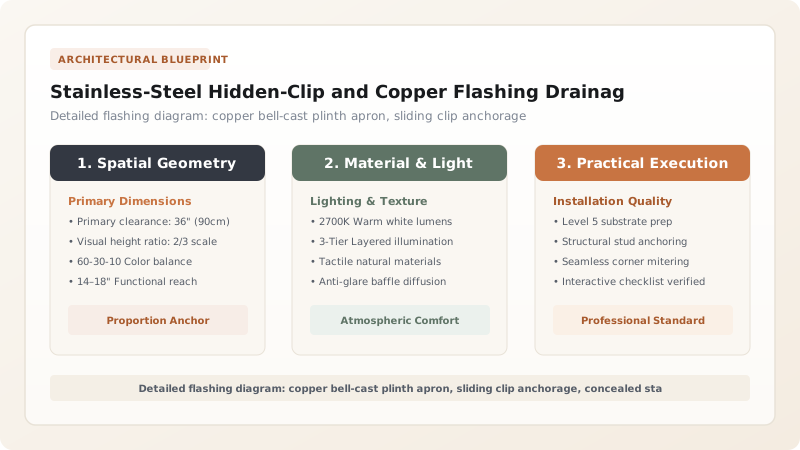
The Evolution from Forged Iron to Modern Stainless Steel
Historically, German wood shingle envelopes were secured with hand-forged wrought-iron nails (Schindelnägel) produced by village blacksmiths. While wrought iron possessed high slag content that provided reasonable rust resistance compared to modern mild steel, centuries of exposure to damp mountain conditions inevitably took their toll. Over decades, moisture oxidizing the iron shanks expanded their diameter, splitting the dense wood grain around the fastener hole and allowing shingles to blow away during severe winter storms.
In modern German timber engineering, standards codified in DIN 68800 and the Fachregeln des Deutschen Dachdeckerhandwerks mandate the exclusive use of high-grade austenitic stainless steel fasteners. Shingles must be secured with A2 (AISI 304) or, in coastal and polluted environments, marine-grade A4 (AISI 316) stainless steel ring-shank nails or specialized hidden mounting clips. These non-corrosive fasteners are completely impervious to atmospheric oxidation and provide unyielding mechanical withdrawal resistance that endures as long as the wood itself.
Chemical Metallurgy: Managing Tannic Acid Reactions
The imperative for stainless steel fasteners becomes immediately apparent when examining the internal biochemistry of alpine softwoods. European mountain larch (Larix decidua) and mature oak contain exceptionally high concentrations of naturally occurring tannic acids and resinous extractives. These polyphenolic compounds are precisely what make the wood so durable against fungal decay.
However, when standard galvanized or mild steel fasteners come into contact with wet wood tannins, an aggressive chemical reaction occurs. The tannins attack and dissolve the sacrificial zinc coating on galvanized nails within two to four years. Once the underlying carbon steel is exposed, iron ions react with tannic acid to form iron tannate—a black, water-soluble chemical pigment chemically identical to historic iron-gall writing ink. This reaction causes unsightly black bleed stains to weep down the facade while corroding the nail shank down to a needle-thin wire. Stainless steel, by contrast, forms a passive chromium oxide surface film that remains completely inert in the presence of concentrated tannins.
Copper Flashing Integration and Natural Biocidal Washing
For all perimeter terminations, window aprons, roof valleys, and foundation plinth transitions, German shingle architecture relies on natural rolled copper sheet (Cu-DHP). Copper possesses ideal architectural properties: it is highly malleable, easily soldered and folded into intricate weatherings on site, and develops a protective cuprous oxide and basic copper carbonate patina that lasts over a century.
Crucially, copper works in profound ecological synergy with wood shingles. As rainwater washes over copper valley gutters and eaves flashings, it picks up sub-microscopic trace quantities of dissolved copper ions (Cu²⁺). When this runoff water trickles across the lower shingle courses, the copper ions act as a gentle, natural biocide. The copper wash naturally inhibits the colonization of moisture-trapping mosses, lichens, and fungal spores without requiring toxic chemical biocides, keeping the wooden shingles clean, dry, and healthy throughout their long service life.
Galvanic Isolation and the Metal Nobility Hierarchy
When integrating metals into a wood shingle envelope, architects must strictly respect the electrochemical series of metals to prevent catastrophic galvanic corrosion. Copper is a highly noble metal with a high positive electrode potential. If rainwater containing dissolved copper ions drains onto less noble metals—such as zinc, galvanized steel, or aluminum—a galvanic cell is instantaneously established.
In this galvanic circuit, the less noble metal acts as a sacrificial anode, corroding and disintegrating with alarming speed. German roofing guidelines strictly prohibit placing zinc or aluminum components downstream from copper flashings. Furthermore, where copper flashings intersect stainless-steel substructure brackets or masonry plinths, carpenters install non-conductive EPDM rubber membranes or bituminous separation strips. By isolating dissimilar metals and fastening flashings with sliding copper clips (Haften) that accommodate thermal movement, the envelope functions as a unified, maintenance-free ecological system that honors the highest standards of alpine craftsmanship.
Metal Fastener & Flashing Compatibility Matrix for Wood Shingles
Use this reference table to calculate exact physical dimensions, ratios, and specifications before purchasing:
| Metal Typology | Corrosion Resistance | Reaction with Wood Tannins | Compatibility with Copper | Specification Status |
|---|---|---|---|---|
| A2 Stainless Steel (304) | Superior atmospheric resistance | Completely inert; zero staining | Excellent; no galvanic reaction | Standard industry recommendation |
| A4 Stainless Steel (316) | Marine / Acid-rain immune | Completely inert; zero staining | Optimal; zero galvanic reaction | Mandatory in coastal & alpine industrial zones |
| Solid Copper (Cu-DHP) | Forms self-healing patina | Inert with wood; slight greening | Self-compatible; ideal partner | Preferred for flashings, gutters & nails |
| Hot-Dip Galvanized | Moderate (poor in acids) | Tannins dissolve zinc coating | Severe galvanic corrosion if downstream | Strictly prohibited on larch/oak shingles |
| Aluminum Alloy | Moderate; pitted by salts | Sensitive to alkaline lime/wood acids | Severe galvanic reaction with copper | Not recommended in traditional shingle craft |
Practical Constraints
Every successful decoration project must account for physical and environmental constraints:
Tannic acid leaching from freshly installed larch or oak shingles during the first year
Tannin runoff can cause temporary brown staining on underlying concrete, glass, or light masonry. Mitigation: Design wide copper catchment gutters and treat vulnerable stone surfaces with sacrificial wax.
Thermal expansion and contraction of long continuous copper valley flashings
Rigid nailing of metal gutters causes buckling, metal fatigue, and seam rupture. Mitigation: Fasten copper flashings using sliding expansion clips (Haften) allowing free thermal movement.
Execution Blueprint & Craftsmanship Sequence
Execute this professional sequence to achieve flawless results without backtracking:
Counter-Batten & Ventilation Substructure Assembly
Install vertical 24x48 mm preservative-free spruce counter-battens over the weather-resistant membrane, verifying an uninterrupted 24 mm airflow gap from plinth to roof.
Perforated Stainless Insect Mesh Installation
Fix a continuous L-shaped perforated A2 stainless steel insect screen across the bottom air intake, preventing wasps, rodents, and bats from nesting in the cavity.
Copper Plinth Apron Flashing Fabrication
Form 0.6 mm copper sheets into an outward-flaring bell-cast drip flashing, incorporating a continuous 15 mm hemmed drip lip that projects 30 mm clear of the stone foundation.
Sliding Copper Haften Clip Fastening
Secure the copper flashings to the timber battens using copper expansion clips (Haften) fastened with copper ring nails, permitting unrestrained thermal expansion.
Pneumatic Nailer Calibration for Stainless Fasteners
Calibrate the air pressure on pneumatic shingle nailers to drive A2 stainless steel ring-shank nails perfectly flush with the wood face, preventing bruised fibers.
Setting Hidden Fastener Coordinates
Drive two stainless fasteners into each shingle exactly 20 mm above the exposure line and 20 mm inside each side edge, anchoring directly into the underlying batten.
Window Sill and Jamb Copper Integration
Fold and solder custom copper window sill aprons with turned-up side water-bars, weaving the surrounding shingle courses over the flashing flanges.
Top Ventilation Exhaust Detailing
Terminate upper shingle courses 30 mm beneath the roof overhang, capping with a perforated stainless-steel exhaust strip and copper head apron.
Common Mistakes & Countermeasures
Avoid these costly errors that compromise aesthetics, ergonomics, and budget:
Using galvanized steel nails to fasten resinous larch or oak shingles
Placing zinc or aluminum flashings downstream from copper roofs or gutters
Project Execution Checklist
Track your physical progress. Checkboxes persist automatically on this device:
Frequently Asked Questions
Why must shingle nails be hidden (blind nailed) rather than face nailed?
Blind nailing places the fastener heads 20 mm above the exposure line, where they are buried beneath two solid layers of overlapping shingles. This protects the fastener from direct rain, snow, and UV exposure. Furthermore, face nailing exposes nail heads to weathering, where water can track down the nail shank into the battens, creating localized rot.
Why is copper the ideal metal to pair with wood shingles?
Copper and wood shingles are natural architectural partners. Both have comparable lifespans (over 80 years) and require zero maintenance. As copper oxidizes, rainwater washing over it carries microscopic traces of dissolved copper salts; this mild copper wash acts as a natural fungicidal rinse that inhibits moss, lichen, and algae growth on shingles downstream.
What is the danger of using standard electro-galvanized nails in larch shingles?
European mountain larch is rich in tannic acids. When electro-galvanized nails are used, the acidic wood sap quickly dissolves the thin electroplated zinc coating. The exposed steel reacts chemically with the tannins to form iron tannate—a dark, inky compound that produces unsightly black vertical streaks down the facade and rusts the nail in two within a few seasons.