Beaver-tail Rundschindel scalloped layered weather-lapping—named after the traditional rounded Biberschwanz roof tile—is the most iconic ornamental and functional wood shingle profile in German alpine architecture. Hand-carved with a semicircular rounded bottom butt, these shingles are laid in an overlapping three-ply (dreilagig) matrix where each course exposes only one-third of its length. The rounded scalloped tails create a hydrodynamic drip point that concentrates rainwater at the center of each shingle, shedding deluge rainfalls and snowmelt far clear of adjacent vertical joint seams.
At a Glance: Key Takeaways
- Profile Geometry: Semicircular curved bottom butt (Rundschindel / Biberschwanz)
- Lapping Architecture: Dreilagig (3-ply / three overlapping layers at every point)
- Standard Dimensions: Length: 250–350 mm; Width: 60–140 mm; Butt Thickness: 8–12 mm
- Weather Exposure (Lattmaß): One-third total length (typically 80 mm to 110 mm exposure)
- Joint Staggering: Minimum 30 mm lateral offset on all alternating courses
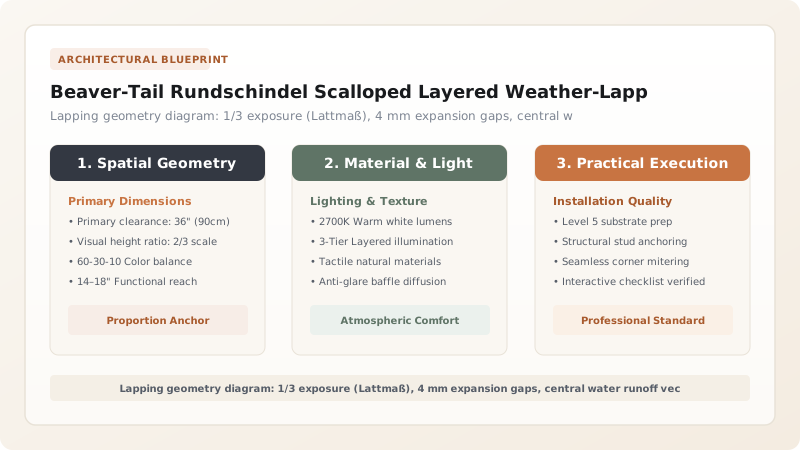
The Architectural Iconography of the Beaver-Tail
Among the diverse ornamental shingle profiles found across the Germanic alpine world—ranging from sharp pointed shingles (Spitzschindeln) to rhombic diamonds (Rautenschindeln)—none possesses the timeless aesthetic grace and hydrodynamic functional perfection of the Rundschindel. Known colloquially as the Biberschwanz (beaver-tail) due to its resemblance to the broad, rounded tail of the European beaver, this semicircular scalloped shingle has defined the visual silhouette of Black Forest hamlets and Bavarian mountain chalets for centuries.
The beaver-tail was originally developed in medieval clay roof tile manufacturing, but alpine woodworkers quickly translated the form into hand-riven larch and spruce heartwood. When installed across expansive wall planes, the thousands of curved, overlapping shingles create a mesmerizing, fish-scale textural rhythm that softens the massive geometric bulk of alpine timber architecture, integrating the building seamlessly into the surrounding pine-clad mountain ridges.
Hydrodynamic Drainage Mechanics of the Curved Tail
The semicircular scalloped shape is a masterpiece of passive fluid dynamics. On a conventional straight-cut rectangular shingle, rainwater flows down the face in broad, parallel sheets. When the water reaches the bottom horizontal edge, wind buffeting easily forces the droplets to spread laterally toward the vulnerable vertical joint gaps between adjacent shingles.
The Rundschindel completely eliminates this vulnerability through pure geometry. Because the bottom edge forms a continuous convex semicircle, water landing anywhere on the shingle is guided by gravity toward the lowest apex of the curve—the dead center of the tail. The water converges into a concentrated droplet stream that drips off the center, falling directly onto the thick, solid center of the shingle in the course below, at the maximum possible distance from any vertical joint. Even during ferocious alpine cloudbursts, water is directed harmlessly away from structural seams.
The Mathematics of the Dreilagig Overlap Matrix
The structural watertightness of a Rundschindel facade is founded on the dreilagig (three-ply) overlapping matrix. In this system, every horizontal course of shingles covers two-thirds of the course beneath it, exposing only one-third of its total length to the weather. For example, when using a standard 300 mm shingle, the exposure gauge (Lattmaß) is exactly 100 mm, leaving 200 mm buried beneath upper overlapping courses.
Viewed in cross-section, this means that at any point on the finished wall, there are three solid layers of hand-riven heartwood between the external atmosphere and the building substructure. The vertical joints in each course are staggered by at least 30 to 50 millimeters relative to the courses above and below, ensuring that the vertical seam between two shingles is always backed by solid, unbroken wood in the two layers beneath it. Even if an outer shingle experiences severe physical impact or splits after forty years of weather exposure, the two underlying shingle layers maintain 100% weather integrity.
Corner Detailing: Gestoßene Ecke vs Eckleiste
Resolving external and internal building corners with scalloped beaver-tail shingles requires master-level artisan joinery. In traditional alpine carpentry, two principal details are employed. The first is the Eckleiste (corner casing): two dressed, vertical larch boards are fixed to the corner framing, forming a crisp, 90-degree wooden corner trim against which the Rundschindel courses terminate with clean vertical cuts, bedded over concealed copper flashings.
The second, more technically challenging method is the gestoßene Ecke (lapped or woven corner). In this master detail, no corner boards are used. Instead, the corner shingles are hand-beveled along their edges at precise 45-degree angles using a drawknife, overlapping each other in alternating directions course-by-course. When executed by a master craftsman, the scalloped beaver-tail curves wrap continuously around the building corner like an unbroken woven basket, showcasing the absolute pinnacle of German vernacular woodworking.
Rundschindel Lapping Gauges, Angles & Overlap Geometry
Use this reference table to calculate exact physical dimensions, ratios, and specifications before purchasing:
| Building Surface | Roof/Wall Incline | Lapping System | Exposure (Lattmaß) | Waterproofing Safety Factor |
|---|---|---|---|---|
| Vertical Alpine Wall | 90° (Vertical) | Dreilagig (3-ply) | 100–110 mm (33% exposure) | Extreme weather safety; 60–80 year lifespan |
| Steep Alpine Gable | 60°–85° (Steep pitch) | Dreilagig (3-ply) | 90–100 mm (30% exposure) | High wind-driven rain and blizzard resistance |
| Alpine Roof Pitch | 40°–55° (Moderate) | Dreilagig (3-ply) | 80–90 mm (25% exposure) | Resists heavy winter snowpack and ice dams |
| Curved Wall Bell-Cast | Flaring curve (70° to 45°) | Dreilagig with wedge shims | 70–80 mm exposure | Throws water clear of foundation plinth |
| Sheltered Under-Eaves | Vertical / Overhung | Zweilagig (2-ply) | 140–160 mm (50% exposure) | Economical; suited only for protected dry zones |
Practical Constraints
Every successful decoration project must account for physical and environmental constraints:
Complex compound curves around window surrounds, eyebrow dormers, and hexagonal turrets
Requires custom tapering and hand-trimming of every individual shingle in the curve. Mitigation: Use narrow 50–70 mm shingles and adjust side tapers progressively along radial chalk lines.
Heavy drifting snow accumulating along horizontal wall moldings and window sills
Standing snow can wick moisture upward behind shingle tails through capillary action. Mitigation: Maintain a minimum 150 mm clearance beneath sills and install continuous copper drip flashings.
Execution Blueprint & Craftsmanship Sequence
Execute this professional sequence to achieve flawless results without backtracking:
Substructure Batten Layout and Chalk Snapping
Snap horizontal chalk reference lines across spruce battens at precise intervals equal to one-third of the shingle length (typically 100 mm exposure for a 300 mm shingle).
Bell-Cast Cant Strip Installation (Aufschiebling)
Fix a continuous beveled wooden cant strip along the base batten to kick the starter course outward at a 10-degree angle, ensuring positive water throw.
Three-Layer Starter Course Execution
Lay an initial short cut course (100 mm), covered by a medium course (200 mm), and topped by the first full-length Rundschindel (300 mm) to establish the 3-ply matrix.
Sorting and Grading by Width
Sort shingles into narrow, medium, and wide bins, using consistent widths across specific wall sections to maintain balanced, harmonious visual courses.
Setting the Semicircular Scallop Alignment
Position each Rundschindel with its rounded tail resting exactly on the chalk line, aligning the apex of the curve directly above the vertical joint seam beneath.
Joint Gap Calibration
Insert a 4 mm wooden spacer shim between adjacent shingle sides before nailing, ensuring adequate lateral clearance for seasonal timber expansion.
Concealed Stainless Fastener Placement
Drive two stainless steel ring-shank nails 20 mm above the exposure line and 20 mm in from each side, nailing through to the underlying horizontal batten.
Top Ridge and Eaves Termination
Finish upper wall courses beneath eaves with two overlapping rectangular trim courses, bedding the top edges tightly beneath copper apron flashings.
Common Mistakes & Countermeasures
Avoid these costly errors that compromise aesthetics, ergonomics, and budget:
Laying shingles tightly edge-to-edge without lateral expansion gaps
Aligning vertical joints between the first and third courses (stacking joints)
Project Execution Checklist
Track your physical progress. Checkboxes persist automatically on this device:
Frequently Asked Questions
Why is the beaver-tail (Rundschindel) shape hydrodynamically superior to flat-bottomed shingles?
When water sheets down a flat-bottomed rectangular shingle, it flows off the entire width of the edge, often allowing water droplets to migrate horizontally toward the vertical joint seams. A beaver-tail (Rundschindel) has a continuous convex curve: gravity naturally channels water toward the lowest center point of the semicircle, draining water directly onto the solid center of the shingle below and away from joint seams.
How do carpenters handle external building corners with Rundschindel shingles?
External corners are detailed using two primary methods: the 'lapped corner' (gestoßene Ecke), where shingles are beveled and alternately overlapped course-by-course; or the 'corner board' (Eckleiste), where vertical dressed larch boards form a crisp corner casing against which the scalloped shingles terminate.
Can Rundschindel wood shingles be installed on curved walls or conical turrets?
Yes. One of the greatest virtues of wood shingles is their flexibility on three-dimensional curved surfaces. On round towers, church spires, or curved eyebrow dormers, craftsmen hand-trim the sides of narrow shingles into subtle trapezoids (Keilschindeln), allowing them to wrap seamlessly around tight radiuses.