Traditional German Schindel wood shingle cladding (Holzschindeln)—prominent across the Black Forest (Schwarzwald), Allgäu, Bavarian Alps, and Erzgebirge—is a high-performance vernacular building envelope system. Hand-riven along natural radial wood grain from winter-felled European mountain larch (Larix decidua) and mountain spruce (Picea abies), these wooden shingles are applied in overlapping multi-layer systems (dreilagig / 3-ply on roofs and walls). The assembly creates a rainscreen that breathes vapor outward while shedding severe alpine blizzards, aging over decades into a dignified protective silver-grey patina.
At a Glance: Key Takeaways
- Craft Discipline: German Holzschindelhandwerk / Alpine Wood Shingle Cladding
- Geographic Heartland: Black Forest (Schwarzwald), Bavarian Alps, Allgäu, Harz, Erzgebirge
- Primary Timber Species: Alpine Mountain Larch (Lärche) & High-Elevation Spruce (Fichte)
- Lapping Architecture: Dreilagig (3-ply / one-third exposure) on weather-exposed facades
- Lifespan Expectancy: 50 to 80+ years without chemical preservatives on ventilated walls
In-Depth Guides in this Directory
Explore specialized subtopic blueprints, technical dimensions, and execution checklists:
Radial Hand-Riven Larch and Spruce Heartwood Cleaving: The Schindelmacher Craft
Technical guide to the German Schindelmacher craft: radial hand-riving of mountain larch and spruce heartwood with froe, club, and shaving horse (Schnitzbank).
Beaver-Tail Rundschindel Scalloped Layered Weather-Lapping: Alpine Geometry
Technical analysis of German beaver-tail Rundschindel wood shingles: semicircular scalloped profiles, dreilagig 3-ply lapping, and weather-shedding geometry.
Stainless-Steel Hidden-Clip and Copper Flashing Drainage: Modern Schindel Detailing
Technical guide to modern German wood shingle detailing: A2/A4 stainless steel hidden fasteners, galvanic corrosion prevention, and pure copper flashing integration.
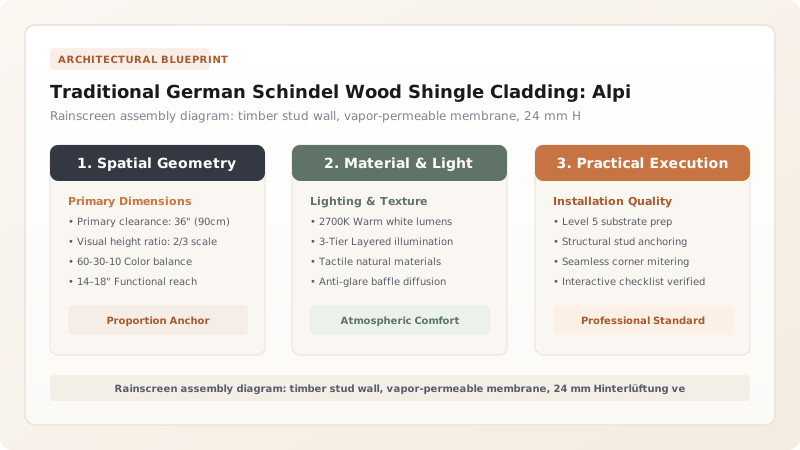
The Alpine Vernacular Tradition of Holzschindeln
Across the mountainous landscapes of Central Europe—from the rain-swept heights of the Black Forest (Schwarzwald) to the snow-covered valleys of the Bavarian Alps, the Allgäu, the Swiss cantons, and the Erzgebirge along the Czech border—the wooden shingle (die Holzschindel) has reigned for centuries as the supreme architectural skin. In these rugged upland environments, traditional builders faced extreme climatic challenges: hurricane-force mountain gales, sub-zero winter blizzards, driving horizontal rain, and intense solar radiation reflected from snowfields.
Far from being a primitive compromise, the German Schindelverkleidung (wood shingle cladding) is an engineered building envelope of extraordinary sophistication. Utilizing the natural cellular architecture of alpine softwoods, master shingle makers (Schindelmacher) crafted a dynamic, multi-layered rainscreen that breathes vapor outward from the building interior while presenting an impenetrable barrier to driving rain and windblown snow. Over decades of service, this living wooden envelope transforms gracefully, patinating from warm golden amber into a dignified, velvety silver-platinum shield.
Forestry Science: Slow-Grown Alpine Heartwood
The exceptional durability of German shingle cladding begins in the high-altitude mountain forests. Masons and carpenters adhered to strict traditional forestry wisdom, harvesting timber from elevations above 1,000 meters where cold temperatures and short growing seasons force conifers to grow with extreme slowness. In these high-elevation trees, the annual growth rings are packed with microscopic density—frequently less than 1 to 1.5 millimeters apart—creating wood of immense mechanical hardness and fine cell structure.
Felling occurred strictly in mid-winter (Mondholz / winter felling), during the tree's dormant sap rest when moisture content is at its annual low and starch levels within the sapwood are minimal, drastically reducing susceptibility to fungal sporulation. The preferred species is European mountain larch (Larix decidua), renowned for its high resin and natural tannin content, followed by slow-grown mountain spruce (Picea abies) and silver fir (Abies alba). Crucially, master shingle makers rigorously cleaved away all white exterior sapwood, utilizing exclusively the dense, pitch-saturated heartwood (Kernholz) for shingles.
The Physics of Hand Riving vs Machine Sawing
The paramount difference between authentic historic German shingle craft and modern industrial wood cladding lies in the method of separation: riving (splitting) versus sawing. Industrial shingles are cut with high-speed circular or bandsaws. Saws operate indiscriminately, slicing through millions of microscopic wood cells and capillary vessels at arbitrary angles. This creates an open-pored, fuzzy surface that acts as a continuous sponge, drawing water deep into the wood core via capillary suction and causing rapid rotting within ten to fifteen years.
Authentic German shingles are cleaved strictly by hand (handgespaltene Schindeln). Using a specialized steel froe (Spaltklinge or Klaue) struck with a wooden club, the artisan splits the wood block radially along its natural medullary rays and annual growth rings. Because the wood splits along natural cell boundaries rather than through cell walls, the tubular vascular channels of the tree remain intact, closed, and sealed. Water striking the surface cannot penetrate the cell structure; it simply beads and runs off the smooth, cleaved face, mimicking the natural water-shedding performance of slate stone.
Thermodynamics of the Rear-Ventilated Rainscreen (Hinterlüftung)
The longevity of a modern or historic Schindel facade depends upon the physical principle of continuous rear ventilation, known in German building standards as Hinterlüftung. Shingles are never nailed directly onto flat sheathing. Instead, they are fixed to horizontal battens mounted over vertical counter-battens, creating a continuous vertical air cavity of at least 24 to 40 millimeters behind the shingles.
This air cavity functions as an open thermodynamic chimney. Solar heating of the exterior shingles creates a convective updraft of air within the cavity, which continuously carries away any moisture that transpires outward through the building walls or penetrates past shingle overlaps during heavy rainstorms. Because the rear of the shingles is constantly bathed in fresh air, the wood dries out within hours after a rainstorm, preventing moisture levels from ever remaining above the 20% fiber saturation threshold required for wood-decay fungi to germinate, ensuring a maintenance-free lifespan of sixty to eighty years.
German Schindel Typologies & Application Specifications
Use this reference table to calculate exact physical dimensions, ratios, and specifications before purchasing:
| Shingle Profile | German Designation | Typical Wood | Exposure Ratio | Optimal Architectural Application |
|---|---|---|---|---|
| Beaver-Tail Shingle | Rundschindel / Biberschwanz | Alpine Larch / Spruce | Dreilagig (1/3 exposure) | Curving facade bell-castings, dormers, and alpine gables |
| Straight Chiseled | Gerade Schindel (Legschindel) | Heartwood Larch | Dreilagig (1/3 exposure) | Windward exterior walls and steep alpine roofs (>35°) |
| Pointed Shingle | Spitzschindel | Fine-grain Spruce | Zweilagig (1/2 exposure) | Decorative ornamental friezes and church spires |
| Beveled Wedge | Keilschindel | Cleaved Mountain Larch | Dreilagig (1/3 exposure) | Standard residential rainscreen facades in the Black Forest |
| Chipped Diamond | Rautenschindel | Selected White Fir (Tanne) | Zweilagig or Dreilagig | Architectural focal points, window surrounds, and aprons |
Practical Constraints
Every successful decoration project must account for physical and environmental constraints:
Uneven solar UV exposure creating chromatic variations during natural silver patination
Shaded facade zones remain warm golden-brown while exposed sunny areas turn silver-grey. Mitigation: Educate clients on natural patination dynamics, or apply breathable silicate grey-stain pre-patinators.
Severe alpine freeze-thaw cycles driving snowpack accumulation against lower wall shingles
Moisture absorption at wall bases can accelerate mechanical wear and moss growth. Mitigation: Terminate shingles at least 300 mm above grade over a cantilevered copper drip-apron plinth.
Execution Blueprint & Craftsmanship Sequence
Execute this professional sequence to achieve flawless results without backtracking:
Forestry Tree Selection and Winter Felling
Select slow-grown mountain larch or spruce trees showing tight annual growth rings (less than 1.5 mm apart) and zero spiral twist, harvested during winter dormancy.
Bolt Cross-Cutting & Radial riving (Klaube)
Cross-cut logs into 200–400 mm shingle bolts, cleaving them radially into pie-shaped segments along natural medullary rays using a heavy steel froe and mallet.
Heartwood Shaving and Dressing (Ziehmesser)
Mount riven blanks into a traditional shaving horse (Schnitzbank), drawing a curved drawknife along edges to taper the top half and dress smooth sides.
Rainscreen Substructure & Hinterlüftung Setup
Install a vapor-permeable windtight membrane over the exterior wall, fixing vertical 24x48 mm counter-battens to create the continuous rear ventilation chimney.
Horizontal Lathing & Copper Plinth Flashing
Fix horizontal spruce battens spaced to the designated shingle exposure gauge, mounting a continuous pre-formed copper drip flashing at the base.
Starter Course and Doubling (Doppellage)
Install an initial two-layer or three-layer starter course along the bottom batten to establish the correct outward angle for subsequent overlapping tiers.
Executing the Scalloped Rundschindel Lapping
Lay shingles in regular courses with 3–5 mm joint expansion gaps, staggering vertical joints by at least 30 mm relative to the course beneath.
Fastening with Hidden Stainless Steel Nails
Drive two A2 stainless steel ring-shank nails into each shingle 20 mm above the exposure line, ensuring nail heads are fully concealed by overlapping courses.
Common Mistakes & Countermeasures
Avoid these costly errors that compromise aesthetics, ergonomics, and budget:
Using machine-sawn shingles instead of authentic hand-riven (gespaltene) shingles
Fastening wooden shingles with electro-galvanized or mild steel nails
Omitting the continuous rear-ventilation gap (Hinterlüftung) behind the shingle battens
Project Execution Checklist
Track your physical progress. Checkboxes persist automatically on this device:
Frequently Asked Questions
Why are hand-riven (split) shingles vastly superior to machine-sawn shingles?
When a shingle is hand-riven (split with a froe), the split follows the natural wood grain and medullary rays without cutting across cell structures. The vascular fiber channels remain closed and intact, naturally repelling rainwater like feathers on a duck's back. Sawn shingles, by contrast, slice through thousands of wood capillaries, creating an open sponge-like surface that absorbs water, fosters mold, and rots prematurely.
What is 'dreilagig' and why is it standard in German alpine shingle cladding?
'Dreilagig' translates to 'three-ply' or 'three-layered.' It means that at every single point on the facade wall, there are three overlapping layers of wooden shingles. Each course is exposed to the weather by only one-third of its total length. If an outer shingle develops a hairline crack, two sound, watertight shingle layers beneath it prevent water from ever touching the building structure.
Do traditional German wooden shingles require chemical paints or wood preservatives?
No. When constructed from resinous mountain larch or heartwood spruce with a proper rear ventilation cavity (Hinterlüftung), chemical wood preservatives are completely unnecessary. The natural resins, tannins, and rapid drying from rear airflow protect the wood naturally. Over time, UV sunlight and rain convert surface lignin into cellulose, forming a self-protective, maintenance-free silver-grey patina.
How long does a properly installed German Schindel facade last?
On vertical walls with proper rear ventilation and ground clearance, hand-riven larch shingles routinely achieve lifespans of 60 to 100 years. On steep alpine roofs exposed to heavy snow and ice, lifespans average 35 to 50 years before requiring reshingling.