
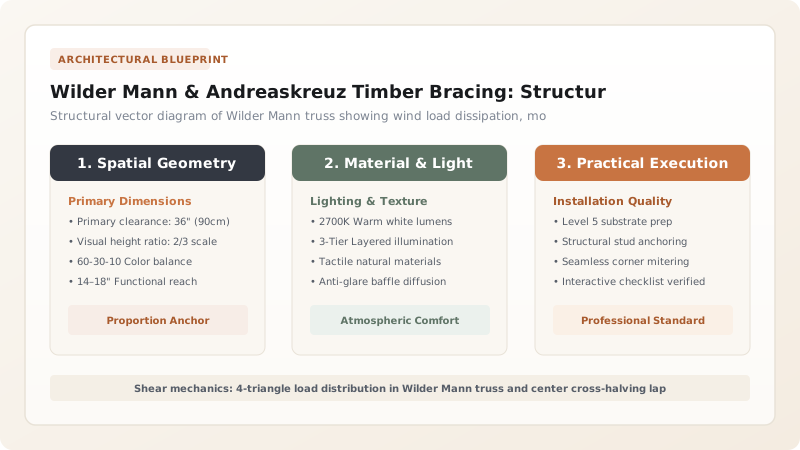
German Fachwerk structural integrity relies on rigid triangulation provided by specialized timber bracing assemblies. The Wilder Mann (or Mann-Figur) combines a central post with upward-stretching 'arm' struts and downward 'foot' braces, creating four interlocked triangles that resist both lateral wind shear and vertical floor loads. For window parapets and corner bays, the Andreaskreuz (St. Andrew's Cross) utilizes two intersecting diagonal timbers joined via center cross-halving lap joints (Kreuzblatt) secured by oak trunnels, converting racking forces into compressive axial thrust directed into the main sill beam.
At a Glance: Key Takeaways
- Cross-Brace Joinery: Cross-halving lap joint (Halbes Kreuzblatt) with center trunnel
- Diagonal Angle Range: 45 to 60 degrees for optimal shear-to-compression load resolution
- Primary Shear System: Wilder Mann anthropomorphic 5-member timber truss
- Structural Oak Section: 160x140 mm to 200x180 mm dense European oak heartwood
The Physics of Triangulation: Resisting Wind Racking Forces
A rectangular timber frame connected solely with mortise-and-tenon joints will easily collapse under horizontal wind loads; the right-angle joints act as rotational hinges under lateral torque. To create a rigid structure, German master carpenters implemented the fundamental geometric law that only a triangle has an immutable shape.
By inserting diagonal braces across the rectangular bays, they transformed flexible rectangles into unyielding triangles. When gale-force winds strike a Fachwerk building, the wind pressure is transferred from the vertical posts into the diagonal braces as pure axial compression or tension. Because oak has immense compressive strength parallel to the grain (>50 MPa), the braces absorb the lateral energy and channel it directly into the massive foundation sill (Schwelle).
Anatomy of the Wilder Mann: Post, Arms, and Feet
The Wilder Mann (Mann-Figur) is the pinnacle of functional structural symbolism in timber framing. Structurally, it consists of five primary timber components:
- Bundständer (Torso): The heavy central vertical post that carries floor joist loads from above.
- Kopfstreben (Arms): Two upward-diagonal braces that mortise into the upper wall plate (Rähm), resisting upper-story horizontal sway.
- Fußstreben (Legs): Two downward-diagonal braces that mortise into the bottom sill (Schwelle), preventing base shear sliding.
Together, these members subdivide a single large rectangular wall bay into four rigid triangular sub-frames. The 'arms' and 'legs' typically meet the central post at angles between 45 and 55 degrees—the mathematical sweet spot that resolves both vertical gravity vectors and horizontal wind vectors with minimal tenon shear stress.
The Andreaskreuz: St. Andrew’s Cross and Halved Lap Joinery
The Andreaskreuz (X-brace) is most frequently deployed in parapet zones directly beneath window openings (Brüstungsfelder). Unlike simple diagonal braces, the two intersecting timbers must cross one another in the same vertical plane without compromising structural thickness.
Carpenters achieved this through the cross-halving lap joint (Halbes Kreuzblatt). Half the thickness of each diagonal is meticulously sawn and chiseled away at the intersection. When pressed together, the two faces lie perfectly flush with the wall surface. A single octagonal oak trunnel is driven through the center of the lap to prevent outward buckling under severe seismic or gale-force compression loads.
Heritage Conservation: Splicing Rotted Braces and Tenon Restoration
Because diagonal braces conduct rainwater downward toward the bottom sill plate, the lower tenons of 'Fußstreben' (the legs of the Wilder Mann) are the most rot-vulnerable points in a historic Fachwerk wall. Centuries of moisture runoff can turn the lower tenon and sill mortise into rotted compost.
Conservators restore these joints using traditional dutchman prosthetic splices. The damaged lower foot of the brace is sawn off along a 3:1 under-squinted scarf angle. A matching piece of dry, 200-year-old salvage oak is hand-carved to recreate the original tenon, glued with resorcinol or polyurethane adhesive, and secured with replacement oak trunnels, preserving the historic timber above.
German Fachwerk Bracing Systems & Engineering Performance
Use this reference table to calculate exact physical dimensions, ratios, and specifications before purchasing:
| Bracing Type | Primary Structural Zone | Mechanical Function | Critical Joinery Interface | Typical Dimensions (mm) |
|---|---|---|---|---|
| Wilder Mann (Mann-Figur) | Main facade corner & center bents | Primary wind shear & vertical load transfer | Housed mortise-and-tenon with 50mm relish | 180 x 160 oak balks |
| Andreaskreuz (St. Andrew's Cross) | Window parapets (Brüstung) | Prevents parallelogram racking below sills | Cross-halving lap (Kreuzblatt) with trunnel | 140 x 120 oak diagonals |
| K-Strebe (K-Brace) | Intermediate partition wall bays | Resists asymmetrical seismic lateral racking | Angled tenons notched into intermediate rail | 160 x 140 oak struts |
| Kopfband (Knee Brace) | Upper post-to-plate junctions | Stabilizes cantilever jetty bressummers | Tapered draw-bored tenon with wedge lock | 120 x 100 curved oak |
Practical Constraints
Every successful decoration project must account for physical and environmental constraints:
Decentered Building Settlement Causing Asymmetric Tension Loads
Ground settlement pulls mortise tenons partially out of their sockets, creating loose joints and water ingress channels. Solution: Re-pin slipped joints with oversized replacement oak trunnels after leveling sills with temporary hydraulic jacking.
Interference Between Diagonal Braces and Modern Window Placement
Modern building codes or renovations often attempt to cut through structural braces to install oversized daylight windows. Solution: Preserve 100% of primary Wilder Mann members; redesign interior spaces around historic bay modules to prevent framing failure.
Execution Blueprint & Craftsmanship Sequence
Execute this professional sequence to achieve flawless results without backtracking:
Bay Layout and Angle Calculation
Establish the 50-degree diagonal intersection line on the framing floor; scribe cut lines on the Bundständer and sill plate.
Mortise Chiseling in Posts and Sills
Chisel 40mm-wide mortises into the central post and bottom sill; cut angled housing shoulders to support brace compressive thrust.
Wilder Mann Tenon Shaping and Draw-Bore Boring
Saw tenons on the ends of the diagonal arm and leg timbers; bore 22mm trunnel holes with a 3mm draw-bore offset toward the shoulder.
Andreaskreuz Halved Lap Joint Cutting
Mark the center intersection of crossing diagonals; saw shoulders to 50% timber depth; chisel out waste to create a snug lap joint.
Dry-Fit Assembly and Diagonal Verification
Assemble the entire braced bay on the framing floor; verify that opposite corner diagonals are equal within 2mm tolerance.
Trunnel Pinning and Framing Erection
Raise the braced bent into vertical position; drive tapered octagonal oak pegs into all draw-bore holes; drive center Andreaskreuz trunnel.
Common Mistakes & Countermeasures
Avoid these costly errors that compromise aesthetics, ergonomics, and budget:
Omitting the Housed Shoulder on Diagonal Brace Mortises
Cutting Andreaskreuz Center Halving Joints Too Loose
Project Execution Checklist
Track your physical progress. Checkboxes persist automatically on this device:
Frequently Asked Questions
Can an Andreaskreuz be constructed without the center cross-halving joint?
No. If one timber were simply cut into two separate pieces and tenoned into the sides of the continuous diagonal, the interrupted member would lose 70% of its axial compressive strength and fail under buckling. The halved lap joint preserves structural continuity across both crossing members.
Why are some Wilder Mann figures carved with curved legs and arms?
In Franconian and Thuringian Baroque Fachwerk, carpenters deliberately selected naturally curved oak branches (compass timbers) for the braces. Beyond artistic elegance, the curved timber has continuous, unbroken wood grain following the contour of the curve, providing superior resilience against shock loads compared to straight-sawn lumber.
What is the difference between a Wilder Mann and a simple K-brace?
A K-brace consists of a single vertical post with two diagonals that meet at its midpoint forming the letter 'K'. The Wilder Mann is a double-ended symmetrical system with both upper arms (Kopfstreben) and lower feet (Fußstreben) radiating from the central post, providing four-way triangulation and superior structural redundancy.
How do you test if a historic oak trunnel in a brace has failed?
Conservators lightly tap the head of the oak peg with a brass testing hammer. A solid, healthy trunnel produces a crisp, high-pitched ring, while a sheared, rotted, or loose peg produces a dull, hollow thud and will exhibit hairline perimeter gaps around the hole.


