
In German half-timbered architecture, the jetty bressummer beam (Schwelle / Brustriegel) and corner posts (Eckständer) serve as the primary focus for monumental relief carving. The signature motif of the Lower Saxon and Weser Renaissance styles is the Fächerrosette (fan rosette or sunburst)—a semicircular solar emblem carved with 12 to 24 radiating fluted segments symbolizing divine light and cosmic order. Master carvers paired these sunbursts with twisted rope moldings (Taustab), dentil friezes, and deeply incised Gothic-script house blessings (Hausinschriften) finished in historical mineral pigments (iron oxide red, gold leaf, and bone black).
At a Glance: Key Takeaways
- Carving Substrate: Dense, quarter-sawn European Oak heartwood (Quercus robur)
- Primary Carving Chisels: Deep gouges (Sweep 7-9), V-parting chisels, curved spoon gouges
- Signature Motif: Fächerrosette (Semicircular radiating fan rosette / sunburst)
- Traditional Pigments: Linseed-bound iron oxide red, lead white, vine black, 23.75kt gold leaf
The Fächerrosette: Geometry and Solar Symbolism
Originating during the transition from late Gothic to the Weser Renaissance in the 16th century, the Fächerrosette (fan rosette) became the definitive decorative emblem of German Fachwerk architecture across Lower Saxony and Hesse. Carved into the cantilevered ends of floor joists and across the horizontal face of bressummer sills, the motif represents the rising sun.
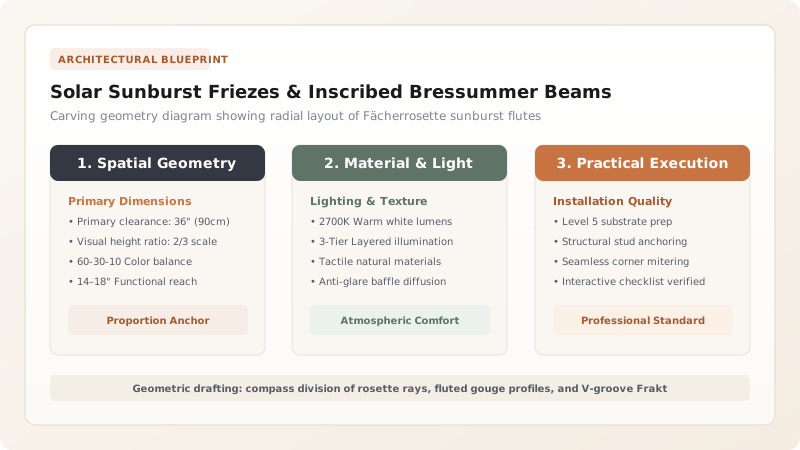
A master carver laid out the rosette using compasses and dividers. The perimeter semicircular arc was divided into an odd number of segments (typically 13, 17, or 21 rays). Each radiating ray is carved as a concave flute flanked by convex beads, creating dramatic high-contrast chiaroscuro shadows when illuminated by raking sunlight across the facade.
Architectural Moldings: Taustab, Schiffskehlen, and Dentils
Surrounding the solar rosettes, horizontal beams were carved with elaborate continuous friezes. The most iconic of these is the Taustab (ship's cable or twisted rope molding), symbolizing maritime trade connections and domestic unity. The rope spirals were chiseled with double-curved relief cuts that give the illusion of real coiled hemp fibers.
Along the lower edge of the bressummer, carpenters cut the Schiffskehle (ship’s keel cove)—a wide, hollow scotia molding punctuated by carved rosettes or acanthus leaves. Above this, rhythmic dentil bands (Zahnfriese) and egg-and-dart moldings created classical Renaissance horizontal articulation, visually breaking the massive heavy timber balks into delicate linear bands.
Inscribed House Blessings (Hausinschriften) and Calligraphy
A German Fachwerk house is a literate building. Deeply carved into the center of the main bressummer beam is the Hausinschrift (house blessing). Incised in Gothic minuscule or monumental Fraktur script, these inscriptions follow a standardized cultural formula:
- The Divine Invocation: 'Mit Gott angefangen, durch Ihn vollendet' (Begun with God, through Him completed).
- The Builder and Date: The names of the house builder (Bauherr), his wife, the master carpenter (Zimmermeister), and the completion date.
- The Apotropaic Curse/Blessing: Prayers protecting the timber dwelling from catastrophic urban fires, lightning, plague, and envious neighbors.
The letters are incised with sharp 60-degree V-grooves using straight parting tools, ensuring legibility from the cobblestone street below.
Historical Polychromy: Mineral Pigments and Linseed Oil Binders
Historically, Fachwerk carvings were never left as raw, unfinished wood. Master painters (Faßmaler) highlighted the carved reliefs with vibrant, weather-resistant mineral paints bound in pure cold-pressed linseed oil. The palette was strictly derived from natural earth and mineral pigments:
Deep vermilion and ochre were formulated from pulverized iron oxides; white was derived from carbonate of lead; black came from calcined vine charcoal; and blues were sourced from azurite or smalt. The central rosettes and Gothic initials were frequently illuminated with 23.75-karat double-weight gold leaf applied over a red oil bole sizing, ensuring that the solar symbols gleamed brightly even on overcast North German winter days.
German Fachwerk Decorative Carving & Polychromy Guide
Use this reference table to calculate exact physical dimensions, ratios, and specifications before purchasing:
| Decorative Element | Traditional Tool Specification | Carving Depth / Profile | Authentic Pigment / Finish | Symbolic Significance |
|---|---|---|---|---|
| Fächerrosette (Sunburst) | No. 7 sweep gouge (25mm) & V-tool | 18-25 mm deep hollow flutes | Iron oxide red background, gilded rays | Solar vitality, life force, divine blessing |
| Taustab (Twisted Rope) | No. 5 curved gouge & riffler file | 12 mm continuous helical undercut | Raw umber & golden yellow ochre | Maritime prosperity, strength, family bond |
| Schiffskehle (Keel Cove) | Broad hollowing adze & radius plane | 40 mm wide concave cove molding | Bone black with white bead highlights | Safe harbor, structural stability |
| Hausinschrift (Fraktur Text) | Straight 60-degree V-parting chisel | 6-8 mm crisp V-groove lettering | White lead lettering on black ground | Civic record, fire protection prayer |
Practical Constraints
Every successful decoration project must account for physical and environmental constraints:
Extreme Timber Hardness of Century-Old Seasoned European Oak
Seasoned oak heartwood resists standard woodcarving gouges, causing edge chipping and craftsman hand strain. Solution: Carve beams while timber is still semi-green, or soften seasoned oak surfaces with damp hot-towel poultices prior to chiseling.
Atmospheric Sulfur and Acid Rain Deteriorating Historical Pigments
Industrial pollutants turn historic lead-white and azurite blue paints into dirty black sulfates within years. Solution: Seal restored paint layers with pure non-yellowing stand oil and microcrystalline wax to create a barrier against acid rain.
Execution Blueprint & Craftsmanship Sequence
Execute this professional sequence to achieve flawless results without backtracking:
Quarter-Sawn Oak Beam Preparation
Dress the bressummer face with smoothing planes to a dead-flat surface; verify zero knots across carving zones.
Geometric Compass Layout and Scribing
Strike centerlines; swing semicircular perimeter arcs; step off odd-numbered ray divisions using proportional dividers.
Rosette Flute Gouging and Hollow Relief
Gouge each radiating ray with a No. 7 sweep chisel; taper the flute toward the hub, undercutting ray edges for shadow depth.
Taustab Rope Helical Undercutting
Saw diagonal helical guide kerfs across the molding bead; round the rope twists with curved rasp and fine gouges.
Fraktur House Blessing Letter Carving
Transfer calligraphic text via carbon paper; carve crisp V-grooves using razor-sharp parting tools, deepening letter terminals.
Linseed Oil Priming and Polychrome Painting
Prime carved oak with boiled linseed oil; apply mineral pigments in multiple thin glazes; water-gild rosette tips with gold leaf.
Common Mistakes & Countermeasures
Avoid these costly errors that compromise aesthetics, ergonomics, and budget:
Carving Relief into Slabs Containing Unstable Pith or Heart-Rays
Using Synthetic Acrylic Paint to Retouch Historic Fachwerk Carvings
Project Execution Checklist
Track your physical progress. Checkboxes persist automatically on this device:
Frequently Asked Questions
Why did Renaissance carvers choose fan rosettes over other shapes?
The semicircular fan rosette (Fächerrosette) perfectly harmonized with the rectangular proportions of horizontal beams and jetty joist ends. Because it expands outward and upward from a single focal anchor point, it visually expressed the architectural transfer of loads radiating through the cantilevered jetty.
How were the Gothic letters carved so cleanly into rock-hard oak?
Carvers used specialized parting chisels (Geißfuß) honed to an acute 20-degree micro-bevel. The artisan makes two diagonal incisions that meet at the bottom of the V-groove, allowing the central wood chip to pop out cleanly without bruising the crisp surface edges of the letter.
Did the colors on Fachwerk carvings have specific symbolic meanings?
Yes. Red (iron oxide) symbolized life, protection, and the blood of Christ; gold represented divine celestial glory and wealth; white (lead carbonate) signified purity and truth; and black (soot) provided solemn contrast and legibility for sacred inscriptions.
How often does the paint on historic bressummer carvings need renewal?
Authentic mineral pigments bound in cold-pressed linseed oil do not peel or blister. They slowly weather via gradual chalking. In normal northern European climates, a well-formulated linseed paint system only requires a light wipe with boiled linseed oil every 5 to 7 years to restore rich chromatic saturation.


