
Cast lead came ornaments, solder joint dynamics, and cylinder glass cutting form the artisanal core of authentic Georgian fanlight fabrication. To achieve neoclassical delicacy without brittle failure, master smiths cast detailed ornamental motifs—such as anthemion palmettes, drapery swags, classical urns, and faceted drops—in carved bronze chill molds using soft lead alloys. These ornaments were soldered over wrought-iron armature ribs using 60/40 tin-lead solder applied with electric or charcoal-heated copper soldering irons. Hand-blown cylinder glass and crown glass rondels are hand-scribed with natural diamond cutters along curved timber templates, snapped with notched pliers, and bedded into pure linseed oil-whiting putty within the lead came channels, creating a waterproof, flexible glazed screen that withstands centuries of atmospheric weathering.
At a Glance: Key Takeaways
- Chill Mold Lead Casting: 99.5% pure refined lead poured into pre-heated two-part bronze or soapstone molds at 340°C.
- Came Section Profiles: H-shaped, U-shaped, and ornamental heart-profile lead cames drawn through hand-cranked glazing mills.
- Eutectic Soldering Dynamics: 60% tin / 40% lead alloy solder melting at 183°C, bonding came joints without melting host lead.
- Tallow & Stearin Flux: Natural non-corrosive organic flux preventing lead oxidation during iron contact soldering.
- Mouth-Blown Cylinder Glass: Hand-blown glass featuring subtle ream marks, wavy refractions, and microscopic air seeds.
- Diamond Scribing Protocol: Natural industrial diamond point held at 60° cutting curved glass templates with zero edge chipping.
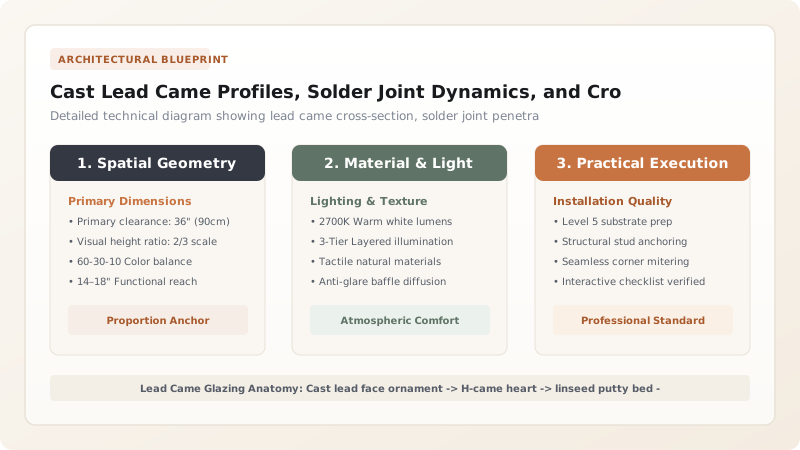
1. Bronze Chill Molds and Lead Ornament Casting
Lead was the miracle material of the late Georgian architectural metalworker. Highly ductile, melting at a relatively low temperature ($327^\circ\text{C}$), and completely immune to atmospheric rust, lead could be cast into razor-sharp sculptural relief that iron could never match.
Artisans carved high-relief positive models in boxwood, from which two-part bronze or fine-grained soapstone molds were cast. Molten lead—often alloyed with 1% to 2% antimony to increase hardness and sharpness of detail—was poured into the pre-heated mold at $340^\circ\text{C}$. The chilled mold instantly solidified the metal, producing crisp, classical Greek urns, husks, rosettes, and drops with rear attachment tabs or slotted channels designed to clasp around structural iron glazing spokes.
2. Came Drawing and Solder Joint Metallurgy
Lead cames for glazing were produced by casting a thick lead bar (ingot) and passing it repeatedly through a hand-cranked came mill (tire-plomb). Hardened steel wheels squeezed the soft lead into precise H-section or U-section channels with grooved internal hearts that held glazing putty.
Soldering lead requires extreme metallurgical control: pure lead melts at $327^\circ\text{C}$, while standard tin-lead solder melts at $183^\circ\text{C}$. If a soldering iron is too hot, it will melt through the delicate host lead came in a fraction of a second, destroying hours of handwork:
- Eutectic 60/40 Solder: Glaziers utilize a 60% tin / 40% lead alloy, which has a sharp melting point and excellent capillary flow.
- Stearin and Tallow Flux: Liquid acid fluxes are strictly prohibited because they corrode lead over time. Artisans rub joints with solid beef tallow or stearin wax candles. The wax melts ahead of the copper iron, stripping lead oxide films without leaving toxic residues.
- Quick Tacking: The hot copper bit touches the fluxed joint for only 1.5 seconds—just long enough for solder to flow and form a smooth, rounded meniscus puddle bonding the intersecting cames.
3. Hand-Blown Cylinder Glass Cutting and Whiting Putty Bedding
Mouth-blown cylinder glass (manufactured by blowing a giant hollow glass cylinder, cutting off both ends, slicing it down the side, and flattening it on an oven hearth) has a distinctive, organic optical character. It exhibits gentle waves (ream) and trapped elongated air bubbles (seeds).
Cutting curved fanlight panes from this fragile 2mm glass requires a steady hand. The artisan lays the glass over a stiff cardboard template cut from the came opening, running a natural diamond-tipped stylus along the curved perimeter with a single, continuous, light stroke. A gentle tap from underneath snaps the curve cleanly. Panes are bedded into traditional linseed oil whiting putty (pure chalk calcium carbonate mixed with raw linseed oil). The flexible lead came flanges are burnished tight against the glass face using a horn or boxwood bone folder, sealing the fanlight against torrential Atlantic driving rain.
Glazing Came Alloys, Solder Specifications, and Glass Typologies
Use this reference table to calculate exact physical dimensions, ratios, and specifications before purchasing:
| Process Component | Material Composition | Melting / Processing Temp | Physical Role | Inspection Benchmark |
|---|---|---|---|---|
| Cast Ornaments | 98% Lead + 2% Antimony alloy | 340°C pour temperature | Acanthus, urns, drops in high relief | Zero cold-shuts; sharp mold facet relief |
| H-Section Glazing Came | Pure refined milled lead | Cold-drawn in tooth mill | Holds glass panes and structural putty | Even 1.5mm leaf width with milled grip teeth |
| Assembly Solder | 60% Tin / 40% Lead eutectic | 183°C melting point | Bonds came intersections and lead rosettes | Bright silver rounded fillet puddle |
| Soldering Flux | Pure refined stearin wax / tallow | Melts at 55°C | De-oxidizes lead surface instantly | Leaves zero corrosive acid residue |
| Historic Glazing Glass | Mouth-blown cylinder glass (2mm) | Cut at ambient room temp | Refracts daylight with wavy antique ream | Free of modern flat float glass reflections |
| Glazing Bedding Putty | Chalk whiting + raw linseed oil | Applied at room temp | Waterproofs came channel; cushions glass | Remains flexible for 20+ years under lead |
Practical Constraints
Every successful decoration project must account for physical and environmental constraints:
Lead Toxicity Safety Protocols
Cylinder Glass Availability
Step-by-Step Casting, Soldering, and Glazing Protocol for Lead Fanlights
Execute this professional sequence to achieve flawless results without backtracking:
Bronze Mold Preheating and Dressing
Preheat two-part bronze chill mold to 150°C; dust mold cavities with talcum powder release agent to prevent molten lead sticking.
Lead-Antimony Alloy Pouring
Melt lead with 2% antimony in cast-iron ladle to 340°C; pour in a single continuous stream into mold sprue; de-mold after 30 seconds.
Lead Came Milling and Stretching
Pass lead ingots through came mill to produce 8mm H-profile cames; stretch came 3% to align crystalline grain and eliminate kinks.
Came Layout on Full-Scale Cartoon
Pin cames to wooden cartoon board over horseshoe nails, forming radial spokes and swagged loops with lead bending irons.
Stearin Fluxing and Joint Soldering
Rub all came intersections with stearin wax; solder joints with 60/40 solder using clean 100W copper soldering iron (1.5-second touch).
Diamond Scribing Cylinder Glass
Scribe hand-blown cylinder glass using natural diamond stylus along cardboard templates; tap undersides to run score lines cleanly.
Linseed Putty Packing and Burnishing
Force soft linseed whiting putty into came channels; insert glass panes; press lead leaves down with boxwood burnisher; clean with whiting powder.
Common Mistakes & Countermeasures
Avoid these costly errors that compromise aesthetics, ergonomics, and budget:
Using modern acid-core electrical solder or zinc-chloride liquid fluxes on lead cames
Holding the soldering iron on a lead came joint for more than 2 seconds
Setting cylinder glass dry into lead cames without traditional linseed whiting putty
Project Execution Checklist
Track your physical progress. Checkboxes persist automatically on this device:
Frequently Asked Questions
Why did Georgian craftsmen use lead instead of wood for delicate fanlight tracery?
Lead can be cast into microscopic classical relief (leaves, husks, urns) that would split or rot if carved from wood. Furthermore, lead is completely weatherproof, rust-proof, and flexible, allowing it to absorb the severe shock of front doors slamming shut without cracking the fragile glass.
How do you identify authentic mouth-blown cylinder glass from modern reproduction glass?
Authentic mouth-blown cylinder glass displays subtle parallel undulating ripples (ream lines) created when the glass cylinder was flattened in the annealing oven, along with tiny, elongated air bubbles (seeds) aligned in the direction of the glass draw. Modern machine glass is dead flat with zero bubble character.
Can historic lead cames be repaired if they are bent or torn?
Yes. Master stained glass and fanlight conservators can straighten bent cames using specialized lead spatulas. Torn joints are cleaned of old putty, re-fluxed with stearin, and bridged with fresh 60/40 solder. Missing cast ornaments are recast from silicone impressions of surviving original motifs.


