
Sand-cast brass door furniture represents the monumental hardware suite of the classic British and Irish Georgian townhouse entrance. Cast from dense high-copper brass (70% copper, 30% zinc) in green sand foundry molds, authentic Georgian fittings are massive, thick-walled, and heavily weighted. Rather than mounting doorknobs near the latch edge, Georgian doors featured a monumental sand-cast octagonal or beehive reeded knob bolted through the exact geometric center of the door's central timber rail, used strictly as a pull handle. Security and latching were provided by heavy surface-mounted box rim locks featuring internal steel lever wards, sliding solid brass deadbolts, and cast brass night latches. Entrance doors were completed by heavy Doctor's knockers, reeded brass cylinder escutcheons, and barrel letter plates, hand-burnished to an unlacquered golden luster.
At a Glance: Key Takeaways
- Foundry Metallurgy: 70/30 alpha-brass sand-cast in fine silica sand molds, producing dense, porosity-free hardware.
- Center Octagonal Pull Knobs: 75–100mm wide octagonal knobs with stepped bases, mounted dead-center on the door leaf.
- Heavy Box Rim Locks: 200x125mm surface-mounted cast iron or brass lock boxes with hand-cut sliding brass deadbolts.
- Doctor's Door Knocker: Monumental cast brass pendulum knocker (300mm long, weighing 1.5–2.5 kg) striking a brass stud.
- Reeded Beehive & Escutcheon Detailing: Concentric reeded lathe-turned banding providing tactile grip and neoclassical ornament.
- Unlacquered Living Finish: Natural raw brass developing an organic, deep golden-bronze ambient patina over decades of hand contact.
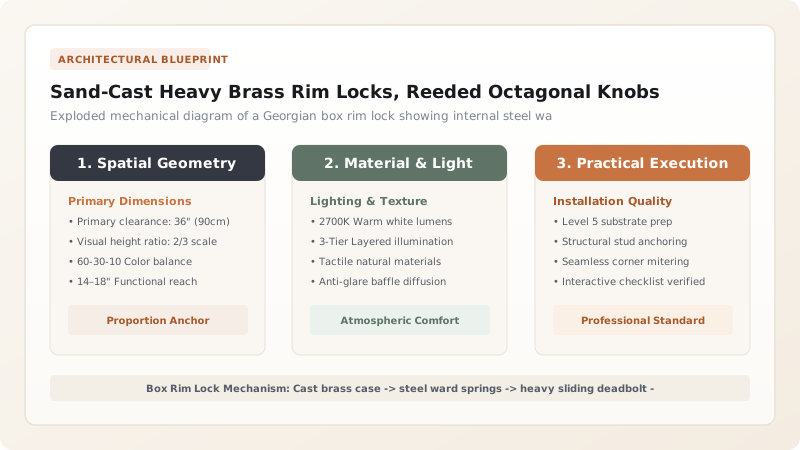
1. Birmingham Foundry Heritage: Green-Sand Brass Casting
During the 18th century, Birmingham, England, emerged as the brassware capital of the Western world (known as the 'toyshop of Europe'). Craftsmen perfected green-sand casting to produce monumental architectural hardware that was virtually indestructible.
Patternmakers carved mahogany positive models of knockers, knobs, and rim lock cases. These patterns were pressed into two-part cast-iron flasks (the cope and drag) packed with 'green sand'—moist fine-grained silica sand blended with 8% bentonite clay and coal dust. Molten 70/30 brass (70% copper, 30% zinc) was poured at $1050^\circ\text{C}$. The slow cooling in sand produced dense, fine-grained metal with thick cross-sections (often 5 to 8mm wall thicknesses) that possessed substantial hand-feel, resonance, and mechanical durability.
2. Center Octagonal Knobs, Beehive Turnery, and Door Ergonomics
The arrangement of Georgian door furniture is radically different from modern doors. Because entrance doors were heavy 6-panel solid hardwood assemblies (often 55mm to 65mm thick), opening the door required a substantial hand grip:
- Center Octagonal Knob: Positioned in the exact optical center of the central door rail (typically 900–1000mm from the floor), the octagonal knob is 75mm to 95mm across, featuring faceted sides and a stepped rose base. It does not rotate to latch the door; rather, a heavy 12mm threaded steel spindle passes through the door core, locked from the rear with a massive iron plate and square nut.
- Beehive Reeded Knobs: Secondary interior knobs turned on foot-lathes with concentric circular reeding (resembling a skep beehive). The reeding is not purely ornamental: it provides high friction for sweaty or gloved hands.
3. The Mechanical Architecture of Rim Locks and Doctor's Knockers
Security was provided by monumental box rim locks surface-mounted on the interior face of the door, accompanied by external brass escutcheons and knockers:
The rim lock body (measuring typically 200x125mm) was cast in heavy brass or black-japanned cast iron with brass fittings. Internally, a hand-forged steel spring operated a sliding brass deadbolt thrown by a heavy decorative brass bit key. A secondary sliding brass privacy bolt on the interior allowed nighttime deadlocking without a key.
On the exterior door face hung the iconic Doctor’s Knocker. Measuring up to 300mm in length and weighing over 2 kilograms, this massive pendulum knocker struck a solid brass anvil stud bolted through the door. The loud, resonant sonic crack reverberated up four stories of townhouse staircases, ensuring that sleepy household servants or night porters were awakened immediately.
Georgian Entrance Brassware Suite Dimensions, Weights, and Placement
Use this reference table to calculate exact physical dimensions, ratios, and specifications before purchasing:
| Hardware Element | Material & Metallurgy | Standard Dimensions | Door Mounting Location | Primary Functional Mechanism |
|---|---|---|---|---|
| Center Octagonal Knob | Solid sand-cast 70/30 brass | 85mm wide x 85mm projection | Dead center of mid-rail (1000mm) | Through-bolted heavy door pull handle |
| Doctor's Knocker | Heavy cast brass pendulum | 280mm length; 2.2 kg weight | Top center stile (1500mm eye-level) | Acoustic percussive summons onto brass anvil stud |
| Box Rim Lock | Sand-cast brass case + steel springs | 200mm wide x 125mm high x 30mm | Interior stile edge at latch height | Double-throw deadbolt + sliding interior night catch |
| Reeded Key Escutcheon | Cast brass with swinging drop cover | 55mm diameter x 8mm profile | Exterior face over rim lock keyway | Prevents draft wind and keyhole inspection |
| Barrel Letter Plate | Heavy cast brass with spring flap | 250mm wide x 75mm aperture | Bottom rail or mid-rail center | Receives post mail with internal draft seal |
| Lion's Head Knocker | Cast brass sculptural relief | 220mm high x 140mm wide | Center upper panel | Alternative aristocratic heraldic door knocker |
Practical Constraints
Every successful decoration project must account for physical and environmental constraints:
Door Leaf Core Thickness Demands
Routine Hand Polishing Discipline
Mounting Protocol for Heavy Georgian Sand-Cast Brass Door Furniture
Execute this professional sequence to achieve flawless results without backtracking:
Door Leaf Geometry and Optical Center Layout
Determine precise geometric and optical center of the door's horizontal lock rail using crossing diagonals; mark pilot center-punch.
Center Knob Spindle Through-Boring
Bore 14mm perpendicular hole through solid door leaf using auger bit; counter-bore rear face 35mm to receive flush recessed iron back-nut.
Mounting Center Octagonal Pull Knob
Insert heavy steel threaded spindle from front; seat brass stepped rose; tighten heavy square nut on rear with socket wrench until rigid.
Doctor's Knocker Eye-Level Alignment
Position Doctor's knocker at 1,500mm eye-level on top central stile; bore through-holes for upper hinge bolt and lower strike anvil stud.
Interior Rim Lock Case Fitting
Position rim lock box flush with door edge; scribe keyhole and spindle holes; drill keyway; screw rim lock case using slotted brass screws.
Jamb Keep (Box Striker) Mortising
Mortise timber door jamb to receive the heavy brass rim lock keep; align deadbolt and latch clearances with zero binding during door closing.
Exterior Escutcheon and Letter Plate Fixing
Mount reeded brass keyhole escutcheon with brass dome-head screws; bolt spring-loaded letter plate to mid-rail with through-bolts.
Unlacquered Hand Burnishing
Polish all installed brassware with non-abrasive metal cream (Brasso) and micro-cloth, leaving natural unlacquered golden luster.
Common Mistakes & Countermeasures
Avoid these costly errors that compromise aesthetics, ergonomics, and budget:
Using modern stamped or hollow brass-plated steel door hardware on historic Georgian doors
Coating authentic brass hardware with clear polyurethane or spray lacquer
Fastening heavy rim locks with modern Phillips-head zinc screws
Project Execution Checklist
Track your physical progress. Checkboxes persist automatically on this device:
Frequently Asked Questions
Why is it called a 'Doctor's Knocker'?
In Georgian and Victorian Britain, physicians and surgeons mounted these particularly large, heavy, loud knockers on their front doors so night callers in medical emergencies (or messenger boys) could summon them quickly in the middle of the night without waking the entire street.
What is an 'unlacquered living finish' on brass door hardware?
A living finish means the brass has zero artificial clear-coat lacquer or plastic sealant. As people touch the brass and it is exposed to atmospheric oxygen, the metal naturally tarnishes into a warm, rich, antique bronze-gold patina. Areas touched frequently remain gleaming gold, while recesses darken, creating beautiful natural contrast.
Can an antique box rim lock meet modern home insurance security standards?
Historic rim locks have simple lever wards that do not meet modern British Standard BS3621 insurance requirements. Most Georgian townhouse owners maintain the historic rim lock for day-to-day use and aesthetics, but install an insurance-approved British Standard mortise deadlock or concealed night latch lower on the door.


