
Georgian fanlights, lead came glazing, and cast brass door furniture represent the architectural climax of British and Irish neoclassical townhouses from 1714 to 1830. Developed to illuminate dark entrance staircases before domestic gas lighting, the semi-circular or elliptical fanlight sits within an arched doorhead above a six-panel timber door. Innovated by Robert Adam and master London smiths, fanlights combined structural wrought iron or carved pine radial glazing bars with delicate, cast decorative lead cames (featuring urns, festoons, anthemion leaves, and teardrops) holding hand-blown cylinder or crown glass panes. Below, entrance doors were crowned with heavy sand-cast brass architectural hardware—including center-hung octagonal door knobs, cylinder rim locks, lion's head knockers, and reeded letter plates—burnished to a warm, reflective golden glow against deep Brunswick green or black oil-enameled door leaves.
At a Glance: Key Takeaways
- Entrance Hall Illumination: Engineered to project natural daylight deep into narrow Georgian townhouse entrance passages.
- Adam & Neoclassical Geometry: Graceful semi-circular, segmental, and elliptical arches featuring radiating sunburst and spider-web tracery.
- Composite Lead & Iron Tracery: Structural wrought-iron framing combined with soft, detailed cast lead cames soldered at intersections.
- Mouth-Blown Glass Typologies: Hand-blown cylinder glass and crown glass rondels displaying subtle waviness and seed bubbles.
- Sand-Cast Heavy Brassware: Solid 70/30 brass cast in green sand molds, featuring reeded octagonal knobs and precision rim locks.
- Doctor's Knockers & Rim Locks: Monumental cast brass knockers and exterior box rim locks with sliding brass deadbolts and lever keys.
In-Depth Guides in this Directory
Explore specialized subtopic blueprints, technical dimensions, and execution checklists:
Semi-Circular and Elliptical Fanlight Geometry, Adams Radiance, and Radial Glazing Bars
Mathematical and architectural drafting guide to semi-circular and elliptical Georgian fanlights: radial spoke geometry, Adams radiating sunbursts, and timber joinery.
Cast Lead Came Profiles, Solder Joint Dynamics, and Crown/Cylinder Glass Cutting
Technical metalworking and glazing guide to casting decorative lead came ornaments, low-temperature soldering, and hand-cutting mouth-blown cylinder glass for Georgian fanlights.
Sand-Cast Heavy Brass Rim Locks, Reeded Octagonal Knobs, and Doctor's Knockers
Architectural hardware guide to authentic Georgian entrance door furniture: sand-cast 70/30 brass, center octagonal pull knobs, heavy box rim locks, and doctor's knockers.
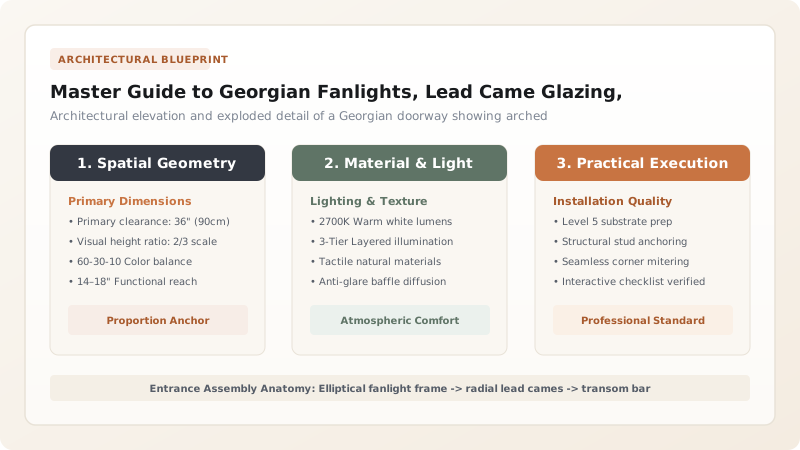
1. Lighting the Georgian Townhouse: The Architectural Necessity of the Fanlight
In 18th-century London, Edinburgh, and Dublin, urban population growth led to the development of narrow, deep terraced townhouses. Typically only three bays wide and extending back four rooms deep, the central entrance hallway and stair hall were plunged into near-total darkness during daylight hours.
Because interior tallow candles were smoky and expensive, architects seized upon the entrance doorhead as a primary daylight aperture. Early Georgian fanlights (circa 1720–1760) were simple semi-circular glazed transoms divided by thick wooden sash bars (astragals). However, with the rise of the neoclassical revolution spearheaded by Robert Adam in the 1770s, the fanlight was transformed into a delicate work of high art. Arches became wide elliptical and segmental curves; heavy wood was replaced by gossamer-thin wrought iron and cast lead, allowing maximum light transmission while presenting a magnificent neoclassical calling card to the street.
2. Composite Tracery: Wrought Iron Bones, Lead Skins, and Cylinder Glass
A common misconception is that Georgian fanlights are made either of solid wood or plain stained-glass lead. In reality, master architectural smiths developed an ingenious composite construction:
- Wrought-Iron Structural Skeleton: The main perimeter arch and radiating spokes were forged from slender flat or T-section wrought iron (typically 12x4mm), providing the structural stiffness needed to resist gale-force wind gusts and door slams without buckling.
- Cast Lead Decorative Cames: Soft lead was cast in bronze molds into intricate classical ornaments—urns, husks, rosettes, Greek acanthus, and drops. These lead castings were grooved on the reverse and soldered directly over the iron spokes with tin-lead solder.
- Mouth-Blown Cylinder Glass: Glaziers cut individual panes of mouth-blown cylinder glass (also called broad glass), embedding the wavy, seed-flecked glass into linseed oil putty against the lead cames. When morning sunlight struck the glass, the microscopic imperfections refracted light in dazzling crystalline patterns across the entrance floor.
3. Sand-Cast Brass Furniture: Rim Locks, Octagonal Knobs, and Knockers
Beneath the radiant fanlight, the six-panel timber entrance door was furnished with heavy, unlacquered sand-cast brass hardware that conveyed security, dignity, and civic standing:
Birmingham brass foundries produced monumental door furniture cast in 'green sand' (moist silica sand bound with clay). Key elements included:
- The Doctor’s Knocker: A massive solid brass pendulum knocker with a central ring or scroll, originally designed for easy gripping by carriage drivers seeking medical aid.
- Center-Hung Octagonal Knobs: Mounted in the exact optical center of the door leaf (rather than near the latch edge), used purely as a pull handle to swing the heavy 55mm thick hardwood door.
- Heavy Box Rim Locks: Surface-mounted on the interior face of the door, featuring hand-filed brass lock cases, sliding brass deadbolts, steel ward springs, and oversized decorative brass keyhole escutcheons.
Georgian Doorway Hardware and Glazing Typologies by Period
Use this reference table to calculate exact physical dimensions, ratios, and specifications before purchasing:
| Stylistic Period | Fanlight Head Geometry | Glazing Bar Material | Dominant Motifs | Brass Hardware Suite |
|---|---|---|---|---|
| Early Georgian (1714–1745) | Simple semi-circular arch | Molded white pine / oak (thick) | Square panes, plain radials | Wrought iron rim locks; small brass drop handles |
| Mid-Georgian / Palladian (1745–1770) | Semi-circular with rusticated stone | Slender pine with lead rosettes | Teardrop arches, interlace loops | Sand-cast brass rim lock; beehive reeded knobs |
| Adamesque / Late Georgian (1770–1800) | Elliptical or wide segmental | Wrought-iron spoke + cast lead cames | Anthemion leaves, urns, sunbursts, spiderwebs | Center octagonal knobs, lion's head knockers, cylinder escutcheons |
| Regency (1800–1830) | Segmental with Greek Revival accents | Cast iron or leaded zinc ribs | Greek keys, laurel swags, starbursts | Reeded reeded knobs, barrel letter plates, heavy night latches |
| Victorian Transition (1830+) | Flattened arch or rectangular transom | Machine-rolled cast iron or timber | Heavy geometric quadrants | Mortise latches, pressed brass plates, chrome coatings |
Practical Constraints
Every successful decoration project must account for physical and environmental constraints:
Complex Curved Glass Replacement
Lead Glazing Maintenance and Slumping
Restoration and Assembly Protocol for a Georgian Fanlight and Hardware
Execute this professional sequence to achieve flawless results without backtracking:
Opening Scribing and Arch Template Drafting
Scribe masonry brick arch with timber trammel; draft exact semi-circular or elliptical radius onto 1:1 plywood template board.
Wrought-Iron Backbone Forging
Forge outer curved frame and radial spokes from mild wrought iron; drill spoke intersections for mechanical rivet and wire tie-ins.
Cast Lead Came Dressing and Soldering
Cast decorative lead anthemion and husk cames in bronze molds; wrap around iron spokes; solder junctions with 60/40 tin-lead solder.
Hand-Blown Glass Cutting and Numbering
Scribe mouth-blown cylinder glass panes with diamond cutter, snapping curved segment panes to match individual came pockets with 1.5mm clearance.
Linseed Putty Bedding and Glazing
Bed glass into traditional chalk-linseed oil glazing putty; fold lead came flanges over glass perimeter, burnishing down with boxwood tools.
Door Timber Preparation and Painting
Paint 6-panel solid pine/mahogany door leaf with traditional dark Brunswick green or gloss black linseed oil enamel.
Sand-Cast Brass Center Knob Mounting
Locate optical center of mid-rail; bore 12mm through-hole; bolt solid brass octagonal knob using heavy rear iron back-nut.
Rim Lock and Doctor's Knocker Alignment
Mortise keyway; mount internal brass box rim lock; bolt heavy brass knocker through upper stile at 1,500mm eye-level datum.
Common Mistakes & Countermeasures
Avoid these costly errors that compromise aesthetics, ergonomics, and budget:
Replacing broken hand-blown cylinder glass with modern perfectly flat float glass
Lacquering solid cast brass Georgian door furniture with modern clear acrylic spray
Mounting the primary door pull knob near the edge of the door instead of the center
Project Execution Checklist
Track your physical progress. Checkboxes persist automatically on this device:
Frequently Asked Questions
Why is the large brass doorknob mounted in the center of a Georgian door instead of at the side?
Georgian aesthetics prioritized rigorous classical symmetry above all else. The massive center-hung octagonal knob served as a visual anchor and a heavy pull handle to swing the thick hardwood door open. The actual latching and locking were handled separately by a rim lock or night latch mounted near the edge.
What is the difference between cylinder glass and crown glass in fanlights?
Both are hand-blown antique glasses. Cylinder glass was made by blowing a large glass cylinder, cutting it lengthwise, and flattening it in an oven, resulting in gentle parallel ripples and elongated bubbles. Crown glass was made by spinning a molten globe into a flat disc, resulting in concentric circular waves and a central bullseye 'rondel'.
How do you restore tarnished, blackened antique Georgian brass hardware?
Boil the brass hardware in water with a drop of washing soda to soften old grease and paint. Clean with a soft brass wire brush, then polish by hand with rottenstone powder and mineral oil, followed by Brasso. Never use coarse sandpaper or bench grinders, which erase delicate hand-reeded cast details.


