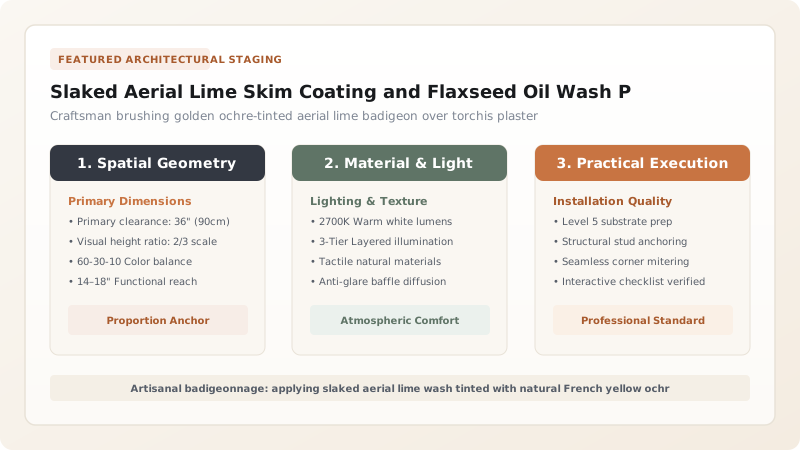
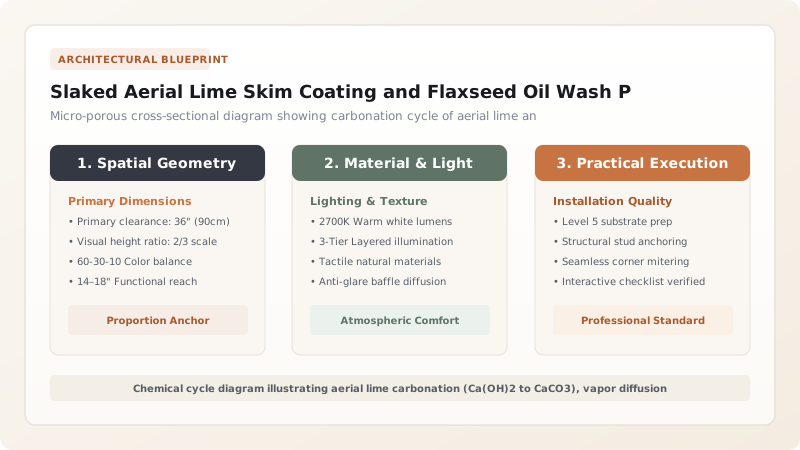
Slaked aerial lime skim coating and flaxseed oil wash protection represents the traditional exterior finishing system that preserves vulnerable earthen torchis half-timbered walls against driving rains. High-calcium non-hydraulic lime (chaux aérienne éteinte CL-90) is aged in water pits to produce a buttery putty, blended with sharp river sand, and applied in thin breathable renders over the keyed clay-straw substrate. The cured lime skin carbonizes with atmospheric CO2 into breathable calcium carbonate limestone. A final sacrificial application of raw, unrefined flaxseed oil (huile de lin) wash provides natural water-shedding hydro-repellency while preserving 100% vapor permeance.
At a Glance: Key Takeaways
- Lime Typology: Slaked Aerial Lime Putty (Chaux aérienne éteinte / EN 459-1 CL-90-S)
- Aggregate Matrix: Washed sharp siliceous river sand (0.5 mm to 2.0 mm grain size)
- Coating Layers: 10 mm corps d'enduit (leveling coat) + 3 mm badigeon (lime wash)
- Hydrophobic Treatment: Cold-pressed raw flaxseed / linseed oil wash (Huile de lin crue)
- Vapor Permeability: High breathability (vapor diffusion resistance factor µ < 10)
The Protective Shield: Why Torchis Requires Sacrificial Skin
A properly packed torchis infill of fat clay and wheat straw provides monumental thermal mass, excellent acoustic damping, and perfect hygroscopic humidity buffering. However, clay possesses one fatal vulnerability: it is non-hydraulic. If exposed to the relentless lashing rains and driving drizzle of the Atlantic maritime climate in Normandy and Brittany, liquid water will dissolve the colloidal clay bonds, washing away the mud and exposing the straw core to rot.
To protect this vulnerable earthen core, European vernacular builders developed a symbiotic exterior shield: slaked aerial lime render (l'enduit à la chaux aérienne). Applied in thin, sacrificial layers over the keyed clay substrate, lime plaster acts as a resilient mineral armor that stops driving rainwater while maintaining total vapor permeability, allowing moisture that enters the wall from internal domestic humidity to evaporate harmlessly into the sky.
The Chemistry of Chaux Aérienne: The Crystalline Calcite Cycle
The chemical vehicle of this protection is chaux aérienne (pure non-hydraulic lime, classified modernly as EN 459-1 CL-90). Produced by burning high-purity limestone (calcium carbonate, CaCO3) in wood-fired kilns at 900°C, the carbon dioxide is driven off to yield quicklime (calcium oxide, CaO). When violently slaked with water, it converts exothermically into calcium hydroxide putty (Ca(OH)2), which traditional masons age in wet subterranean pits for months or even years.
Unlike modern Portland cement or hydraulic lime (NHL), which cure rapidly through chemical reaction with water, aerial lime does not set underwater. It cures through carbonation: it slowly reabsorbs carbon dioxide (CO2) from the ambient atmosphere, converting back into pure crystalline calcium carbonate (limestone). This slow curing process yields a micro-crystalline matrix of microscopic interlocking calcite plates. The resulting plaster has an ultra-low modulus of elasticity, allowing it to flex with the seasonal expansion, contraction, and settlement of the oak timber frame without cracking or shearing away from the soft clay infill.
Application Technique: Corps d'Enduit and Ochre Badigeon
Applying aerial lime over torchis requires strict adherence to craft protocol. The bone-dry clay wall must be thoroughly wetted 24 hours in advance to reach a saturated surface-dry state; otherwise, the thirsty clay will instantly suck the water out of the fresh plaster, causing it to desiccate into powdery chalk. The mason applies a 10 mm leveling coat (corps d'enduit) composed of 1 part aged lime putty to 2.5 parts sharp river sand, pressing it firmly into the scored keys of the torchis and wood-floating it to an open, textured plane.
Once carbonated, the wall receives its aesthetic crown: badigeon (lime wash). Formulated from pure lime putty diluted with water to the consistency of whole milk, the wash is pigmented with lightfast, UV-immune natural earth minerals—such as French yellow and red ochres from the quarries of Roussillon. Applied with wide hog-bristle brushes in dynamic figure-eight sweeps, the badigeon imbues the facade with an exquisite, velvety, luminous texture that shifts subtly in tone between sunshine and rain.
Hydrophobic Armor: The Cold-Pressed Flaxseed Oil Wash
The final ancestral secret of Norman half-timbered weather defense is the flaxseed oil wash (traitement à l'huile de lin). While aerial lime is water-resistant, continuous torrential rain during coastal winter gales can saturate the outer millimeters of the plaster, increasing thermal conductivity and inviting frost damage.
To provide high-performance water repellency without ruining breathability, craftsmen apply a penetrating wash of cold-pressed, unrefined raw flaxseed oil (huile de lin crue) diluted with natural gum turpentine over the carbonated lime. The tiny polyunsaturated triglyceride molecules penetrate deep into the microscopic pores of the calcite crystals. As the oil oxidizes, it coats the interior pore walls with a hydrophobic film that causes liquid water droplets to bead up and roll off the facade, while leaving the pore centers open for continuous water vapor transmission—delivering a masterclass in vernacular green nanotechnology that has stood the test of centuries.
Exterior Protection for Earthen Torchis: Slaked Aerial Lime vs Modern Acrylic Render vs Silicate Paint
Use this reference table to calculate exact physical dimensions, ratios, and specifications before purchasing:
| Plaster / Coating System | Slaked Aerial Lime (Chaux CL-90) + Flaxseed Oil | Modern Synthetic Acrylic Render (RPE) | Potassium Silicate Mineral Paint |
|---|---|---|---|
| Vapor Permeance (Breathability) | Ultra-High (µ = 6–8); moisture evaporates effortlessly, keeping the internal timber frame bone-dry | Zero to Low (µ > 150); creates a vapor-tight plastic bubble that traps interior moisture | High (µ = 10–15); mineral-bonded silicate allows excellent vapor transmission |
| Substrate Elastic Compatibility | Exceptional; low elastic modulus accommodates seasonal timber swelling and clay flexing without cracking | Poor; high thermal expansion differentials cause peeling and blistering along timber edges | Moderate; rigid mineral bond can crack along dynamic oak-to-clay movement joints |
| Natural Biocidal Protection | High Natural Alkalinity (pH 12–13); destroys mold spores, lichen, and bacteria on contact | Zero Natural Alkalinity; requires toxic synthetic biocides that leach out into garden soil | High Alkalinity; excellent mold and fungal resistance without toxic synthetic chemicals |
| Aesthetic Luster & Color Depth | Exquisite; micro-crystalline calcite reflects light with velvety, vibrating luminescence | Flat, Plastic & Uniform; artificial synthetic sheen destroys historic architectural texture | Matte and Chalky; good natural look but lacks the velvety depth of genuine lime putty |
| Re-Coating & Maintenance | Effortless; sacrificial lime wash is renewed every 5–8 years with a quick brush application | Disastrous; failing acrylic cannot be patched; entire wall must be chemically stripped | Moderate; requires specialized silicate primers before re-coating |
Practical Constraints
Every successful decoration project must account for physical and environmental constraints:
Slow Atmospheric Carbonation Kinetics of Aerial Lime
Aerial lime does not set chemically with water; it hardens exclusively by absorbing atmospheric CO2, requiring weeks of frost-free curing. Mitigation: Schedule aerial lime rendering strictly between May and September, protecting fresh walls from direct driving rain and freezing winds.
Timber Bleed and Tannic Acid Staining on Fresh White Lime
High-tannin green oak timbers release dark brown tannic acid when wetted, which bleeds across fresh white lime renders. Mitigation: Mask timber faces with breathable tape, or celebrate the traditional regional aesthetic of tinted yellow and red ochre lime washes.
Execution Blueprint & Craftsmanship Sequence
Execute this professional sequence to achieve flawless results without backtracking:
Substrate Assessment and Cleaning
Inspect the cured torchis wall infill, verifying that the clay has dried completely (minimum 8 weeks). Brush away loose clay crumbs, straw whiskers, and dust using a stiff coir bristle broom.
Hydration Pre-Wetting
Spray the torchis substrate thoroughly with clean water using a low-pressure garden hose or pump sprayer 24 hours prior to plastering, repeating 2 hours before application until the clay is damp but free of standing surface water.
Basecoat Mortar Compounding
Blend 1 part high-calcium slaked lime putty (chaux aérienne éteinte CL-90-S aged at least 6 months) with 2.5 parts clean, washed sharp river sand (0.5 mm to 2.0 mm grain size), mixing without excess water to achieve a firm, workable mortar.
Leveling Coat Application (Corps d'Enduit)
Trowel the lime mortar firmly into the keyed torchis grooves using a steel float, pressing the paste deep into crevices to achieve a uniform 10 mm thickness. Level flush with the face of the oak framing timbers.
Wood-Float Compaction and Crystalline Keying
As the basecoat firms up (typically 3 to 6 hours post-application), rub the surface vigorously with a circular motion using a wooden float. This compacts the lime paste, closes shrinkage fissures, and leaves an open-pored sand texture.
Badigeon Lime Wash Formulation
Dilute pure lime putty with clean water to the consistency of whole milk (1 part lime putty to 3 parts water). Whisk in natural iron oxide earth pigments (such as French yellow ochre from Roussillon) and 2% casein or animal glue as a natural binder.
Brushwork Application (Badigeonnage)
Dampen the cured basecoat. Apply the badigeon using a wide hog-bristle whitewash brush in dynamic, overlapping figure-eight strokes. Apply two thin coats spaced 24 hours apart, allowing gentle carbonation between coats.
Flaxseed Oil Wash Hydrophobing
Once the lime wash has carbonated for 14 days, prepare a hydrophobic wash of 1 part raw unrefined flaxseed oil (huile de lin crue) and 1 part pure gum turpentine. Brush lightly over the lime render to impart water-shedding bead action without compromising breathability.
Common Mistakes & Countermeasures
Avoid these costly errors that compromise aesthetics, ergonomics, and budget:
Applying hydraulic lime (NHL 3.5 or NHL 5) or Portland cement over soft earthen torchis
Plastering directly over bone-dry, un-misted clay torchis walls
Applying boiled linseed oil containing heavy metal chemical driers to exterior lime
Project Execution Checklist
Track your physical progress. Checkboxes persist automatically on this device:
Frequently Asked Questions
What is the difference between aerial lime (chaux aérienne) and hydraulic lime (chaux hydraulique)?
Aerial lime (chaux aérienne, CL-90) is produced from pure calcium carbonate limestone; it cures exclusively by absorbing carbon dioxide from the surrounding air (carbonation), remaining soft, flexible, and extremely breathable. Hydraulic lime (chaux hydraulique, NHL) is burned from limestone containing silica and alumina clays; it sets chemically with water like cement, forming a denser, harder, and less breathable mortar. For soft earthen torchis, only aerial lime provides the required elastic compatibility.
Why is raw flaxseed oil used instead of boiled linseed oil?
Boiled linseed oil (huile de lin cuite) is heat-treated and frequently blended with chemical metallic driers (such as cobalt or zirconium) that force rapid surface skinning, forming an impermeable varnish film. Raw, unrefined cold-pressed flaxseed oil (huile de lin crue) dries very slowly, penetrating deep into the microscopic pores of the carbonated lime crystals without sealing the pores shut, preserving vapor permeability.
How often does a traditional badigeon lime wash need to be renewed?
In temperate Atlantic climates, an authentic aerial lime wash treated with flaxseed oil typically requires renewal every 5 to 8 years. Because lime wash is a sacrificial, micro-porous mineral skin that weathers by microscopic chalking rather than peeling, maintenance is remarkably simple: the facade is simply washed and a fresh coat of lime milk is brushed directly over the old surface without scraping.
Can natural earth ochres fade under direct sunlight?
No. Natural mineral earth pigments—such as the famous iron oxide ochres quarried in Roussillon and the Luberon—are completely lightfast and inorganic. Unlike synthetic dyes that bleach under solar ultraviolet radiation, natural ochres are chemically stable and retain their vibrant golden, terracotta, and umber tones for centuries.