Norman green oak pan-de-bois carpentry is the traditional heavy timber framing methodology utilized in French half-timbered architecture. Structural frameworks of unseasoned, green pedunculate oak (chêne vert) are laid out on a scribed framing floor (épure) and hand-joined using mortise-and-tenon connections. The joint is locked using drawboring (tire-d'argent)—a deliberate 3 mm offset between the tenon and mortise pinholes. When a hand-shaved, dry octagonal oak trunnel (cheville) is driven through the misaligned holes, its wedge action forces the tenon shoulder into continuous, air-tight compression against the mortise face, locking the structural bent permanently as the green oak seasons.
At a Glance: Key Takeaways
- Structural Timber: Green Pedunculate Oak (Quercus robur / Chêne vert)
- Moisture Content at Joinery: Green / unseasoned (30% to 50% fiber moisture)
- Joinery Typology: Drawbored mortise-and-tenon (tenon et mortaise à tire-d'argent)
- Drawbore Pin Offset: 2.5 mm to 3.5 mm offset toward tenon shoulder
- Fastener Pegs: Hand-shaved octagonal dry oak trunnels (chevilles)
The Green Oak Tradition: Working with Living Moisture
In contemporary carpentry, working with unseasoned green lumber is considered poor practice due to fear of shrinkage and warping. In classical French timber framing (charpenterie traditionnelle), working with green oak (chêne vert) was not merely a matter of convenience; it was a fundamental engineering prerequisite. Sourced from majestic pedunculate oak groves, timbers were felled during winter dormancy and hauled directly to the framing yard while retaining 30% to 50% fiber moisture.
Green oak possesses a yielding, fibrous texture that can be cleanly sliced, gouged, and mortised using hand chisels and broadaxes with minimal tool wear. Once cured, dried oak heartwood reaches extraordinary hardness, requiring immense effort to cut and causing high-carbon steel blades to dull within minutes. By executing all joints while the wood was soft and green, master carpenters achieved a level of geometric complexity and razor-sharp shoulder contact that would be economically and physically impossible in seasoned timber.
L'Épure: Full-Scale Floor Drafting and Scribing
Before a single chisel touches wood, the entire building bent is drafted at full 1:1 scale on a specialized wooden platform known as l'épure. Using the sophisticated geometric drafting system known as l'art du trait—recognized by UNESCO on the Representative List of the Intangible Cultural Heritage of Humanity—carpenters calculate the three-dimensional intersections of roofs, hips, and dormers through complex stereotomy.
The rough-hewn timbers are placed directly over the chalked lines of the épure. Because hand-hewn timbers naturally exhibit subtle variances in width, taper, and sweep, carpenters do not rely on abstract measurements. Instead, they use a plumb line and scribing awl to transfer the exact surface contours of one timber directly onto the face of another (piquage). Every single joint in a Norman colombage manor house is thus a unique, custom-sculpted connection tailored to the individual character of the intersecting trees.
La Tire-d'Argent: The Mechanical Genius of the Drawbore Joint
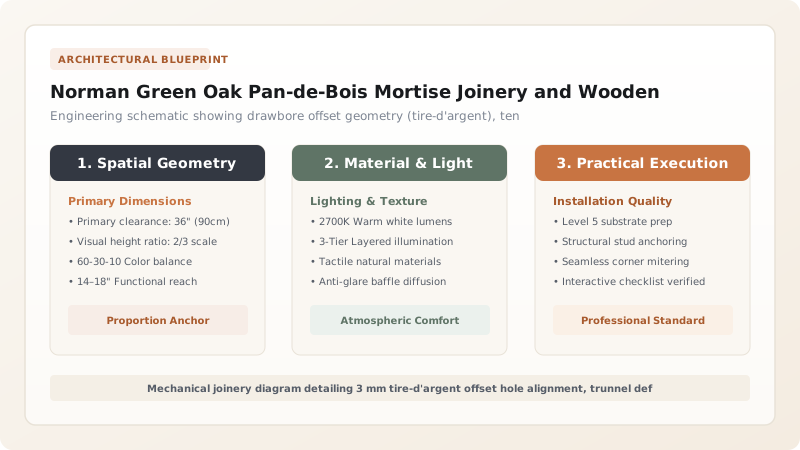
The core mechanical connection holding the pan de bois together against gale-force Atlantic windstorms is the drawbored mortise-and-tenon (tenon et mortaise à tire-d'argent). Once the tenon is cut and seated inside its mortise, a 20 mm hole is bored through the mortise cheeks. The tenon is extracted, and the craftsman marks the center of the hole onto the tenon tongue. But rather than boring through this mark, the hole is deliberately offset 2.5 mm to 3.5 mm closer to the joint shoulder.
When the joint is reassembled and an octagonal, bone-dry oak peg (cheville) is driven home with a heavy mallet, the tapered tip enters the misaligned holes. The immense wedge pressure forces the tenon backward into the mortise, drawing the joint shoulders into violent, air-tight compression. This dynamic draw generates hundreds of kilograms of continuous clamping force that closes any gaps. As the green oak frame seasons and shrinks over its first decade, the dry, flexible trunnel maintains its mechanical grip, ensuring that the structural bent never loosens or sags.
The Octagonal Cheville: Metallurgy Without Metal
Why did traditional French carpenters reject iron nails and bolts in favor of wooden pegs? The answer lies in the aggressive chemistry of oak. Oak heartwood is rich in tannic acid. When wet green oak comes into contact with ferrous iron, the acid reacts vigorously, corroding the metal and forming dark black pockets of iron tannate rot that systematically destroy the surrounding timber fibers.
The cheville bypasses this vulnerability completely. Split by hand along straight grain planes from bone-dry oak heartwood or black locust (acacia), the peg is shaved into an octagonal cross-section. When driven into a round augered hole, the eight sharp longitudinal facets crush into the softer end-grain of the hole wall. This creates a powerful mechanical interlock that resists withdrawal under cyclic wind vibration, functioning as a living wooden fastener that breathes, expands, and contracts in perfect chemical and physical harmony with the mighty oak skeleton.
Timber Framing Fastening Strategies: Drawbored Oak Trunnels vs Cast Iron Timber Bolts vs Modern Structural Screws
Use this reference table to calculate exact physical dimensions, ratios, and specifications before purchasing:
| Fastener Performance | Drawbored Octagonal Oak Trunnels (Chevilles) | Through-Bolted Cast Iron Rods | Modern Carbon Steel Structural Screws |
|---|---|---|---|
| Long-Term Clamping Tension | Dynamic & Self-Adjusting; dry oak peg swells and locks tighter as green frame dries | Rigid; requires periodic manual retorquing as timber shrinks away from metal washers | Static; screw threads strip inside soft green timber fibers over seasonal humidity cycles |
| Tannic Acid Chemical Reaction | 100% Compatible; oak peg shares identical pH and tannin chemistry with oak beam | Corrosive; oak tannic acid rapidly attacks ferrous iron, creating black rust rot pockets | Vulnerable; acidic sap eats through zinc galvanizing, inducing catastrophic fastener shearing |
| Thermal Bridging & Condensation | Zero; wood possesses low thermal conductivity, preventing localized cold-spot condensation | Severe; iron rods conduct winter frost deep into the joint core, incubating internal fungal rot | High; steel screws act as thermal conductors inside the wall cavity |
| Reversibility & Restoration | High; trunnels can be bored out cleanly on a drill press and re-pegged with zero damage to beam | Moderate; rusted bolts seize and must be cut out with angle grinders | Poor; snapped hardened screws are nearly impossible to extract without destroying mortise cheeks |
| Embodied Carbon & Craft Lineage | Zero Carbon; 100% renewable local oak coppice; ancestral French master guild heritage | High; energy-intensive iron smelting and casting | High; industrial metallurgical smelting and petrochemical coatings |
Practical Constraints
Every successful decoration project must account for physical and environmental constraints:
Differential Radial vs Tangential Shrinkage of Green Oak
Green oak shrinks roughly twice as much tangentially as radially, causing mortise mouths to open slightly during drying. Mitigation: Orient timber grains deliberately on the épure so that primary shrinkage vectors tighten the tenon against the mortise face.
High Risk of Tenon Shearing Under Excessive Drawbore Offset
If the drawbore offset exceeds 4 mm, driving the hard peg can violently split the end of the tenon along its grain. Mitigation: Calibrate the offset strictly to 3.0 mm (no more than the thickness of an old silver coin, hence tire-d'argent).
Execution Blueprint & Craftsmanship Sequence
Execute this professional sequence to achieve flawless results without backtracking:
Timber Squaring and Grain Assessment
Select freshly felled green oak trunks. Hew them square to 180 mm × 180 mm using a broadaxe, checking for straight longitudinal grain and absence of violent spiral grain that could cause severe twisting during seasoning.
Full-Scale Épure Layout
Snap chalk lines on a flat wood platform to draw the full-scale building elevation (épure). Place the hewn timbers over the lines, dogging them in place with iron timber dogs, and scribe joint intersections directly with a plumb bob and scoring knife.
Cutting Assembly Identification Marks
Before cutting joints, carve Roman-numeral assembly marks (marques de charpente) across every joint intersection using a race knife (rouanne). This ensures that every individually tailored timber is returned to its exact location during site rearing.
Mortise Chiseling and Boring
Bore out the waste wood along the mortise layout using an 18 mm T-auger. Clean and square the mortise cheeks to a depth of 120 mm using a heavy forged mortise chisel (bédane) and wooden mallet, checking that the cheeks are dead-parallel.
Tenon Saws and Shoulder Relieving
Saw the tenon cheeks on the mating beam using a crosscut saw, cutting square shoulders. Undercut the shoulders slightly by 1 degree toward the inside to ensure that the visible outer seam closes with razor-sharp perimeter contact.
Mortise Cheek Boring
Assemble the joint dry. Bore a clean 20 mm hole through both cheeks of the mortise, perpendicular to the timber face, using a hand-cranked auger or heavy framing drill.
Tire-d'Argent Drawbore Pricking
Disassemble the joint. Insert an alignment awl into the mortise hole to prick the center point onto the tenon. Remove the tenon, measure exactly 3 mm from the prick toward the tenon shoulder, and bore a 20 mm hole through the tenon at this offset center.
Trunnel Driving and Clamping
Reassemble the joint. Taper the tip of an octagonal, bone-dry oak peg (cheville) and grease with tallow. Drive the peg firmly through the misaligned holes with a heavy mallet; the peg bends slightly, pulling the green tenon shoulder into powerful, permanent compression.
Common Mistakes & Countermeasures
Avoid these costly errors that compromise aesthetics, ergonomics, and budget:
Boring the tenon peg hole directly in line with the mortise hole without drawbore offset
Using round, lathe-turned dowels instead of hand-shaved octagonal oak trunnels
Using green or unseasoned wood to carve the fastener pegs (chevilles)
Project Execution Checklist
Track your physical progress. Checkboxes persist automatically on this device:
Frequently Asked Questions
What is 'tire-d'argent' and why does it have that name?
Tire-d'argent translates poetically to 'silver draw'. In historic French timber guilds, master carpenters calibrated the drawbore offset distance by the exact thickness of an antique French silver coin (approximately 2.5 mm to 3.0 mm). If the hole was offset by more than the thickness of this silver coin, driving the peg risked shearing the tenon; if less, the joint lacked clamping power.
Why are traditional French timber framing pegs octagonal instead of round?
Hand-shaved octagonal pegs (chevilles à huit pans) have eight crisp longitudinal ridges. When driven into a round bored hole, the corners crush into the soft end grain of the hole walls, creating massive mechanical friction that prevents the peg from ever backing out under wind vibration. Round dowels lack these biting ridges and can work loose.
How do carpenters ensure green oak frames don't twist violently while drying?
By assembling the entire structure with interlocking diagonal braces (écharpes) and through-tenons locked with drawbored pegs, the timber frame functions as a rigid 3D truss. The immense mechanical clamping force of dozens of drawbored joints restrains individual timbers, forcing them to season in place without twisting or warping out of square.
What species of oak was preferred for Norman colombage?
French carpenters favored Quercus robur (pedunculate oak, or chêne pédonculé), harvested from damp lowland forests. Its straight, long trunk and dense, tannin-saturated heartwood provide extraordinary natural resistance to wood-rotting fungi and insects, requiring zero chemical preservatives.