Hazel éclisses lathing and straw-rich fat clay torchis packing is the traditional wattle-and-daub infill system of French half-timbered colombage architecture. Springy vertical hazel or split chestnut stakes (éclisses) are wedged under tension into pre-routed V-grooves in the oak framing rails, laced horizontally with flexible split hazel wattle. The wall cavity is then packed with torchis—an earthen composite formulated from high-plasticity alluvial fat clay (argile grasse) and long-stemmed wheat or rye straw, kneaded into rolls (torches) and packed simultaneously from both sides of the wall to eliminate interior air voids.
At a Glance: Key Takeaways
- Wattle Stakes: Coppiced Hazel (Corylus avellana) or Split Sweet Chestnut (Éclisses)
- Lath Spacing: 100 mm to 140 mm on center across the timber bay
- Infill Binder: Alluvial Fat Clay (Argile grasse / 20%–30% clay fraction)
- Infill Fiber: Long-stemmed winter wheat or rye straw (paille de blé / seigle)
- Thermal Mass Density: 1,400 to 1,600 kg/m³ dry cured density
The Wattle Substrate: Coppiced Hazel and Chestnut Éclisses
In the construction of a French half-timbered building, the oak pan de bois frame provides structural load-bearing capacity, but it cannot hold an earthen daub on its own. The wall requires an internal skeletal armature—the wattle substrate. In Normandy and Picardy, this armature is engineered from éclisses (also called palâtres or guettes), split stakes derived from coppiced hazel (Corylus avellana) or sweet chestnut (Castanea sativa).
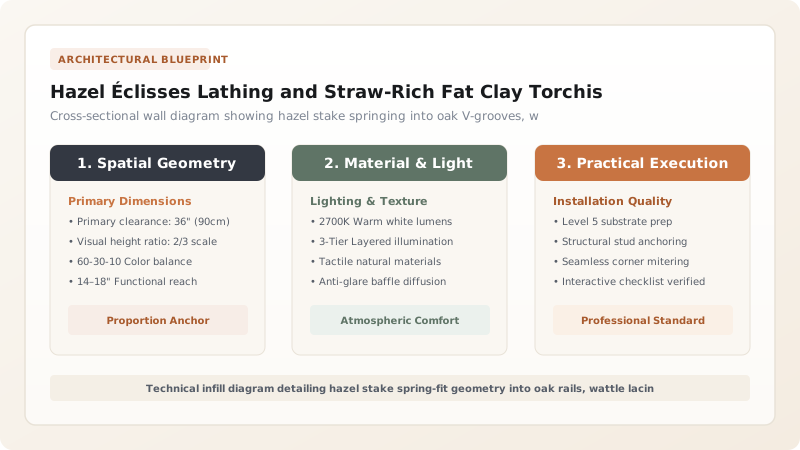
Coppicing is an ancient agroforestry system where tree stumps are cut back to ground level every 3 to 5 years, stimulating the growth of dozens of straight, unbranched, highly flexible poles. To mount these stakes without using expensive metal nails, carpenters gouged continuous V-shaped channels into the horizontal oak timbers: a deep 25 mm groove along the underside of the upper girt, and a shallower 15 mm groove along the sill. The craftsman cuts the hazel stake slightly longer than the bay opening, inserts the top into the deep upper groove, flexes the springy wood outward, and pops the bottom into the sill groove. Upon release, the internal elastic tension locks the stake securely in place.
Agrarian Synergy: The Mineralogy of Argile Grasse and Cereal Straw
The infill material itself is torchis, a profound example of agrarian circular economy. The primary mineral binder is argile grasse (fat clay), excavated from subsoil horizons beneath topsoil. Composed primarily of illite and smectite clay minerals, fat clay possesses immense plastic cohesion when wet and high compressive strength when dry. However, pure clay shrinks dramatically (up to 15% by volume) as water evaporates, causing catastrophic cracking and disintegration.
To counteract this shrinkage, the clay is blended with an agricultural byproduct: long-stemmed cereal straw (paille de blé or paille de seigle). Winter rye straw was especially prized: its hollow cellulosic stems are reinforced with natural biogenic silica, providing tremendous tensile strength that does not collapse under moisture. The straw fibers act as a continuous three-dimensional micro-reinforcing armature, distributing shrinkage stresses across millions of microscopic fiber interfaces and preventing the formation of macro-cracks.
The Ritual of Pugging: Foot Kneading and Torche Fabrication
Preparing torchis is an intensely physical, communal craft. In a shallow pit excavated near the building site, the clay subsoil is soaked with water and allowed to slake for 24 hours to break down hard clods. Long straw (cut to lengths of 200 mm) is strewn across the mud bed. The mixture is then pugged—traditionally kneaded under the bare feet of workers or trampled by heavy draft horses or oxen walking in circles.
The rhythmic stamping forces the sticky clay paste to coat every single strand of straw, expelling entrapped air and developing an elastic, cohesive dough. Once properly pugged, the material is formed into torches—elongated loaves or rolls roughly 300 mm long and 100 mm in diameter. The worker twists the bundle (giving the technique its historic name), preparing convenient, pre-measured portions ready for immediate wall packing.
Simultaneous Two-Sided Packing and Mechanical Keying
Installing torchis into the timber bays—a process called le torchage—requires synchronized teamwork. A critical rule of the craft is that torchis must never be applied from one side against a dead backing; doing so creates massive internal air pockets around the rear of the hazel stakes that trap moisture and weaken the wall.
Two craftsmen position themselves on opposing sides of the open wall frame (one exterior, one interior). As wet torches are tossed onto the scaffolding, both workers take rolls, wrap them around the vertical hazel éclisses, and drive their fists together, compressing the clay-straw mass toward the center of the wall simultaneously. The clay oozes through the spaces between the stakes, knitting the two faces into a monolithic, void-free core. Before the clay stiffens, the surface is scraped flush with the oak timbers using a wooden paddle and vigorously scored with diagonal criss-cross grooves, creating deep mechanical keys essential for bonding the exterior lime plaster.
Vernacular Infill Systems: Hazel-Clay Torchis vs Fired Brick-Nogging vs Lime-Hemp (Chanvre)
Use this reference table to calculate exact physical dimensions, ratios, and specifications before purchasing:
| Infill Typology | Traditional Hazel-Clay Torchis | Traditional Fired Brick-Nogging (Briquettes) | Modern Lime-Hemp Bio-Composite (Chanvre) |
|---|---|---|---|
| Substrate Compatibility with Timber | 100% Elastic Compatibility; clay flexes and breathes with seasonal oak movement | Poor; rigid bricks and hard mortar separate from timber, creating drafty perimeter cracks | Excellent; lime-hemp yields elastically, hugging irregular hewn oak posts |
| Thermal Mass & Acoustic Performance | High Thermal Mass; dense clay stores solar heat and provides exceptional low-frequency sound deadening | Moderate to High; dense brick mass but high thermal conductivity leads to rapid heat loss | Low Thermal Mass / High Insulation; porous hemp shivs deliver high R-value with low mass |
| Wall Breathability & Hygroscopic Buffer | Active Moisture Buffer; absorbs up to 10% of its dry weight in humidity without degrading | Low; fired clay bricks have slow moisture absorption; condensation forms on inner surfaces | Exceptional; hemp hurd cell structure buffers extreme indoor humidity swings |
| Material Cost & Local Sourcing | Near Zero; subsoil dug on-site, agricultural crop straw, hedgerow coppiced hazel | Moderate; requires brickworks kiln firing and transport of masonry units | Moderate to High; requires commercial agricultural hemp processing and hydraulic lime |
| Embodied Carbon & Environmental Impact | Carbon-Negative; agricultural straw sequesters carbon; zero manufacturing emissions | High; energy-intensive kiln firing of ceramic clay bricks | Carbon-Negative; industrial hemp absorbs immense CO2 during rapid growth cycle |
Practical Constraints
Every successful decoration project must account for physical and environmental constraints:
Volumetric Clay Shrinkage and Perimeter Separation Cracks
As water evaporates from the fat clay, the torchis panel shrinks inward, creating a 5 mm to 10 mm gap along the oak timber posts. Mitigation: Maximize straw fiber content (up to 50% by volume) to restrain shrinkage, and point perimeter gaps with fibrous lime-clay putty after 6 weeks.
Extensive Water Quantity Introduced into the Building Skeleton
A typical two-story colombage house requires up to 15 tonnes of wet clay daub containing over 3,000 liters of water. Mitigation: Ensure continuous cross-ventilation through open window bays and install temporary rain screens over eaves to speed evaporation.
Execution Blueprint & Craftsmanship Sequence
Execute this professional sequence to achieve flawless results without backtracking:
Coppiced Hazel Harvesting and Splitting
Harvest straight, knot-free hazel poles (25 mm to 35 mm diameter) from local hedgerows during winter dormancy. Split poles exceeding 30 mm in half down their pith using a curved froe, yielding springy D-section laths (éclisses).
Timber Bay Rail Grooving
Using a router plane or specialized grooving chisel, plow a continuous 25 mm deep V-groove along the upper horizontal oak tie-beam, and a 15 mm deep groove along the lower sill beam, checking that the grooves are clean of splinters.
Springing Vertical Stakes (Éclisses)
Cut the hazel éclisses to length (bay height plus 35 mm). Bevel both ends into wedge points. Insert the top tip deep into the upper V-groove, bow the springy stake slightly outward, and pop the bottom tip into the lower sill groove at 120 mm centers.
Horizontal Wattle Weaving
Weave thin, flexible whole hazel rods or split willow osiers horizontally through the vertical stakes in an alternating basket weave. Secure the top and bottom passes with twisted willow withes to lock the armature into a rigid, self-supporting hurdle.
Clay Sedimentation Testing and Sourcing
Excavate yellow or grey subsoil from beneath the agricultural topsoil layer. Perform a jar sedimentation test to confirm 20% to 30% clay content, verifying that the clay is free of organic humus and roots.
Torchis Pugging and Kneading
Spread the clay over a clean canvas or mud pit. Add water and knead into a thick paste. Strew long-stemmed wheat or rye straw across the mud, stomping the slurry vigorously with bare feet until the straw fibers are thoroughly coated in sticky clay.
Two-Sided Simultaneous Packing (Torchage)
Divide workers into exterior and interior teams. Shape wet clay-straw into 300 mm long sausages (torches). Wrap each torch over a hazel stake and compress firmly against the opposing worker's push, filling the bay to a uniform 140 mm thickness.
Surface Scraping and Keying
While the torchis remains damp, strike off excess mud flush with the oak timber faces using a flat wooden paddle. Score deep diagonal diamond cross-hatching across the clay face using a notched wooden comb, providing mechanical keys for the future lime render.
Common Mistakes & Countermeasures
Avoid these costly errors that compromise aesthetics, ergonomics, and budget:
Packing torchis daub from one side of the wall only against an open wattle hurdle
Using lean, sandy topsoil instead of cohesive subsoil fat clay (argile grasse)
Applying wet torchis infill during freezing winter or rainy autumn weather
Project Execution Checklist
Track your physical progress. Checkboxes persist automatically on this device:
Frequently Asked Questions
Why is rye straw preferred over wheat straw in traditional torchis?
While wheat straw is widely used, traditional masons in northern France prized rye straw (paille de seigle) above all others. Rye straw produces longer, tougher, and more silica-rich hollow stems that do not crush or soften easily when soaked in wet clay. Furthermore, rye contains natural bitter phenolic compounds that strongly repel mice, rats, and insects.
What tools are used to test clay suitability on a building site?
Traditional builders use simple tactile field tests: the 'cigar test' (rolling moist clay between palms into a 20 mm thick cylinder; if it extends 100 mm to 150 mm before snapping under its own weight, the clay fraction is ideal) and the 'ribbon test' (flattening moist soil between thumb and forefinger; a continuous glossy ribbon confirms high-plasticity fat clay).
Can torchis be applied directly over modern metal lath or plastic mesh?
No. Modern metal lath corrodes rapidly in contact with damp, acidic earthen clay, while plastic mesh lacks the flexural stiffness required to support heavy wet clay packing. The natural spring-tension and rough bark texture of hazel and chestnut éclisses provide an irreplaceable organic substrate that flexes with the building without de-bonding.
How do builders prevent cracking as the thick clay dries?
Cracking is controlled by two factors: high tensile fiber volume (straw must make up 40% to 50% of the wet mix by loose volume) and slow, controlled shaded drying. If a wall dries too fast under direct sun, it will fissure; traditional builders shield fresh torchis with damp burlap sheets or reed mats during high summer heat.