
Torchis is Normandy's traditional wattle-and-daub infill composite. Composed of local silty clay (limon de plateau), sharp sand, animal dung, and chopped flax shives (anas de lin) or rye straw, the mixture is hand-wrapped around flexible split-hazel slats (palissons) wedged into grooved oak posts. Once cured, the exterior is protected from maritime rains with a breathable two-coat render of natural hydraulic chalk lime (chaux aérienne) and sand, preserving timber health and vapor breathability.
At a Glance: Key Takeaways
- Clay Soil Type: Norman Plateau Silt-Clay (Limon de Plateau, 25-35% clay fraction)
- Lathing Armature: Split hazel / chestnut slats (Palissons) wedged in post grooves
- Plant Reinforcement: Chopped flax shives (Anas de lin) or long winter rye straw
- Protective Render: Natural pure chalk lime putty (Chaux grasse aérienne) + River sand
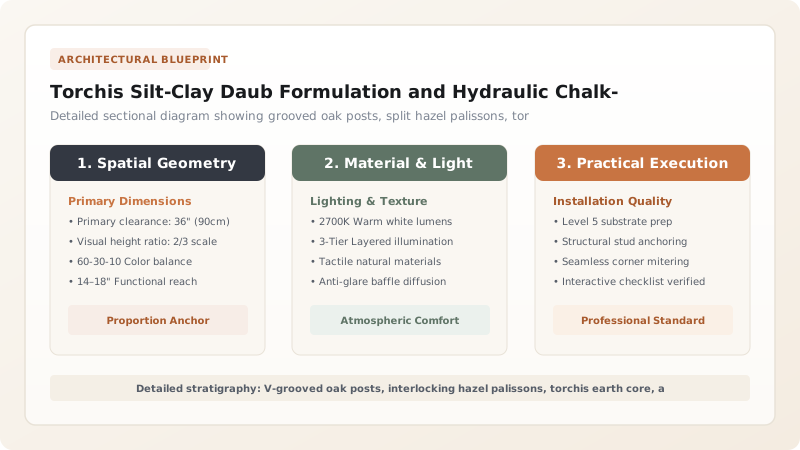
Soil Mineralogy: The Norman Limon de Plateau Silt-Clay
Normandy’s plateau geology is capped by thick Quaternary eolian silt-clay deposits known as limon de plateau. Unlike heavy plastic ball clays which shrink excessively, this soil has a balanced grain distribution: roughly 25% to 30% clay minerals (illite and kaolinite), 50% quartz silt, and 20% fine sand.
This natural grain-size curve makes it the ideal raw material for earth construction. It possesses sufficient clay platelets to bind the matrix under compaction while the high silt and sand fractions limit linear drying shrinkage to a modest 3% to 5%, preventing deep structural fissures across the wall bay.
Biological Reinforcement: Flax Shives (Anas de Lin) and Animal Dung
Normandy is the historic heartland of European flax cultivation. While long flax fibers were spun into fine Norman linen, the woody inner stem fragments—known as anas de lin (flax shives)—were incorporated into torchis.
Flax shives possess a high cellulose content, low density, and remarkable micro-capillary elasticity. Added alongside fresh bovine or equine manure, the dung contributes digestive enzymes and casein proteins that dissolve into the wet clay water. As the wall cures, the casein forms an insoluble calcium-protein network that dramatically increases the water-resistance and cohesive tensile strength of the dry clay.
Palisson Lathing: Grooved Post Anchorage and Two-Sided Packing
The infill relies on a wooden armature that requires zero nails. Carpenters cut continuous V-shaped grooves (20mm deep) into the lateral faces of the vertical oak posts. Hand-split hazel, oak, or chestnut slats (palissons) are cut 25mm longer than the bay width, bent into an arch, and sprung into the opposing grooves.
Masons prepare rolls of damp, fibrous torchis (called boudins or mottes), wrapping the clay around each palisson. Two workers—one inside, one outside—press and knead the material simultaneously, forcing the clay into a continuous monolithic core that envelops the wooden slats. The surface is scored with diagonal scratches to provide mechanical keying for finish plasters.
Protective Render: Traditional Chaux Aérienne and Ochre Washes
Torchis cannot withstand direct, prolonged wind-driven rain without protection. Once the earth wall has dried slowly over 4 to 6 weeks, the exterior is coated with a traditional two-pass lime render.
The base coat is formulated with pure slaked chalk lime (chaux aérienne CL90) and coarse washed quartz sand (1:2.5 ratio). The finish coat is troweled to a smooth 4mm thickness, formulated with fine river sand and natural yellow ochre from Normandy. This microporous mineral skin breathes freely—allowing internal domestic water vapor to evaporate—while repelling rain droplets and flexing with the movement of the oak frame.
Norman Torchis & Lime Render Formulation Protocol
Use this reference table to calculate exact physical dimensions, ratios, and specifications before purchasing:
| Wall Layer | Raw Ingredients Ratio | Fiber / Filler Spec | Thickness | Curing Duration |
|---|---|---|---|---|
| Armature Slats (Palissons) | Split green hazel or chestnut | 15mm × 30mm split slats | Spaced 100mm apart in grooves | Sprung into place dry |
| Torchis Earth Core | 1 Limon Clay : 2 Sand : 0.5 Dung | Flax shives / winter rye straw (30%) | 120mm – 150mm (flush with frame) | 4 to 6 weeks slow shade dry |
| Base Scratch Render | 1 CL90 Lime Putty : 2.5 Coarse Sand | Animal goat hair (3 kg/m³) | 8mm – 10mm | 14 days damp hessian cure |
| Finish Lime Skin | 1 CL90 Lime Putty : 2 Fine Sand | Natural iron oxide yellow ochre | 3mm – 5mm | 7 days mist curing |
Practical Constraints
Every successful decoration project must account for physical and environmental constraints:
Seasonal Weather Windows in Maritime Normandy
Torchis must be installed between May and August to ensure complete drying before autumn rainfall and winter frosts arrive.
Sourcing Certified Organic Flax Shives and Manure
Must be sourced from local heritage agricultural co-ops to ensure freedom from chemical pesticides that inhibit bacterial binding.
Execution Blueprint & Craftsmanship Sequence
Execute this professional sequence to achieve flawless results without backtracking:
Soil Extraction and Clay Fraction Testing
Extract local limon de plateau soil; perform sedimentation jar tests to verify clay content is between 25% and 35%, free from topsoil roots.
Torchis Compounding and Pit Maturation
Combine clay soil, sharp sand, fresh cow dung, and chopped flax shives in a mixing pit; knead with water and let sweat covered for 48 hours.
Palisson Lath Insertion
Cut split-hazel slats slightly oversized; bend into an arc and spring into V-grooves in opposing oak posts at 100mm vertical centers.
Simultaneous Two-Sided Torchis Packing
Wrap fibrous clay boudins around palissons, compressing from interior and exterior sides simultaneously to form a dense, void-free monolithic wall.
Surface Scraping and Slow Drying
Dress torchis flush with timber frame faces; score diagonal keys with a wooden comb, and dry under shade burlap for 30 days.
Protective Lime Render Application
Dampen the dry torchis thoroughly; apply two coats of pure chalk lime render tinted with yellow ochre, keeping the plaster edges clean of timber faces.
Common Mistakes & Countermeasures
Avoid these costly errors that compromise aesthetics, ergonomics, and budget:
Applying Modern Cement Renders Over Historic Torchis
Drying Fresh Torchis Rapidly Under Direct Summer Sun
Project Execution Checklist
Track your physical progress. Checkboxes persist automatically on this device:
Frequently Asked Questions
What are 'anas de lin' and why are they used in Norman torchis?
Anas de lin are the chopped woody inner fragments of flax stems remaining after the long textile fibers are stripped. They provide lightweight tensile reinforcement, excellent thermal insulation, and natural mold resistance inside the clay wall.
How do conservators repair cracks between torchis panels and oak posts?
Conservators rake out dust from the perimeter gap, pack it with a flexible hemp-oakum caulking braid, and point the surface with matching lime-clay putty, allowing the oak to expand seasonally without cracking the render.


