Selecting quarter-sawn Flemish brown oak and executing ammonia fuming is the foundational craft practice behind authentic Mechelen cabinetry. Quarter-sawing cuts oak logs radially perpendicular to growth rings, exposing luminous medullary ray flecks (spiegel) and ensuring unmatched dimensional stability with half the shrinkage of flat-sawn timber. Ammonia fuming utilizes the chemical reaction between ammonium hydroxide vapor (26°–28° Baumé) and natural tannic acid inside oak heartwood, turning the wood a deep, permanent nutty brown through the synthesis of ammonium tannate without raising grain or obscuring wood figure.
At a Glance: Key Takeaways
- Timber Species: European brown oak (Quercus robur & Quercus petraea)
- Sawing Geometry: True radial quarter-sawing (growth rings at 60°–90° to face)
- Visual Figure: Silver grain ribbon flecks (spiegel/medullary rays)
- Chemical Agent: Aqueous ammonium hydroxide vapor (26°–28° Baumé / 28–30% NH3)
- Patination Reaction: Ammonia gas cross-links with heartwood tannic acid forming ammonium tannate
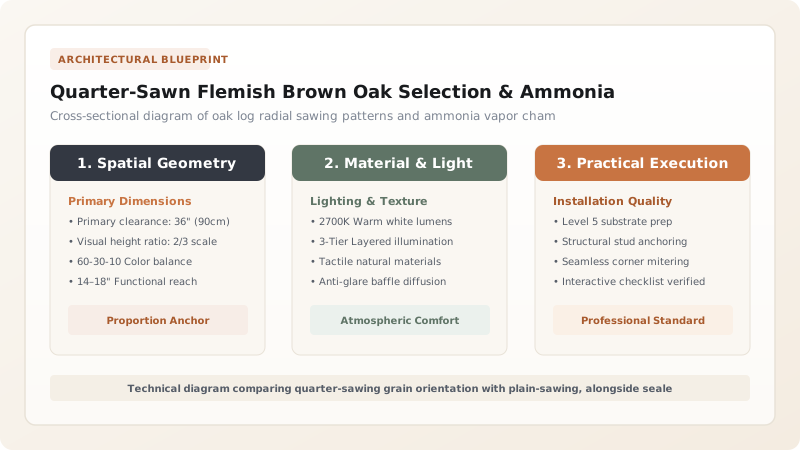
The Mechanics of Radial Sawing: Unlocking the Spiegel Figure
The selection of oak for traditional Mechelen cabinetry begins in the forest with the inspection of slow-growth European oak trunks (Quercus robur and Quercus petraea). For centuries, Flemish master joiners sourced timber from the old-growth forests of Brabant, the Ardennes, and the Spessart region of central Europe, where dense canopy cover compelled trees to grow slowly, yielding tight, uniform annual rings and straight grain lines. The determining factor in timber preparation is the sawing geometry: while plain or flat-sawing cuts tangent to the growth rings—producing broad, wild cathedral patterns with high transverse shrinkage—Mechelen furniture demands radial quarter-sawing.
In true quarter-sawing, the log is first quartered along its longitudinal axis, and each wedge-shaped quadrant is sawn perpendicular to the annual rings. This orientation ensures that the growth rings cross the broad face of the plank at angles between 70 and 90 degrees. This geometry unlocks two fundamental advantages. First, it cuts directly across the tree’s medullary rays—radial bands of parenchyma cells that transport sap and nutrients horizontally from the heartwood to the cambium. When planed, these ray cells reflect light at different angles than the surrounding longitudinal tracheid fibers, creating the radiant, iridescent ribbons known in Flemish woodworking as the spiegel (mirror). Second, quarter-sawn boards exhibit almost zero tendency to cup or twist, allowing carved relief panels to sit flat within their framing grooves across centuries of seasonal atmospheric shifts.
Tannic Acid Chemistry & The Physics of Ammonia Patination
Ammonia fuming (historically discovered in equestrian stables where horse urine vapors naturally darkened oak stalls) is a true chemical synthesis rather than a topical stain. European oak heartwood is naturally saturated with complex polyphenolic compounds known as gallotannins and ellagitannins, which comprise up to 8% to 10% of the dry weight of the wood. When raw oak is introduced into an atmosphere charged with ammonium hydroxide vapor (NH3 gas dissolved in airborne moisture), the tiny ammonia molecules readily diffuse through the open vessel lumens and pit membranes of the wood anatomy.
Within the cell walls, the alkaline ammonia reacts spontaneously with the acidic phenolic hydroxyl groups of the tannins. This reaction catalyzes the polymerization of tannins into insoluble, dark-colored ammonium tannates. Because this reaction occurs at the molecular level within the cell walls, the color change penetrates 2 to 5 millimeters into the solid wood. Unlike liquid water- or alcohol-based stains that deposit pigment particles inside surface pores—frequently muddying the grain and obscuring wood figure—ammonia fuming leaves the cellular anatomy completely clear. The medullary rays, which contain different tannin concentrations and cellular densities, darken at a different rate than the surrounding tracheids, preserving and accentuating the luminous chatoyancy of the quarter-sawn figure.
Constructing & Operating Hermetic Fuming Enclosures
Executing a successful ammonia fume requires strict environmental control. In historical Mechelen workshops, dedicated masonry vaults or timber sheds lined with pitch and oilcloth were employed; in modern professional conservation settings, custom gastight enclosures are constructed using heavy 6-mil polyethylene sheeting taped over a rigid timber or aluminum skeleton. The furniture piece or component boards must be staged with ample clearance, elevated on narrow sticker blocks to ensure that the heavier-than-air ammonia vapors circulate freely over all faces, edges, and carved recesses.
Industrial-grade aqueous ammonium hydroxide (commonly rated at 26° to 28° Baumé, corresponding to approximately 28% to 30% dissolved ammonia gas) is poured into wide, shallow glass, ceramic, or high-density polyethylene trays positioned on the floor of the chamber. Broad surface area is essential, as the rate of vaporization governs the concentration of the atmosphere. The chamber is sealed hermetically using vapor-impermeable tape. Operators maintain ambient temperatures between 18°C and 24°C; temperatures below 15°C severely retard vapor pressure, while excessive heat can cause uneven localized darkening. Small visual inspection windows or removable test coupons allow the craftsman to evaluate the deepening tone over a period ranging from 8 hours for a golden hazelnut to 36 hours for a profound antique Jacobean shade.
Post-Fuming Stabilization, Neutralization & Grain Integrity
Once the target depth of color is achieved, the chamber must be safely purged. Because concentrated ammonia vapor is severely hazardous to the respiratory tract and eyes, extraction requires mechanical exhaust ventilation ducted safely to the exterior, with the operator wearing full respiratory protection rated for ammonia gas. After unsealing, the casework must undergo a crucial stabilization phase. While ammonia is volatile and will largely evaporate on its own, residual alkaline salts remain within the surface pores for several days.
The oak must be stored in a dry, warm, well-ventilated workshop for a minimum of 48 to 72 hours. During this period, the pungent odor completely dissipates, and the wood chemistry stabilizes. Crucially, because no liquid water was applied to the timber, the surface grain remains completely smooth and unraised—a profound advantage over water-based stains that require aggressive sanding that would ruin crisp, hand-cut carving facets. Once fully cured, the fumed surface is wiped with a clean, dry flannel cloth or lightly brushed with stiff horsehair to clear microscopic salt residues, leaving the wood in an optimal, receptive state for the application of saturating drying oils and protective beeswax pastes.
Ammonia Fuming Parameters & Patina Development in European Oak
Use this reference table to calculate exact physical dimensions, ratios, and specifications before purchasing:
| Desired Patina Depth | Ammonia Concentration | Chamber Exposure Time | Wood Reaction Color | Recommended Subsequent Finish |
|---|---|---|---|---|
| Warm Golden Amber | 20° Baumé (15% NH3) | 6 to 8 hours | Rich honey-bronze with golden ray ribbons | Raw linseed oil cut with turpentine & clear beeswax |
| Classic Flemish Hazelnut | 26° Baumé (28% NH3) | 12 to 16 hours | Nutty medium brown with silvery-grey ray flecks | Boiled linseed oil & amber-tinted paste wax |
| Deep Antique Jacobean | 26° Baumé (28% NH3) | 24 to 36 hours | Dark chocolate brown with charcoal undertones | Double boiled linseed oil & dark brown carnauba wax |
| Monastic Ebony Brown | 28° Baumé + Tannin Wash | 48 hours (re-charged) | Near-black espresso tone, rays remain translucent | Pure tung oil & black microcrystalline wax |
Practical Constraints
Every successful decoration project must account for physical and environmental constraints:
High vapor toxicity and mucosal irritation associated with concentrated ammonium hydroxide
Inhalation hazard and ocular risk require stringent PPE and dedicated workshop fuming spaces. Mitigation: Wear a full-face respirator with ammonia-rated cartridges (K-class/green label), neoprene gloves, and vent chamber to outdoors.
Natural tannin variance between individual oak trees harvested from different soil compositions
Casework assembled from multiple distinct logs can exhibit mismatched fumed colors across adjacent stiles. Mitigation: Group components from the same log quadrant for adjacent facade elements and batch-test wood samples.
Execution Blueprint & Craftsmanship Sequence
Execute this professional sequence to achieve flawless results without backtracking:
Log Selection & Radial Cleaving
Select straight-grained, slow-growth European oak logs (minimum 60 cm diameter), marking radial lines from the pith outward to guide quarter-sawing.
Sawing & Grain Angle Verification
Mill boards on true radial planes, ensuring growth rings intersect the broad face at angles between 70° and 90° to expose maximum medullary ray flecks.
Equilibrium Seasoning & Surface Preparation
Season timber to 9% moisture content; scrape surfaces cleanly with cabinet scrapers rather than fine sanding to keep wood pores open for vapor entry.
Chamber Construction & Casework Staging
Build a temporary airtight chamber using heavy 6-mil polyethylene plastic over a timber frame, elevating the cabinet on sticker blocks to permit 360° air circulation.
Deploying Ammonium Hydroxide Vapor Trays
Pour concentrated 26° Baumé ammonium hydroxide into broad, shallow glass or high-density polyethylene trays distributed evenly across the chamber floor.
Hermetic Sealing & Reaction Timing
Tape the chamber access flap completely shut with duct tape, recording ambient temperature (ideally 18°–24°C) and maintaining exposure for 12 to 24 hours.
Chamber Purging & Safe Ventilation
Open external exhaust vents while wearing protective gear; allow the chamber to purge fully into outdoor air before extracting casework.
Post-Fume Curing & Neutralization
Store the darkened oak in a warm, dry environment for 48 hours to complete ammonia outgassing, wiping surfaces with a dry flannel cloth to remove residual surface dust.
Common Mistakes & Countermeasures
Avoid these costly errors that compromise aesthetics, ergonomics, and budget:
Allowing sapwood into cabinetry intended for ammonia fuming
Splashing liquid ammonium hydroxide directly onto raw oak surfaces
Sealing oak with finish coats before ammonia vapors have fully outgassed
Project Execution Checklist
Track your physical progress. Checkboxes persist automatically on this device:
Frequently Asked Questions
Why is quarter-sawn oak superior to plain-sawn oak for Mechelen furniture?
Quarter-sawn oak offers unparalleled structural and aesthetic benefits. Structurally, it expands and contracts radially at roughly half the rate of tangentially sawn (plain-sawn) boards, preventing warp and frame distortion. Aesthetically, it cuts directly through the tree's medullary rays—ribbons of cells radiating from center to bark—producing the shimmering, silvery "spiegel" figure that defines historical Flemish Renaissance cabinetry.
Can red oak be fumed with ammonia instead of European brown oak?
While American red oak (Quercus rubra) will react to ammonia, it contains significantly lower and less consistent tannic acid concentrations than European white/brown oak (Quercus robur). Red oak tends to turn a muddy, greenish-grey tone rather than the rich, warm, nutty brown characteristic of European oak. If fuming red or low-tannin oak, artisans often apply a pre-treatment wash of tannic acid powder or pyrogallol dissolved in warm water.
Does ammonia fuming damage the wood fibers or weaken glue joints?
No, ammonia vapor does not degrade cellulose or lignin fibers, nor does it raise the wood grain because the reaction occurs in a gas phase without liquid water saturation. However, if modern PVA or polyurethane glues are exposed to intense ammonia vapor, some breakdown can occur. Traditional hot hide glue (protein-based) is remarkably resistant to ammonia fuming, which is why historical Mechelen joiners fumed fully assembled case frames with total confidence.