The structural longevity and tactile beauty of Flemish Mechelen cabinetry depend upon drawbore mortise-and-tenon carcass framing, hand-cut dovetail drawer joinery, and traditional beeswax-turpentine buffing. Constructed from seasoned European brown oak, the carcass stiles and rails are locked with tapered oak trunnels driven through offset drawbore holes, pulling joints permanently tight without metal fasteners. Drawers utilize fine through-dovetails and slotted runners to accommodate seasonal movement. Finishing involves saturating the oak with cold-pressed boiled linseed oil, followed by hand-rubbed paste wax compounded from pure beeswax, carnauba flakes, and gum spirits of turpentine, buffed with natural horsehair brushes to a lustrous satin sheen.
At a Glance: Key Takeaways
- Carcass Joinery: Drawbore-pinned blind mortise-and-tenon with dry oak trunnels
- Drawer Joinery: Hand-cut through and half-blind dovetails on oak drawer carcasses
- Glue Chemistry: Hot animal bone and hide glue (reversible, high shear strength)
- Finish Formulation: Boiled linseed oil base coat; beeswax, carnauba, and gum turpentine paste
- Buffing Medium: Stiff natural horsehair buffing brushes and flannel polishing cloths
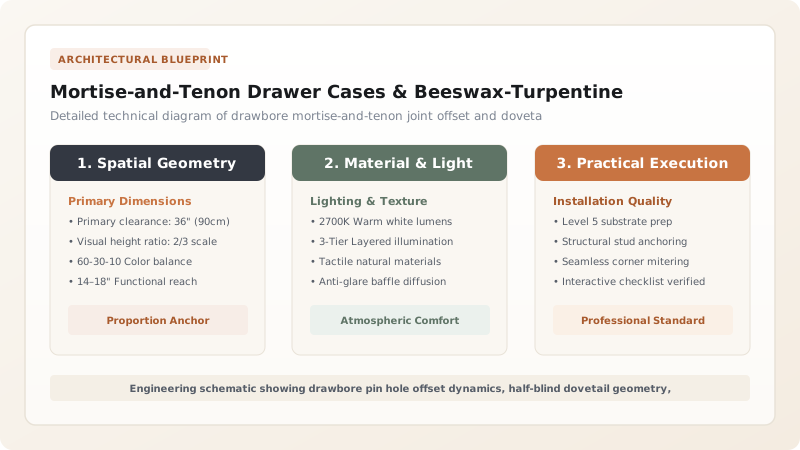
Carcass Architecture: Drawbore Pinning & Structural Rigidity
The monumental proportions of Mechelen buffets and armoires—often standing over two meters tall and weighing upwards of two hundred kilograms—imposed formidable structural demands upon the cabinetmaker. To withstand internal racking forces and the dead weight of heavy carved doors, joiners relied upon the drawbore mortise-and-tenon joint. In this venerable system, mortises are chopped deeply into the corner posts to a depth equal to two-thirds the width of the post, while the matching rails are cut with substantial tenons featuring haunched shoulders to resist twisting.
The defining innovation of drawboring is the deliberate misregistration of the pin holes. A hole is bored through the mortise walls, the tenon is inserted and marked, and the tenon hole is drilled approximately 2 millimeters closer to the shoulder. When a tapered, faceted peg (trunnel)—hand-whittled from seasoned, bone-dry oak heartwood—is driven into the hole, its taper pulls the tenon relentlessly inward, drawing the joint shoulders into hermetic contact with the post face. This mechanical clamp exerts hundreds of pounds of pressure, eliminating the need for modern bar clamps and ensuring that the structural carcass remains rigid and square even if environmental humidity fluctuations degrade the animal glue centuries later.
Drawer Carcass Engineering: Hand-Cut Dovetails & Floating Bottoms
The drawers of an authentic Mechelen cabinet were subjected to decades of rigorous domestic use, holding heavy silver services, linens, and documents. To ensure effortless operation, joiners constructed drawer carcasses using hand-cut dovetail joinery. The drawer fronts, frequently carved with deep Mannerist strapwork, were joined to the oak sides using half-blind dovetails, concealing the end-grain of the pins behind a solid 8 to 12 millimeter timber lip. The rear corners were joined with through-dovetails, featuring slender pins and wide tails cut at a traditional 1:7 pitch.
Accommodating seasonal wood movement was essential in drawer bottom construction. Solid quarter-sawn oak bottom panels were milled with beveled tongues around three edges, sliding into grooved slips plowed into the drawer sides and front. Crucially, the rear edge of the bottom panel passed freely beneath the drawer back, secured only by a single wooden pin or wrought nail driven through the center of the bottom into the drawer back. This configuration allowed the wide bottom board to expand and contract across its grain with seasonal humidity shifts without exerting lateral pressure that could blow out the delicate dovetailed side joints.
Formulating the Traditional Beeswax-Carnauba Paste
The signature tactile finish of Mechelen furniture is rooted in the chemistry of natural waxes and plant solvents. Raw beeswax, collected from regional apiaries, provides warmth, plasticity, and natural water repellency. However, pure beeswax is relatively soft, with a melting point of approximately 64°C, leaving it susceptible to dulling, fingerprinting, and heat marks in domestic environments. Flemish polishers solved this by blending beeswax with high-melt carnauba wax flakes, harvested from the leaves of the Brazilian Copernicia prunifera palm, which possesses a melting point of 84°C to 86°C and cures to a rock-hard, glassy crystalline film.
The compounding process demands extreme care. In a traditional water bath (double boiler), 400 grams of pure yellow beeswax and 100 grams of carnauba flakes are gently melted together. Once completely liquefied, the heat source is extinguished to eliminate fire hazards, and 500 milliliters of pure gum spirits of turpentine—distilled from the resin of maritime pine trees—is slowly whisked into the molten wax. Gum turpentine acts as a superior carrier solvent: its natural pinene terpenes penetrate deep into the pores of the fumed oak, carrying microscopic wax molecules into the cellular structure. As the mixture cools, it solidifies into a creamy, aromatic paste that remains supple and easily workable at room temperature.
The Hand-Buffing Methodology: Developing the Satin Patina
Applying the traditional wax finish is an art of patience and physical exertion. Prior to waxing, the fumed and cured oak casework is treated with a very thin, penetrating wash of cold-pressed boiled linseed oil, which satisfies the wood’s natural porosity and deepens grain contrast. Once the oil has fully polymerized over 24 to 48 hours, the wax paste is applied using a coarse linen or cotton pad. The polish is worked in tight circular motions, ensuring that a microscopic layer coats every flat stile, fluted column, and deep carved hollow.
The critical factor is allowing the turpentine carrier to flash off: after 15 to 25 minutes, the wet sheen hazes into a dull matte film. The craftsman then takes up a stiff, natural horsehair buffing brush. The dense, resilient bristles generate friction and localized warmth, spreading the high-melt carnauba crystals evenly across the surface and burnishing them into a continuous, micro-thin protective shield. A final brisk polishing with a soft wool flannel cloth removes any excess wax from the carved recesses, transforming the fumed oak into a glowing, tactile, velvety surface that resists moisture, repels airborne dust, and acquires an ever-deeper, luminous patina over centuries of care.
Joinery Specifications & Finishing Formulas in Mechelen Casework
Use this reference table to calculate exact physical dimensions, ratios, and specifications before purchasing:
| Assembly Area | Primary Joint Type | Fastener / Adhesive | Expansion Allowance | Finishing Sequence |
|---|---|---|---|---|
| Main Cabinet Carcass | Drawbore mortise-and-tenon | Tapered oak trunnels & hot hide glue | None (longitudinal frame) | Fumed, 1x linseed oil wash, 2x beeswax buffing |
| Drawer Box Carcass | Hand-cut through dovetails | Hot animal hide glue | None (interlocking grain) | Light mineral oil on runners, raw beeswax on sides |
| Drawer Bottom Panel | Slotted tongue into slips | Friction-fit with front center pin | 6–8 mm rear clearance | Unfinished underside, light wax top face |
| Cabinet Door Panels | Floating raised panel in groove | Free-floating (no glue) | 4 mm per side in stiles/rails | Full ammonia fume, 2x linseed oil, 2x buffed wax |
| Back Enclosure Wall | Shiplapped tongue-and-groove | Wrought-iron rosehead nails at center | 3 mm per plank gap | Light oil wash or planed raw wood |
Practical Constraints
Every successful decoration project must account for physical and environmental constraints:
Substantial weight of monumental solid oak cabinetry imposing extreme racking forces
Moving or shifting large two-tier cabinets can loosen structural joints if unreinforced. Mitigation: Incorporate internal diagonal corner gussets and heavy hardwood drawbore pins in all structural frames.
Extreme flammability of gum turpentine vapors during traditional wax paste formulation
Direct heating of turpentine over open flames can cause catastrophic workshop flash fires. Mitigation: Always melt beeswax in an indirect water bath (double boiler) with all open flames and heat sources extinguished.
Execution Blueprint & Craftsmanship Sequence
Execute this professional sequence to achieve flawless results without backtracking:
Carcass Member Mortising & Tenoning
Layout and chop mortises into structural corner posts; cut matching tenons with haunched shoulders on rails, testing for a snug friction fit.
Drawbore Hole Boring & Trunnel Carving
Bore 10 mm holes through mortise cheeks, insert tenons, mark hole centers, and drill through tenon tongues offset 2 mm toward the joint shoulder.
Carcass Glue-Up & Drawbore Pinning
Coat tenons with hot hide glue, clamp the frame, and drive octagonal tapered seasoned oak pins through the holes, mechanically pulling shoulders tight.
Drawer Carcass Dovetailing
Layout half-blind dovetails on oak drawer fronts and through dovetails on drawer backs, sawing pins and tails cleanly with a fine-toothed gent's saw.
Drawer Bottom Fitting & Runner Installation
Plow grooves into drawer sides, slide in solid quarter-sawn oak bottom panels, and fit seasoned beech or oak drawer runners inside the carcass.
Formulating the Traditional Wax Paste
Melt 400 g pure yellow beeswax and 100 g carnauba wax flakes in a double boiler; remove from heat and stir in 500 ml pure gum spirits of turpentine.
Linseed Oil Foundation Application
Apply a thin, penetrating wash of boiled linseed oil cut 30% with turpentine over fumed surfaces, wiping away excess after 30 minutes and curing for 24 hours.
Hand-Buffing the Beeswax-Turpentine Patina
Rub warm wax paste into the wood grain with cotton cloth; after 20 minutes of solvent flash-off, buff vigorously with horsehair brushes to a rich satin luster.
Common Mistakes & Countermeasures
Avoid these costly errors that compromise aesthetics, ergonomics, and budget:
Using modern metal screws or nails to secure cabinet face frames and drawer runners
Applying thick coats of cold paste wax over raw, un-oiled fumed oak
Gluing drawer bottom panels solidly into their perimeter frame grooves
Project Execution Checklist
Track your physical progress. Checkboxes persist automatically on this device:
Frequently Asked Questions
What is drawbore mortise-and-tenon joinery and why is it essential for oak furniture?
Drawbore joinery is a time-tested mechanical clamping system. A hole is bored through the mortise cheeks, and a matching hole is drilled through the tenon tongue offset roughly 2 millimeters closer to the shoulder. When a tapered, dry hardwood pin (trunnel) is driven through, the offset forces the tenon deeper into the mortise, locking the shoulder against the stile with immense mechanical pressure. Even if the glue degrades over centuries, the joint remains locked tight and cannot pull apart.
Why is carnauba wax added to the traditional beeswax and turpentine finish?
Pure beeswax is relatively soft and has a low melting point (approx. 62°–64°C), making it prone to smudging, finger-marking, and dust retention. Carnauba wax, derived from Brazilian palm fronds, is one of the hardest natural waxes known, with a melting point around 82°–86°C. Adding 15% to 25% carnauba to the beeswax-turpentine paste dramatically increases surface hardness, water repellency, and polishability, producing a durable, high-gloss luster that withstands daily handling.
Why is hot hide glue preferred over modern PVA glues in traditional Mechelen cabinetmaking?
Hot animal hide glue (derived from rendered collagen) offers distinct physical properties: it sets through cooling and drying, creating a rigid, glass-hard bond line with zero glue creep under sustained mechanical stress; it takes wood stains and finishes naturally, preventing unsightly glue resist spots; and it is 100% reversible with heat and moisture, allowing future conservators to disassemble and repair joints centuries later without damaging historic wood fibers.