Traditional Flemish Mechelen carved oak cabinetry, developed from the 16th-century Northern Renaissance through the 19th-century revival in the city of Mechelen (Malines), represents the pinnacle of Low Countries woodcraft. Characterized by dense, slow-growth European brown oak (Quercus robur) selected for medullary ray figure, these architectural cabinets, buffets (dressoirs), and armoires feature deep, high-relief hand carving of lion mascarons, fruit garlands, and Mannerist strapwork. Constructed with pinned blind mortise-and-tenon frames and hand-cut dovetail drawers, they are traditionally aged through ammonia fuming to react with natural wood tannins, followed by saturating coats of boiled linseed oil and hand-buffed beeswax-turpentine paste.
At a Glance: Key Takeaways
- Geographic Epicenter: Mechelen (Malines), Duchy of Brabant, Flanders, Belgium
- Primary Timber: Old-growth European brown oak (Quercus robur & Quercus petraea)
- Signature Carving: High-relief lion mask bosses, fruit festoons, acanthus scrolls, and strapwork
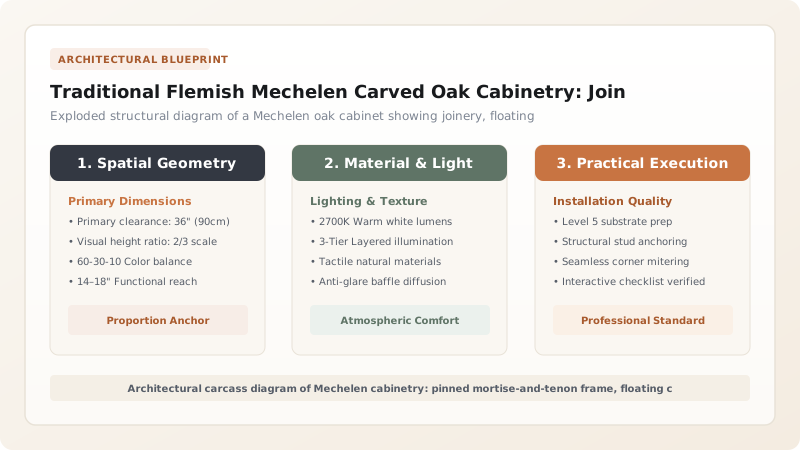
- Structural Joinery: Dowel-pinned mortise-and-tenon frames with hand-cut dovetailed drawer carcasses
- Historic Finish: Ammonia fuming (tannin reaction), raw linseed oil, and buffed beeswax-turpentine
In-Depth Guides in this Directory
Explore specialized subtopic blueprints, technical dimensions, and execution checklists:
Quarter-Sawn Flemish Brown Oak Selection & Ammonia Fuming Techniques
Technical guide to selecting quarter-sawn Flemish brown oak and executing traditional ammonia fuming for deep, authentic antique patination in cabinetry.
Lion Mask & Fruit Garland High-Relief Chisel Carving in Mechelen Furniture
In-depth guide to carving high-relief lion masks and fruit garlands in Mechelen oak cabinetry. Explore gouge selection, roughing out, undercutting, and facet modeling.
Mortise-and-Tenon Drawer Cases & Beeswax-Turpentine Buffing for Flemish Oak
Comprehensive joinery and finishing guide for Mechelen oak cabinetry: mortise-and-tenon casework, dovetailed drawers, and traditional beeswax-turpentine buffing.
Guild Traditions & The Rise of Mechelen Woodcraft
During the 16th century, the city of Mechelen (historically known as Malines in French) emerged as an administrative and cultural capital of the Habsburg Netherlands under Margaret of Austria. Amidst this flourishing court patronage, the local Guild of Saint Luke established rigorous standards for woodcarving, cabinetmaking (schrijnwerkers), and sculpture. Mechelen craftsmen developed a distinct idiom that bridged Northern Renaissance humanism with the robust, tactile theatricality of Flemish Baroque design. Unlike the lighter walnut furniture favored in contemporary France and Italy, the cabinetmakers of Brabant turned to their native slow-growth European brown oak (Quercus robur and Quercus petraea), creating monumental buffets, double-bodied armoires (twee-delige kasten), and court dressoirs designed to display wealth and civic prestige.
By the late 19th century, the historic craft underwent a massive international revival. Mechelen workshops, employing thousands of skilled carvers, supplied ecclesiastical furnishings, civic council chambers, and affluent domestic interiors across Europe and the Americas with faithful Neo-Renaissance masterpieces. Central to the guild's legacy was a strict division of labor between the structural joiner, who engineered dimensionally stable post-and-beam carcasses, and the master sculptor (beeldhouwer), who executed heroic figurative mascarons, botanical swags, and intricate strapwork (rolwerk) directly into solid oak panels.
Timber Anatomy: European Brown Oak & Medullary Ray Figure
The integrity and beauty of authentic Mechelen cabinetry rest entirely upon timber selection. European brown oak harvested from mature Flemish and Ardennes forests offers dense annual growth rings, fine cellular structure, and an abundance of vascular medullary rays. In traditional practice, master craftsmen rejected flat-sawn (tangential) lumber for visible surfaces because of its tendency to warp, cup, and expose broad, wild cathedral grain patterns that distract from fine carving. Instead, logs were converted through true radial quarter-sawing, where log quadrants are split or sawn perpendicular to the annual rings.
This radial conversion exposes the internal medullary ribbons—known in Dutch as spiegel or "mirror"—creating shimmering, ribbon-like chatoyancy across the surface of stiles, rails, and door faces. Crucially, quarter-sawn oak shrinks and swells by only 4% to 5% across its width in response to seasonal relative humidity shifts, compared to 8% to 10% for flat-sawn stock. This dimensional stability ensured that complex mortise-and-tenon joints remained tight across centuries and prevented carved relief panels from binding inside their perimeter frame grooves.
Sculptural Iconography: Lion Mascarons & Mannerist Festoons
The visual signature of Mechelen cabinetry is its unapologetic sculptural depth. Carvers working in the Mannerist tradition of Cornelis Floris and Hans Vredeman de Vries populated cabinet facades with rich allegorical programs. Foremost among these motifs is the lion mask (leeuwenkop), an emblem of courage, strength, and civic sovereignty. Carved in deep high-relief protruding 40 to 65 millimeters from the panel ground, these lion heads feature furrowed brows, flaring nostrils, snarling jaws often grasping solid brass suspension rings or flowing drapery swags, and stylized manes that transition seamlessly into curling acanthus leaf scrollwork.
Flanking these mascarons are overflowing fruit and vegetable festoons, celebrating agricultural bounty with realistic depictions of pomegranates, grapes, figs, wheat sheaves, and artichokes bound with knotted ribbon bands. Executing these motifs required a sophisticated sequence of hand chiseling: carvers used deep gouges to hollow out the background, V-parting tools to establish perimeter outlines, and delicate spoon gouges and macaroni tools to undercut fruit clusters, creating dramatic shadow lines that give the cabinetry its vibrant three-dimensional presence under ambient candlelight and daylight.
Chemical Patination: Ammonia Fuming & Beeswax Buffing
Authentic Mechelen oak derives its characteristic antique warmth not from pigmented surface stains, but from a profound chemical transformation known as ammonia fuming. European oak contains rich concentrations of natural polyphenolic tannic acids. When the completed, unvarnished oak cabinet was sealed inside an airtight room or tent with open vessels of concentrated ammonium hydroxide, the evaporating ammonia gas reacted with the tannic acid within the wood cells, forming insoluble, lightfast ammonium tannate compounds. This reaction deepens the raw, pale yellow timber into rich hazelnut, warm umber, and dark chocolate hues that penetrate several millimeters into the wood without raising grain fibers.
Following fuming and thorough ventilation, artisans saturated the parched wood fibers with warm boiled linseed oil cut with gum spirits of turpentine, which intensified grain contrast and brought the silver medullary rays into luminous relief. The final protection was achieved through the application of a proprietary paste wax composed of melted virgin beeswax, high-melt carnauba wax flakes, and natural gum turpentine. Hand-buffed with stiff horsehair brushes and wool cloths, this historic finish created a microporous, tactile, satin sheen that resisted dust, repelled atmospheric moisture, and developed a glorious, velvety patina over decades of domestic care.
Component Specifications in Traditional Mechelen Oak Cabinetry
Use this reference table to calculate exact physical dimensions, ratios, and specifications before purchasing:
| Cabinet Component | Wood Selection | Joinery System | Carving Typology | Finish Protocol |
|---|---|---|---|---|
| Base Plinth & Cornice | Quarter-sawn heartwood oak (40–50 mm) | Mitred bridal joints with internal corner blocks | Egg-and-dart, fluted dentils, acanthus leaf moldings | Deep ammonia fumed, oiled, high-wax sheen |
| Structural Corner Posts | Solid boxed-heart oak (80x80 to 100x100 mm) | Heavy mortise-and-tenon pegged with dry oak trunnels | Integrated fluted Corinthian pilasters or caryatid figures | Full ammonia fumed, satin wax finish |
| Upper Cupboard Doors | Book-matched quarter-sawn panels (25–35 mm) | Floating tongue-and-groove into mortised stiles | Central lion mask boss surrounded by hanging fruit swags | Chisel-cut facets preserved, double oiling, micro-wax |
| Drawer Carcasses | Rift-sawn straight-grained oak (16–20 mm) | Hand-cut through dovetails (half-blind on drawer fronts) | Incised strapwork borders on drawer faces with brass bail pulls | Natural waxed interior, fumed exterior front face |
| Backing Panels | Cleft or thin quartered oak boards (10–14 mm) | Shiplapped or beaded loose tongue joints | Planed smooth with slight hand-adzed hollows, uncarved | Lightly waxed or left unfinished to breathe |
Practical Constraints
Every successful decoration project must account for physical and environmental constraints:
High natural tannic acid variability across different oak harvests and sapwood zones
Ammonia fuming produces uneven, blotchy darkening if sapwood is mixed with mature heartwood. Mitigation: Strictly exclude all sapwood from visible casework and pre-test offcuts from every board in the fuming chamber.
Extreme seasonal humidity shifts causing cross-grain dimensional expansion in wide case tops
Rigidly fastened solid tops crack along grain lines or tear apart supporting frame rails. Mitigation: Fasten solid oak tops using slotted wooden buttons or steel figure-eight fasteners allowing 6–10 mm lateral expansion.
Execution Blueprint & Craftsmanship Sequence
Execute this professional sequence to achieve flawless results without backtracking:
Timber Selection & Radial Quarter-Sawing
Procure prime slow-growth European brown oak logs, sectioning them radially into true quarter-sawn planks to maximize medullary ray exposure and dimensional stability.
Equilibrium Seasoning & Stock Dimensioning
Air-dry rough planks for a minimum of one year per inch of thickness, followed by gentle kiln conditioning down to 8–10% equilibrium moisture content before flattening.
Structural Framework Mortise-and-Tenon Joinery
Cut precision blind mortises and haunched tenons for the main cabinet stiles, rails, and corner posts, drilling offset drawbore holes for tapered seasoned oak pins.
Panel Profiling & Floating Tongue Fitting
Mill perimeter tongues onto solid center door panels, inserting them into deep grooves within the perimeter frame stiles with 4 mm seasonal expansion clearance.
Rough-Out (Bosting) High-Relief Carvings
Trace architectural patterns onto blank panels and use heavy #7 and #8 sweep gouges with a wooden carver's mallet to establish deep 30–50 mm relief depths.
Fine Chisel Modeling of Lion Masks & Fruit Garlands
Model anatomical features, snarling lion jaws, grape clusters, and curling acanthus leaves using razor-sharp V-tools, spoon gouges, and curved skew chisels.
Hermetic Ammonia Chamber Fuming
Place the assembled cabinet without hardware into a sealed vapor tent with shallow trays of 26° Baumé aqueous ammonia for 12–24 hours until rich brown color develops.
Linseed Oil Saturation & Beeswax-Turpentine Buffing
Apply a penetrating wash of cold-pressed boiled linseed oil to nourish the wood fibers, followed by two hand-rubbed coats of paste wax buffed with horsehair brushes.
Common Mistakes & Countermeasures
Avoid these costly errors that compromise aesthetics, ergonomics, and budget:
Using flat-sawn oak rather than true quarter-sawn stock for wide cabinet door panels
Applying modern synthetic polyurethane or film-forming poly varnishes over carved surfaces
Power sanding over intricate carved details prior to finishing
Project Execution Checklist
Track your physical progress. Checkboxes persist automatically on this device:
Frequently Asked Questions
What distinguishes Mechelen carved oak furniture from other Flemish or French Renaissance cabinetry?
Mechelen cabinetry is renowned for its architectural scale, heavy reliance on monumental European brown oak, and deep, sculptural high-relief carving. Unlike French Renaissance pieces that favored walnut and delicate low-relief arabesques, Mechelen artisans favored robust, Mannerist strapwork, prominent three-dimensional lion mascarons clutching brass rings, overflowing fruit and vegetable swags, and tiered architectural pediments with turned balusters.
How does ammonia fuming work chemically on Flemish oak?
Ammonia fuming is a chemical reaction rather than a surface stain. European brown oak contains high concentrations of natural tannic acid (polyphenols). When exposed to airborne ammonium hydroxide gas (NH4OH) in an airtight chamber, the ammonia molecules penetrate deeply into the wood cells, reacting with the tannins to synthesize insoluble ammonium tannate compounds. This turns the wood a deep, permanent, nutty golden-brown or dark espresso tone without raising the grain or obscuring the medullary ray ribbons.
Why is quarter-sawn oak mandatory for traditional Mechelen cabinet doors?
Quarter-sawn oak is cut perpendicular to the tree's growth rings, which yields two enormous advantages: first, it displays the dramatic, silvery "spiegel" or medullary ray flecks prized by Renaissance artisans; second, quarter-sawn oak has nearly half the radial shrinkage and swelling rate of flat-sawn oak, preventing large carved door panels from binding, warping, or cracking inside their grooved frames across humid Low Countries seasons.
How should an authentic antique Mechelen oak cabinet be cleaned and preserved?
Never use commercial silicone sprays, water, or chemical detergents on historical Mechelen oak. Dust gently with a soft natural bristle brush to clean out deep relief crevices. Every one to two years, apply a very thin coat of paste wax formulated with pure beeswax, carnauba flakes, and gum spirits of turpentine using a lint-free cotton cloth. Allow the solvent to haze for 20 minutes, then buff vigorously with a stiff horsehair brush followed by flannel to maintain the lustrous historic patina.