Straw animal finials are sculptural folk art pieces woven from golden winter wheat straw and mounted at the gable apexes of English thatched roofs. Descended from pagan corn dolly harvest traditions, master thatchers construct a seasoned timber and copper wire armature, wrapping it in complex multi-strand straw plaits (such as spiral, cat’s foot, and braid weaves) to sculpt realistic pheasants, foxes, cockerels, or hares that serve as trade signatures.
At a Glance: Key Takeaways
- Sculptural Motifs: Pheasants, Cockerels, Foxes, Hares, Wheat Sheaves, & Crowns
- Weaving Straw: Hollow-stemmed winter wheat straw stripped of leaves & soaked in water
- Internal Armature: Carved oak or ash timber spindle with heavy copper wire skeleton
- Weaving Techniques: 5-Strand Spiral Plait, Hair Braid, & Overlapping Feather Shingles
- Roof Mounting: Tenoned and bolted directly into the timber ridge apex beam
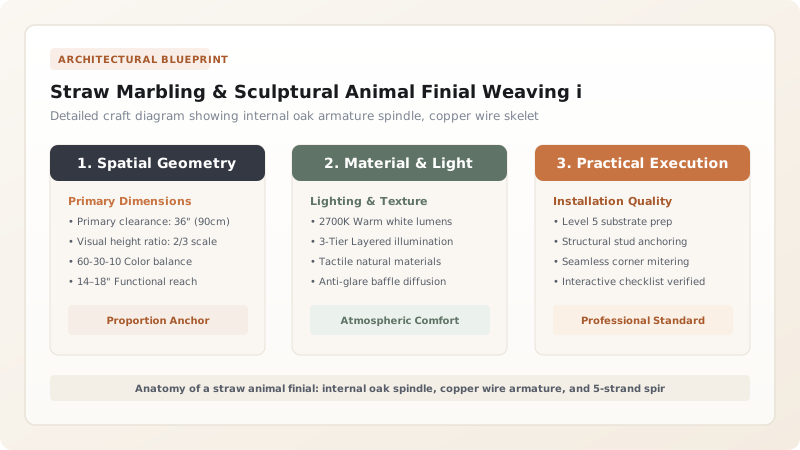
Pagan Origins and Agrarian Folklore of the Corn Dolly
Perched high atop the gable apexes and hipped ridges of English thatched cottages, sculptural straw animals and figures represent one of the oldest surviving expressions of British folk art. While modern homeowners view them as charming decorative flourishes, their historical origins are rooted in ancient pre-Christian harvest mythology and the cult of the corn dolly.
In traditional agrarian England, rural folklore held that the divine spirit of the cereal crop fled before the sickles of the reapers, finally taking refuge in the very last standing sheaf of wheat. To preserve this fertility spirit through the barren winter, reapers cut the final sheaf with great ceremony and plaited the golden stems into intricate symbolic forms—such as the Kern Baby, the Mell Doll, or harvest knots. Placed atop the newly thatched granary or cottage ridge, the sculpture was believed to protect the homestead from lightning, fire, and famine until the spring planting.
Wheat Straw Biology and Tempering Chemistry
Crafting a weather-resilient, three-dimensional sculpture from cereal stems requires precise material selection. Modern commercial dwarf wheat cultivars (bred with short, thick, brittle stalks designed for mechanical combines) are completely useless for weaving. Thatchers rely on historic, tall-stemmed winter wheat varieties (such as Maris Widgeon or Squarehead’s Master) harvested by hand or with vintage reapers that leave the stems unbruised.
The artisan strips away the outer leaf sheaths and cuts the hollow stems just above the joints (nodes), obtaining smooth, golden straw pipes. Before plaiting, the brittle dry straw must undergo tempering. The stems are submerged in warm water for 20 to 30 minutes, followed by wrapping in damp burlap. Water hydrates the lignin and cellulose matrix, converting the rigid hollow tubes into pliant, rubbery ribbons that can be bent, knotted, and braided around tight corners without splitting or crushing.
Armature Engineering: Oak Spindles and Copper Skeletons
A straw finial mounted on an exposed roof ridge must withstand severe meteorological abuse: gale-force Atlantic wind turbulence, heavy snow loads, and torrential rain. To survive without drooping or snapping, master thatchers build the sculpture over a rigid internal structural armature.
The spine of the sculpture is a turned or carved spindle of seasoned oak or ash timber measuring 40 to 60 centimeters in length. Through this timber core, the craftsman drills cross-holes and drives heavy solid copper wire rods (3 to 4 mm in diameter). Copper is non-corrosive and easily bent by hand into the skeletal contours of pheasant wings, cockerel tails, fox legs, or hare ears. The timber spindle extends at least 30 centimeters below the animal base, designed to be tenoned and bolted directly into the structural roof apex beam.
Plaiting Techniques: Spiral Weaves and Shingled Plumage
Over this padded skeletal armature, the master thatcher executes complex decorative plaiting. The body volume is typically constructed using the classical 5-strand spiral plait. Five tempered wheat straws are anchored to the base and woven continuously in a rotating sequence, bending each straw over its neighbor at precise angles to create a seamless, hollow, high-density cylinder that expands or contracts to follow anatomical contours.
For birds such as pheasants and cockerels, the plumage is applied like architectural shingles. Individual straw stems are sliced flat, trimmed to curved feather profiles, and layered over the body core from the tail upward, ensuring that every feather overlaps the one below. When wind-driven rain strikes the finial, water cascades smoothly off the shingled straw plumage like water off a duck’s back. Allowed to dry rock-hard in the sun, the golden straw hardens into a rigid, sculptural trade signature that endures for a decade atop the thatched ridge.
Straw Plaiting Typologies for Architectural Finial Sculptures
Use this reference table to calculate exact physical dimensions, ratios, and specifications before purchasing:
| Plait Typology | Strand Count | Geometric Cross-Section | Anatomical Application | Structural Density |
|---|---|---|---|---|
| Spiral Plait (Corn Dolly) | 5 or 7 Hollow Strands | Hollow pentagonal or heptagonal tube | Animal necks, torsos, and pheasant bodies | Very High (Extremely rigid when dry) |
| Cat’s Foot Plait | 4 Flat Strands | Square, articulated chain pattern | Animal legs, crests, and ears | High; flexible before drying |
| Hair Braid (Flat Plait) | 3 to 5 Wide Strands | Flat ribbon strap | Border trims, collars, and wing edges | Moderate; takes sharp bends |
| Layered Feather Shingle | Single trimmed stems | Overlapping shingled feather coat | Bird plumage and wing covers | High water-shedding efficiency |
Practical Constraints
Every successful decoration project must account for physical and environmental constraints:
Severe Wind Drag and Torsional Fatigue on Roof Apex Sculptures
Gale-force winds buffeting large sculptural finials exert intense twisting moments on timber spindles. Mitigation: Streamline animal silhouettes facing into prevailing winds and anchor spindles with heavy through-bolts.
Bird Perching Damage and Nesting Material Scavenging
Crows and jackdaws perch on straw animals and pull out tail feathers for nest building. Mitigation: Insert discreet stainless-steel anti-perch bird spikes along animal crests and heads.
Execution Blueprint & Craftsmanship Sequence
Execute this professional sequence to achieve flawless results without backtracking:
Straw Selection and Conditioning
Select clean, golden winter wheat straw harvested with a traditional reaper; trim leaves and soak in warm water for 30 minutes until fully pliant.
Armature Carving and Wire Framing
Carve the central animal spine from seasoned oak timber; drill cross-holes and insert heavy 3 mm copper wires to frame wings, legs, and tails.
Core Padding and Body Shaping
Wrap the timber spine with waste straw bundles bound tightly with hemp cord, building up the muscular anatomical contours of the animal body.
Spiral Plait Weaving (Body Skin)
Anchor five tempered wheat straws at the base of the armature; execute a continuous 5-strand spiral plait around the core to form a seamless outer skin.
Feather and Fur Shingling
For pheasants and cockerels, craft individual wing feathers from sliced straw stems; shingle them overlapping from tail to shoulder like roof tiles.
Detailing and Facial Anatomy
Form beaks, eyes, and combs using intricate 3-strand flat plaits and folded straw knots; wire firmly into the head core with copper ties.
Desiccation and Bio-Preservative Coating
Allow the finished sculpture to dry thoroughly in a warm workshop; spray lightly with a bio-based copper naphthalate solution to deter mold.
Apex Installation and Bolting
Hoist the finial onto the roof ridge; drive the protruding oak mounting spindle through the ridge roll, bolting it securely to the timber ridge beam.
Common Mistakes & Countermeasures
Avoid these costly errors that compromise aesthetics, ergonomics, and budget:
Weaving finials from dry, un-soaked wheat straw
Using mild steel wire for internal armature appendages
Mounting the finial onto the straw thatch rather than into the structural timber ridge beam
Project Execution Checklist
Track your physical progress. Checkboxes persist automatically on this device:
Frequently Asked Questions
What is the folklore behind straw finials on English thatched cottages?
Straw finials originated from ancient pagan harvest rituals. At the end of the harvest, the final sheaf of wheat—believed to contain the "corn spirit" (or harvest goddess)—was plaited into a sculptural "corn dolly" and placed in the home or on the roof to ensure agricultural fertility through the winter.
Which animals are most commonly woven into thatch finials?
The pheasant is by far the most popular motif across England, celebrated for its long, dramatic tail feathers. Other common vernacular figures include cockerels, foxes, hares, owls, cats, crowns, and traditional corn dollies representing sheaves of wheat.
How long does a straw animal finial last on a roof?
Because finials are three-dimensional, exposed sculptures mounted on the highest point of the house, they weather more rapidly than the flat roof plane. A well-crafted straw finial typically lasts between 8 and 12 years before requiring re-weaving during ridge maintenance.