A block-cut raised ridge is an ornamental and functional weather-cap crowning an English thatched roof. Constructed over a dense central roll of straw or marsh sedge, flexible reed aprons are folded across the apex and pinned with diamond-spar lattices. Thatchers use razor-sharp paring knives to carve decorative scalloped, saw-toothed, or stepped margins into the bottom edge of the ridge, while maintaining a steep 50° weather angle to shed rain.
At a Glance: Key Takeaways
- Ridge Typology: Raised Block-Cut Ridge standing 15–25 cm proud of the roof plane
- Core Construction: Tightly bound roll of marsh sedge (Cladium mariscus) or unthreshed straw
- Apron Material: Combed wheat reed or winter rye straw wrapped across both roof pitches
- Margin Profiles: Hand-pared scallops, inverted V-points, stepped dentils, & diamonds
- Weather Pitch: 50° to 55° apex slope to ensure instantaneous water shedding
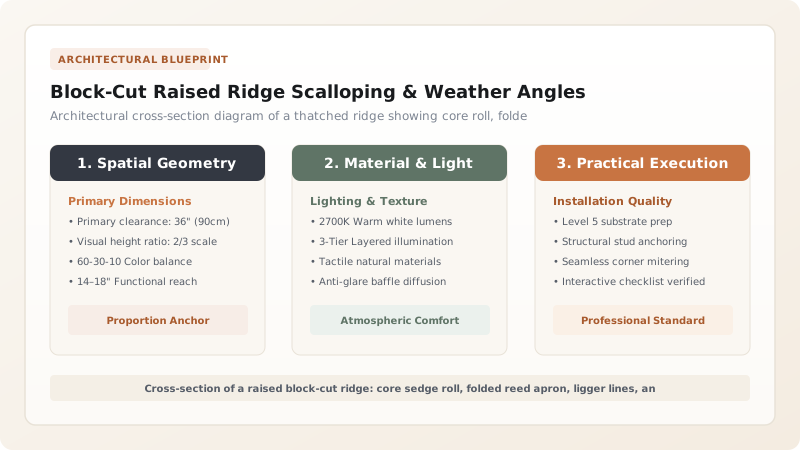
Functional and Aesthetic Evolution of the English Thatched Ridge
In the architecture of a thatched roof, the ridge represents the most vulnerable meteorological junction. Because the individual reeds of the main roof slopes point downward to shed water, the horizontal seam at the apex where opposing slopes meet cannot be thatched in the same direction. It requires an independent capping assembly engineered to seal the apex against water ingress while anchoring the upper margins of the roof slopes.
While earlier medieval roofs utilized simple turf caps or clay ridge tiles, the nineteenth century witnessed the flourishing of the raised block-cut ridge across the Wessex counties of Dorset, Devon, Hampshire, and Wiltshire. Thatchers elevated this functional necessity into an art form, creating thick, stepped ridges with crisp sculptural margins that define the cottage silhouette against English skies.
Anatomy of the Raised Ridge: Core Roll and Apron Layup
Constructing a raised block-cut ridge is an exacting exercise in structural layering. The foundation is the core roll (often called the dolly). Master thatchers bind dense rolls of Great Fen sedge (Cladium mariscus) or long straw into tight 20-centimeter-diameter cylinders. Spiked firmly to the roof rafters along the apex beam, this roll provides a firm, convex crowning armature.
Over this core, the thatcher lays the apron—a 200-millimeter-thick coat of combed wheat reed or flexible winter rye straw. Laid horizontally on both slopes, the upper halves of the reed stems are bent gently over the central roll, interlocking at the peak. Because the apron stands proud of the main roof plane by 15 to 25 centimeters, it creates a pronounced shadow line that visually articulates the roof hierarchy.
The Geometric Lattice: Decorative Diamond Sparring
The apron is held in place by an elaborate lattice of split-hazel liggers and twisted brotches. The craftsman pins two primary horizontal ligger lines: an upper line running just below the apex, and a lower line positioned approximately 100 millimeters above the planned bottom margin.
Between these parallel liggers, the master thatcher inserts dozens of twisted hazel cross-spars, arranging them into intricate decorative patterns. Depending on regional guild traditions, these patterns include interlocking diamonds (the classic Dorset style), double-chevrons, herringbone zigzags, or cross-hatched saltires. This external spar-work is not merely ornamental; it exerts continuous compressive pressure across the entire width of the apron, preventing gales from lifting the bent reed stems.
Precision Block-Cutting and Weathering Geometry
The final flourish of the ridge is block-cutting. Using a notched wooden template and chalk, the thatcher marks out repeating geometric motifs along the bottom overhang of the apron. The motifs range from classical rounded scallops and inverted V-shaped points to Gothic trefoils and stepped dentils.
Using a razor-sharp thatching paring knife, the artisan slices vertically through the compressed straw in a single decisive, shearing stroke. The cut is made dead-square (90° undercut) to the roof pitch. This crisp undercut creates a pronounced drip edge: rainwater streaming down the ridge apron drips directly off the scallops onto the main roof slope below, preventing capillary water from creeping backward beneath the ridge. Maintained at a steep 50° to 55° weather angle, the block-cut ridge ensures that the peak remains dry and watertight through years of driving English rain.
English Thatched Ridge Typologies and Craft Styles
Use this reference table to calculate exact physical dimensions, ratios, and specifications before purchasing:
| Ridge Typology | Profile & Projection | Fastener Arrangement | Regional Association | Average Lifespan |
|---|---|---|---|---|
| Block-Cut Raised Ridge | Raised 15–20 cm proud with pared scallops | Exposed diamond-spar & ligger lattice | Dorset, Devon, & Wessex Counties | 10 to 14 Years |
| Flush Ridge | Flush with main roof pitch; zero step | Concealed stitching or minimal spars | Norfolk & East Anglia (Water reed roofs) | 15 to 20 Years |
| Turned Ridge (Wrap) | Straw folded over apex with rounded crown | Cross-sparred along bottom edge only | Cornwall & Cotswold cottages | 8 to 12 Years |
| Crested Sedge Ridge | Sharp triangular ridge capped in spiked sedge | Intricate multi-tier decorative spars | Cambridgeshire & Fenland districts | 12 to 16 Years |
Practical Constraints
Every successful decoration project must account for physical and environmental constraints:
Bird and Rodent Predation of Grain Residues in Ridge Straw
Sparrows, starlings, and mice burrow into the ridge seeking residual wheat grains, tearing the apron. Mitigation: Cap the entire ridge with 19 mm galvanized wire netting stretched taut over the spar-work.
Accelerated UV and Biological Degradation of the Roof Apex
Being the most exposed section to sun and rain, ridges wear twice as fast as the main roof slopes. Mitigation: Design ridges as sacrificial modular assemblies easily replaced every 10–12 years without re-thatching the roof.
Execution Blueprint & Craftsmanship Sequence
Execute this professional sequence to achieve flawless results without backtracking:
Old Ridge Stripping and Apex Cleaning
Carefully strip degraded old ridge straw down to the sound thatch base; rake out decomposed debris and inspect apex timber rafters.
Core Roll (Dolly) Fabrication
Form a dense, 20 cm diameter cylindrical roll of long straw or Great Fen sedge (Cladium mariscus); bind tightly with baling cord at 30 cm intervals.
Ridge Roll Anchoring
Position the core roll directly atop the rafter apex; spike firmly into roof timbers using heavy 30 cm iron thatch pins or hazel stobbs.
Apron Reed Laying and Folding
Lay 200 mm thick coats of pliant combed wheat reed on both roof slopes; bend the upper half of the stems over the apex roll to interlock at the crest.
Ligger Line Installation
Pin horizontal split-hazel liggers across the apron on both slopes: one row 75 mm below the apex and a second row 100 mm above the bottom edge.
Decorative Cross-Spar Weaving
Insert hundreds of twisted hazel brotches between the two ligger lines to form intricate diamond, herringbone, or chevron cross-lattices.
Pattern Scribing and Marking
Hold a notched wooden template against the bottom edge of the ridge; mark semi-circular scallops or inverted points using chalk or marking knife.
Precision Block-Cut Paring
Slice downward through the thatch along the scribed lines using a razor-sharp paring knife, creating a crisp 90° undercut block edge.
Common Mistakes & Countermeasures
Avoid these costly errors that compromise aesthetics, ergonomics, and budget:
Paring ridge scallops with a dull knife or sawing back and forth
Constructing a flat-topped ridge roll that creates a horizontal shelf at the apex
Cutting ridge scallops too close to the lowest retaining ligger line (under 50 mm)
Project Execution Checklist
Track your physical progress. Checkboxes persist automatically on this device:
Frequently Asked Questions
Why is the ridge replaced more frequently than the main thatched roof?
The ridge is the apex of the building and receives maximum exposure to driving rain, freeze-thaw cycles, ultraviolet sunlight, and perching birds. While a combed wheat reed roof lasts 30 years, the sacrificial ridge typically needs renewal every 10 to 14 years.
What tools are used to carve decorative ridge scallops?
Thatchers use a dedicated thatching paring knife (or cutting knife). This tool features a long, curved, razor-sharp steel blade mounted on an offset handle, allowing the craftsman to make clean vertical guillotine cuts through 20 cm of compressed straw without catching fibers.
What is Great Fen Sedge (Cladium mariscus) and why is it used for ridges?
Fen sedge is a tough, serrated wetland plant harvested in the peat bogs of Cambridgeshire (such as Wicken Fen). Because it is exceptionally fibrous, contains high natural silicates, and flexes without snapping, it is the premier material for building rot-resistant ridge rolls.