
Hakka rammed earth mortar (Sanhe-tu) achieves high compressive strength and water impermeability through organic-inorganic hybridization. In addition to local red clay, coarse river sand, and slaked lime, Hakka masons incorporated fermented glutinous rice slurry, dark brown sugar syrup, and egg whites. These natural bio-macromolecules regulate calcium carbonate crystal growth and cross-link with soil clay colloids, producing a rock-hard composite.
At a Glance: Key Takeaways
- Material Designation: Sanhe-tu ('Three-Harmonies Earth') with organic bio-additives
- Base Inorganic Trio: Red laterite clay (30%), coarse river sand (50%), quicklime / slaked lime (20%)
- Key Bio-Binders: Glutinous rice broth (amylopectin), boiled brown sugar cane syrup, egg whites
- Chemical Mechanism: Biomineralization template directing calcite microcrystalline densification
- Compressive Strength: Reaches 4.0 to 7.5 MPa after 12 months curing
- Water Absorption: Reduced by up to 65% compared to untreated raw rammed earth
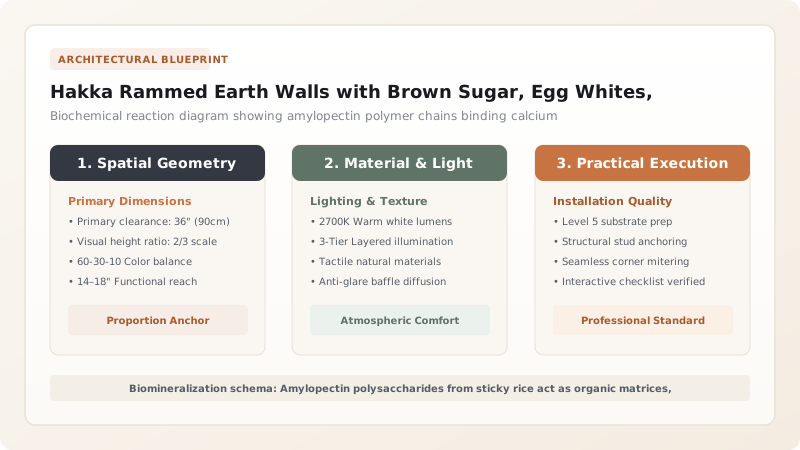
Biochemical Mechanism of Organic Biopolymer Stabilization
The exceptional durability of Hakka earthen fortresses stems from a sophisticated pre-modern understanding of biomineralization. While typical raw rammed earth relies strictly on soil compaction and clay suction, Hakka Sanhe-tu incorporates three critical organic bio-polymers:
- Glutinous Rice Slurry (Amylopectin): Cooked sticky rice broth contains branched polysaccharide amylopectin chains. In the presence of alkaline calcium hydroxide, these starch chains act as a structural template, controlling the nucleation, morphology, and growth rate of calcite crystals, resulting in a much denser crystal packing structure.
- Brown Sugar / Molasses (Sucrose & Fructose): Sucrose acts as an organic set-retarder and plasticizer. It temporarily slows initial lime setting, allowing masons to achieve maximum compaction density under heavy rammers, while enhancing long-term crystal interlocking.
- Egg Whites (Albumen Proteins): Egg albumin contributes hydrophobic polypeptide chains that coat soil particles, dramatically reducing capillary pore suction and rendering the cured earth hydrophobic against penetrating moisture.
Mineral Aggregate Balance: The Sanhe-tu Formula
The mineral matrix must be perfectly proportioned before adding organic broths. Hakka master builders developed the 'Three-Harmonies Earth' rule:
1. Red Mountain Clay (Laterite): Harvested from deep subsoil layers rich in weathered iron oxides and kaolinite. It provides plastic cohesive binding.
2. River Sand and Fine Gravel: Sharp, washed quartz aggregates ranging from 1 to 5 mm, acting as an unyielding compressive skeleton that prevents drying shrinkage.
3. Slaked Lime (Hydrated Calcium Hydroxide): Provides chemical carbonation and pozzolanic reactions with reactive silicates in the laterite clay.
The dry ingredients are mixed thoroughly, moistened with the hot organic rice-sugar-egg decoction to the exact moisture level where a squeezed handful retains its shape without shedding water, and placed into formwork immediately.
Hakka Rammed Earth Walls with Brown Sugar, Egg Whites, and Sticky Rice Binders Architectural Decision Matrix
Use this reference table to calculate exact physical dimensions, ratios, and specifications before purchasing:
| Additive | Chemical Component | Dosage (by Binder Weight) | Primary Physical Effect | Long-Term Contribution |
|---|---|---|---|---|
| Glutinous Rice Broth | Amylopectin polysaccharide | 3–5% liquid weight | Templates calcite crystal nucleation | Dense microcrystalline matrix, high shear strength |
| Cane Brown Sugar | Sucrose & reducing sugars | 1–2% dissolved in broth | Retards premature set, improves compaction | Enhanced ultimate compressive hardness |
| Egg White (Albumen) | Protein / hydrophobic polypeptides | 0.5–1% liquid volume | Lowers surface tension & pore suction | Hydrophobic moisture resistance |
| Hydrated Lime Putty | Calcium hydroxide (Ca(OH)2) | 15–20% dry volume | Carbonation to calcite stone | Long-term monolithization |
Practical Constraints
Every successful decoration project must account for physical and environmental constraints:
Biological Souring Window
Raw Material Sourcing Scale
Batching and Mixing Bio-Stabilized Tulou Earth
Execute this professional sequence to achieve flawless results without backtracking:
Broth Decoction
Boil glutinous rice in copper cauldrons until completely gelatinized into a thick, milky starch gruel; dissolve dark brown sugar syrup into the hot liquid.
Cooling & Protein Addition
Allow the broth to cool to approximately 35°C before whipping in fresh duck or chicken egg whites to prevent premature protein coagulation.
Dry Mineral Blending
Turn over red clay, sharp quartz river sand, and dry slaked lime three times with shovels until the pile achieves uniform reddish-buff coloration.
Moisture Introduction
Sprinkle the organic broth gradually over the dry mix using watering cans, turning continuously until reaching optimum moisture content (~12–14%).
Ball-Drop Moisture Test
Compress a handful of earth into a firm ball; drop it from chest height (1.5 m) onto hard ground. If it shatters into 4–5 pieces, moisture is ideal for ramming.
Common Mistakes & Countermeasures
Avoid these costly errors that compromise aesthetics, ergonomics, and budget:
Adding boiling hot broth directly to egg whites
Excessive sugar addition (>3% by weight)
Using unwashed topsoil containing organic humus
Project Execution Checklist
Track your physical progress. Checkboxes persist automatically on this device:
Frequently Asked Questions
Does the inclusion of food materials like rice and eggs attract insects and rodents?
No. The high alkalinity of the slaked lime (pH > 12) denatures and sanitizes the biological matter. Once cured and carbonated, the matrix forms a dense, alkaline mineral stone that contains no edible nutritional value for pests.
How did ancient Hakka builders discover this organic formula?
Sticky rice lime mortar was developed during the Southern and Northern Dynasties (5th century) for military fortifications and tombs across China. The Hakka adapted this high-status imperial engineering technique to domestic rammed earth construction.


