
Classical Chinese sunmao joinery is the highest expression of non-adhesive, fastener-free structural woodworking. In Nanmu palace and cabinet construction, joints such as the three-way miter (baoduhe) and corner tenon (zongjiaosun) interlock three orthogonal structural members into a rigid, self-locking node that resists twisting while absorbing seismic lateral sway through microscopic friction.
At a Glance: Key Takeaways
- Core Joinery Philosophy: 100% glueless and nailless mechanical interlock; reversible and self-tightening.
- Master Three-Way Joint: Baoduhe (literally 'holding the stomach') three-way mitered corner joint.
- Corner Column Joint: Zongjiaosun (corner tenon) interlocking vertical leg with dual horizontal stretchers.
- Concealed Locking Key: Hidden interior wedge keys (an-sun) that lock mortises without external pins.
- Machining Tolerance: Hand-chiseled to +/- 0.1mm tolerance for tight, sliding friction fits.
- Seismic Performance: Absorbs dynamic lateral earthquake shock waves via micro-joint dissipation.
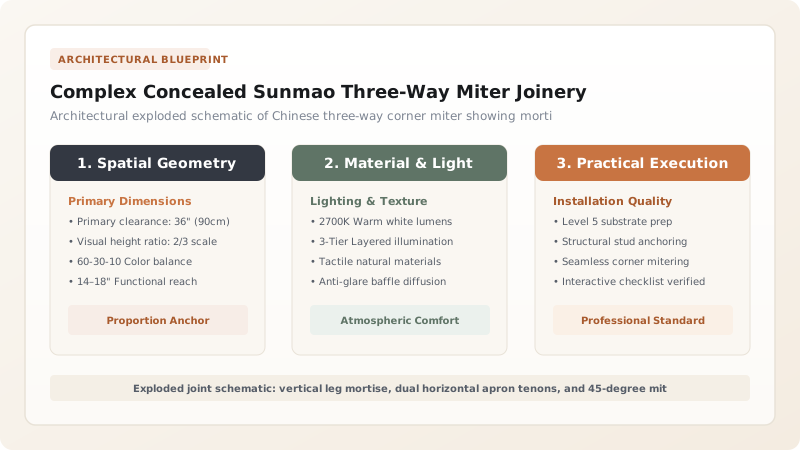
The Philosophy of Sunmao: Dynamic Living Interlocking
In classical Chinese woodworking treatises (such as the Ming Dynasty Lu Ban Jing), architecture is conceived as an organic, breathing organism. Rigid steel nails and modern adhesives create artificial stress concentrations that split timber during seasonal climate shifts.
Instead, Chinese joinery employs sunmao (tenon and mortise)—thousands of variations of interlocking tongues and sockets. The joints allow individual timber members to expand and contract microscopically with ambient humidity without breaking. When subjected to violent earthquakes, the hundreds of sunmao joints in a Nanmu pavilion act as friction shock absorbers, dissipating kinetic energy through microscopic joint slip while keeping the structure plumb.
The Master Joint: Anatomy of the Baoduhe Three-Way Miter
The pinnacle of Chinese joinery complexity is the baoduhe (three-way mitered corner joint). At the meeting point of a vertical post (leg) and two horizontal aprons (stretchers), all three members converge at 90° angles.
From the outside, the joint appears as three clean, razor-sharp 45° miter lines meeting at a single corner point. Internally, however, it conceals an astonishing three-dimensional puzzle: the vertical post features a stepped blind mortise with internal locking shoulders, the first horizontal apron carries a through-tenon with a central slot, and the second apron features a locking tenon that penetrates through the first apron's slot, pinning all three members into an unbreakable mechanical cage.
Chiseling Disciplines and 0.1mm Tolerance Execution
Executing a baoduhe joint in dense, figured Nanmu demands surgical discipline. Craftsmen use Japanese-style fine-toothed pull saws (dôzuki) to slice the 45° miter shoulders, cutting strictly along scribed lines.
The internal mortises and tenon cheeks are pared with wide, heavy paring chisels (guang-zao) ground flat and polished to mirror brightness. There is zero room for error: if a tenon is 0.2mm too tight, driving it home will split the Nanmu post along its radial grain; if it is 0.2mm too loose, the joint will wobble and rack. When correctly executed, the dry pieces slide together with a firm, satisfying pneumatic hiss under hand pressure.
Classical Chinese Sunmao Joinery Types in Architectural Frameworks
Use this reference table to calculate exact physical dimensions, ratios, and specifications before purchasing:
| Joint Name | Chinese Pinyin | Internal Geometry | Structural Role | Disassembly Mode |
|---|---|---|---|---|
| Three-Way Corner Miter | Baoduhe | Triple 45° miter with interlocking dual tenons | Corner legs meeting table aprons & lintels | Sequential slide; non-rotational |
| Corner Tenon | Zongjiaosun | Concealed through-tenons with stepped shoulders | Main post-and-beam perimeter connections | Vertical pull-out |
| Gooseneck Tenon | E-bo-sun | Curved locking tenon sliding into socket | Curved roof brackets & circular armchairs | Rotating locking slide |
| Dovetail Wedge | Yanwei-sun | Trapezoidal tenon resisting tensile withdrawal | Floor beam splices & wide panel joining | Transverse sliding key |
| Through-Pegged Tenon | Chuan-sun | Pass-through tenon locked with wooden key | Heavy architectural post-and-lintel frames | Drive out wedge key to dismantle |
Practical Constraints
Every successful decoration project must account for physical and environmental constraints:
Extreme time investment: a single complex three-way baoduhe joint requires 4 to 6 hours of master bench work
Mitigation: Utilize precision CNC 5-axis roughing machines to remove 80% of waste wood, reserving the final 20% for master hand-paring.
Execution Blueprint & Craftsmanship Sequence
Execute this professional sequence to achieve flawless results without backtracking:
Square and True All Three Timber Members
Hand-plane leg and two stretchers to perfectly square cross-sections with zero twist, checking with winding sticks.
Scribe 45-Degree Corner Miters with Steel Awl
Layout precise 45-degree shoulder miters on all three pieces using hardened brass miter gauge and scoring knife.
Chisel Concealed Stepped Mortise in Vertical Leg
Chisel dual internal mortises inside leg top, creating internal stepped bearing shelves for the apron tenons.
Saw and Pare Interlocking Slotted Tenons on Aprons
Saw male tenons on both aprons, cutting a transverse slot through Tenon A to receive the locking tongue of Tenon B.
Dry-Fit and Fine-Tune Miter Shoulders with Paring Chisel
Slide components together; inspect 45-degree miter lines against light; pare high spots with razor-honed chisel.
Final Assembly with Concealed Hardwood Wedge Key
Assemble joint dry and tap concealed internal wedge (an-sun) home, locking the three-way joint permanently tight.
Common Mistakes & Countermeasures
Avoid these costly errors that compromise aesthetics, ergonomics, and budget:
Applying modern PVA or epoxy glue inside complex sunmao joints
Using a mechanical power router to cut curved tenon shoulders
Project Execution Checklist
Track your physical progress. Checkboxes persist automatically on this device:
Frequently Asked Questions
Can a completed sunmao joint be disassembled after centuries?
Yes. One of the greatest virtues of Chinese sunmao joinery is total reversibility: by locating the concealed locking key or applying gentle mallet taps in reverse order of assembly, the entire structure can be disassembled without damaging a single fiber.
Why don't Chinese carpenters use glue in sunmao joints?
Traditional masters understood that timber must move with seasonal humidity. Glued joints fight the wood's natural movement and inevitably tear apart. Glueless friction joints dissipate internal stress through microscopic sliding movements.


