
Preserving Chinese Nanmu architecture relies on shengqi (raw natural lacquer)—the purified sap of the Toxicodendron vernicifluum tree. Unlike synthetic finishes that cure by solvent evaporation, urushi polymerizes via enzymatic oxidation driven by laccase enzymes in dark, humid curing chambers (yushi) at 75%–85% RH and 22°C–26°C, creating an indestructible, glass-like natural shield that enhances golden chatoyancy.
At a Glance: Key Takeaways
- Botanical Lacquer Source: Purified sap tapped from wild Chinese lacquer trees (Toxicodendron vernicifluum).
- Enzymatic Polymerization: Driven by active laccase enzymes requiring high ambient humidity (75%–85% RH).
- Finishing Typology: Shengqi (raw clear lacquer) hand-rubbed in micro-thin layers to reveal natural wood grain.
- Abrasive Polishing: Water-honing with soft willow charcoal (honoki/yan-tan) and fine deer-horn powder (tsunoko).
- Chemical Immunity: Fully cured urushi is immune to boiling water, alcohol, natural acids, and solvents.
- Refractive Enhancement: High refractive clarity illuminating golden-thread Jinsi Nanmu crystalline ribbons.
Harvesting Shengqi: Tree Sap Chemistry and Purification
Natural Chinese lacquer (qi) has been harvested for over four thousand years from the bark of the Chinese lacquer tree (Toxicodendron vernicifluum, formerly Rhus verniciflua). Master tappers make horizontal incisions into the trunk between June and September, collecting the milky grey sap in bamboo cups.
Raw sap contains approximately 65% urushiol, 25% water, 7% plant gums, and 2% laccase enzyme. To prepare shengqi (raw lacquer for architectural woodworking), the raw sap is filtered through specialized handmade hemp paper to remove bark dust and slowly stirred in open wooden vats under gentle sunlight (kurome process) to reduce water content below 5%, producing a lustrous, translucent honey-like syrup.
The Humid Curing Paradox: The Yushi Chamber
In modern woodworking, applying varnish in a humid room ruins the finish. With natural urushi lacquer, the opposite is true: lacquer will not cure in a dry room. It requires moisture to harden.
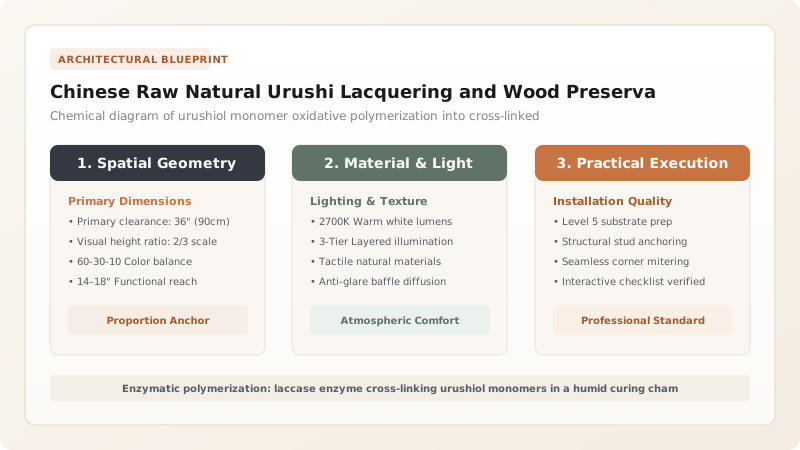
The curing reaction is catalyzed by the biological enzyme laccase. In the presence of atmospheric oxygen and water vapor, laccase oxidizes the phenolic ring of the urushiol molecules, initiating a chain-growth polymerization that cross-links the monomers into an insoluble, three-dimensional polymeric glass. Artisans place lacquered Nanmu components into dedicated underground curing chambers called yushi, maintaining strict conditions of 75% to 85% relative humidity at 22°C to 26°C for 24 to 48 hours per coat.
Multi-Stage Charcoal Honing and Tsunoko Burnishing
Elite imperial finishing requires seven to ten micro-thin coats of shengqi. Applying a thick coat is fatal: the surface skins over prematurely, cutting off oxygen and leaving the underlying lacquer liquid forever.
Between each cured coat, the surface is leveled using soft willow charcoal sticks lubricated with clean water, cutting away microscopic dust nibs without scratching the wood. After the final coat cures, the surface is rubbed with tsunoko (calcined pulverized deer horn powder) mixed with vegetable oil using the soft heel of the craftsman's palm. The frictional warmth produces a breathtaking, satin-smooth 'breathing skin' that showcases the golden threads beneath.
Natural Chinese Urushi Lacquer vs Modern Synthetic Wood Finishes
Use this reference table to calculate exact physical dimensions, ratios, and specifications before purchasing:
| Finishing Medium | Curing Mechanism | Chemical Resistance | Lifespan Potential | Effect on Nanmu Chatoyancy |
|---|---|---|---|---|
| Raw Urushi (Shengqi) | Laccase enzymatic polymerization (in humidity) | Immune to boiling water, acid, alcohol | Thousands of years (archaeologically proven) | Luminous optical depth; highlights golden threads |
| Polyurethane Lacquer | Evaporation & isocyanate cross-linking | Degrades under UV & thermal cycling | 10 to 15 years (cracks & peels) | Flat, plastic appearance; blocks natural aroma |
| Nitrocellulose Lacquer | Simple solvent evaporation | Poor; dissolves in alcohol & solvents | 5 to 8 years (turns brittle & yellows) | Suffocates wood; yellows rapidly in sunlight |
| Boiled Linseed Oil | Oxidative polymerization of fatty acids | Moderate; darkens severely with age | 3 to 5 years (requires frequent re-oiling) | Muddies fine grain; darkens golden chatoyancy |
Practical Constraints
Every successful decoration project must account for physical and environmental constraints:
Raw urushiol sap causes severe allergic contact dermatitis (poison ivy rash) on unprotected skin
Mitigation: Artisans wear long nitrile gloves, protective sleeve gauntlets, and apply barrier creams, working in dedicated negative-air booths.
Execution Blueprint & Craftsmanship Sequence
Execute this professional sequence to achieve flawless results without backtracking:
Filter Purified Raw Lacquer Through Yoshino Paper
Squeeze raw shengqi lacquer through long-fiber mulberry paper to extract all microscopic particulate impurities.
Rub Ultra-Thin First Coat (Fuki-Urushi) with Lint-Free Cloth
Massage raw lacquer into bare Nanmu pores with cotton rag; vigorously buff off all surface pooling with rice paper.
Cure in Yushi Humid Chamber for 24 Hours
Place lacquered components in sealed wooden cabinet maintained at 80% relative humidity and 24°C.
Wet-Hone Surface with Natural Willow Charcoal
Smooth cured lacquer with wet soft charcoal block and water, leveling microscopic dust nits to matte smoothness.
Repeat Multi-Layer Application Across 7 Cycles
Apply successive micro-thin lacquer coats, curing and water-honing between each cycle to build deep vitreous body.
Final Burnish with Deer-Horn Powder and Palm Friction
Rub surface with pulverized calcined deer horn powder (tsunoko) using palm of hand until mirror luster emerges.
Common Mistakes & Countermeasures
Avoid these costly errors that compromise aesthetics, ergonomics, and budget:
Applying raw urushi lacquer in a thick layer like modern paint
Placing wet lacquered wood in a dry room or direct sunlight to dry
Project Execution Checklist
Track your physical progress. Checkboxes persist automatically on this device:
Frequently Asked Questions
Is cured natural urushi lacquer toxic to humans?
Not at all. While wet urushi sap causes severe skin rashes due to active urushiol monomers, fully polymerized cured lacquer is 100% inert, non-toxic, food-safe, and hypoallergenic (traditionally used for imperial chopsticks and tea bowls).
Why does Nanmu look better under natural lacquer than modern varnish?
Raw shengqi lacquer penetrates deeply into the cellular tracheids without forming an artificial plastic film on the surface. Its high refractive clarity illuminates the internal crystalline cellulose fibers, making the golden threads glow with deep, three-dimensional warmth.


