
Chinese Nanmu (specifically Phoebe zhennan / Jinsi Nanmu, or Golden-Thread Nanmu) is the most revered imperial architectural hardwood in Chinese history, reserved exclusively for the Ming and Qing imperial courts, the Forbidden City, and the Temple of Heaven. Renowned for its shimmering golden chatoyancy, natural aromatic fragrance, immunity to wood-boring insects, and zero shrinkage under extreme climate shifts, Nanmu was framed using intricate concealed mortise-and-tenon (sunmao) joinery without nails or glue, finished with raw natural tree lacquer (urushi).
At a Glance: Key Takeaways
- Imperial Exclusivity: Reserved exclusively for imperial throne rooms and palaces; unauthorized use carried death penalties.
- Botanical Species: Phoebe zhennan (Jinsi Nanmu) harvested from mountainous Sichuan and Guizhou river valleys.
- Optical Chatoyancy: Crystalline cellulose cellular ribbons reflecting light like golden silk threads (jinsi).
- Dimensional Stability: Extremely low volumetric shrinkage (under 8.5%), preventing warping across humid summers and freezing winters.
- Joinery Engineering: Master concealed sunmao mortise-and-tenon joints, including three-way mitered baoduhe joints.
- Surface Preservation: Hand-rubbed raw Toxicodendron vernicifluum tree sap (urushi/shengqi) polymerized in humid caves.
In-Depth Guides in this Directory
Explore specialized subtopic blueprints, technical dimensions, and execution checklists:
Golden Thread Jinsi Nanmu Botanical Qualities and Seasoning
Botanical and material science guide to Chinese Jinsi Nanmu: Phoebe zhennan cellular chatoyancy, natural resin chemistry, and multi-year shaded air-seasoning.
Complex Concealed Sunmao Three-Way Miter Joinery
Architectural woodworking guide to classical Chinese sunmao joinery: three-way mitered baoduhe corners, zongjiaosun corner joints, and seismic interlocking friction.
Chinese Raw Natural Urushi Lacquering and Wood Preservation
Master guide to shengqi raw natural lacquer on Nanmu wood: tapping Toxicodendron vernicifluum, filtration, humid cave curing, and charcoal polishing.
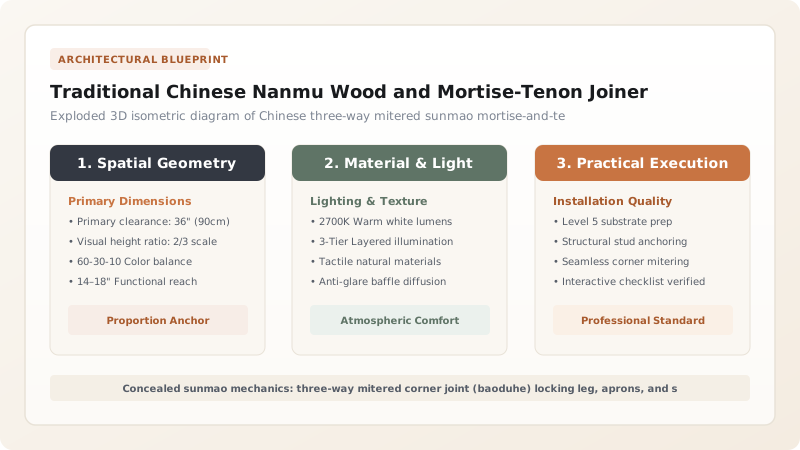
The Emperor's Timber: Imperial Exclusivity and Golden Threads
In Chinese architectural hierarchy, while Zitan (red sandalwood) and Huanghuali reigned supreme for elite cabinet furniture, Nanmu (Phoebe zhennan) was the undisputed king of monumental architecture. During the Ming Dynasty (1368–1644), Emperor Yongle dispatched imperial expeditions deep into the remote, malaria-ridden virgin cloud forests of Sichuan, Hubei, and Guizhou to extract monumental Nanmu boles for the Forbidden City.
Known as Jinsi Nanmu (Golden-Thread Nanmu), the wood possesses a phenomenal optical property: when planed and polished, microscopic crystalline deposits embedded within the cellular tracheids refract light like iridescent golden silk threads floating beneath the surface. Furthermore, the wood emits an enduring, subtle sweet camphor fragrance that naturally repels moths, termites, and silverfish for centuries.
Thermal and Hygroscopic Physics: The Non-Shrinking Hardwood
Beijing experiences brutal climatic extremes: winter temperatures plunge to -15°C with bone-dry Siberian air (20% RH), while summer monsoons bring scorching 38°C heat with 85% relative humidity. Ordinary hardwoods like oak or pine warp, split, and twist violently under these shifts.
Nanmu represents an anomaly in wood physics. With an average air-dry density of 610 kg/m³, it has an exceptionally low tangential shrinkage of only 4.8% and radial shrinkage of 2.6% (T/R ratio of 1.8). Its cellular structure remains completely stable across extreme humidity swings. When Emperor Yongle's master carpenters erected the soaring 14-meter-tall columns of the Hall of Eminent Favor (Sacrificial Hall) in the Ming Tombs in 1427, they used un-spliced Nanmu boles that remain dead plumb and crack-free six centuries later.
Sunmao Joinery and Raw Urushi Lacquer Finishing
Traditional Chinese architecture utilizes no nails or rigid adhesives. Nanmu frameworks rely on sunmao (tenon and mortise) joinery—an intricate mechanical puzzle where wooden members interlock through geometric friction. Joints such as the baoduhe (three-way corner miter) and zongjiaosun (corner tenon) absorb dynamic seismic forces through microscopic joint slip without failing.
The timber was preserved using shengqi (raw natural lacquer tapped from the Toxicodendron vernicifluum tree). Applied in paper-thin coats and cured inside dark, humid underground chambers (yushi), the urushi lacquer polymerizes into an indestructible, glass-smooth natural shield that protects the golden wood fibers from moisture, mild acids, and UV degradation.
Comparison of Imperial Chinese Architectural Hardwoods
Use this reference table to calculate exact physical dimensions, ratios, and specifications before purchasing:
| Timber Species | Chinese Name | Density (g/cm³) | Dimensional Stability | Historic Architectural Application |
|---|---|---|---|---|
| Phoebe zhennan (Golden Nanmu) | Jinsi Nanmu | 0.60 – 0.65 | Superior (near-zero warp/twist) | Imperial throne halls, monumental temple columns |
| Dalbergia odorifera | Huanghuali | 0.82 – 0.94 | High | Imperial palace interior screens, thrones, scholarly furniture |
| Pterocarpus santalinus | Zitan | 1.05 – 1.15 | Very High (sinks in water) | Imperial altar furniture, throne screens, imperial caskets |
| Pinus tabuliformis | Chinese Red Pine | 0.45 – 0.55 | Moderate (requires heavy tar) | Standard residential rafters, roof trusses, temple sub-roofs |
Practical Constraints
Every successful decoration project must account for physical and environmental constraints:
Phoebe zhennan is a strictly protected National Class II endangered species in China with felling bans
Mitigation: Utilize certified reclaimed antique beams salvaged from dismantled Ming and Qing dynasty structures with legal provenance.
Execution Blueprint & Craftsmanship Sequence
Execute this professional sequence to achieve flawless results without backtracking:
Season Nanmu Boles for a Minimum of 5 Years
Slowly air-dry quarter-sawn Nanmu timbers under shaded river sheds until core moisture content stabilizes below 10%.
Hand-Plane Timber Faces with Traditional Chinese Block Planes
Plane surfaces with high-angle wooden smoothing plane (pao) to expose crystalline golden-thread chatoyancy without tearout.
Layout Sunmao Joinery Using Scribe Awls and Ink-Lines
Mark complex three-way mitered tenons and concealed blind mortises using bamboo ink-markers (doumu) and steel scribes.
Chisel Precision Tenons with Hand-Forged Saws and Chisels
Cut tenon shoulders with fine pull-saws and chisel mortises to +/- 0.1mm tolerance for tight friction interlocking.
Dry-Assemble Timber Frame and Drive Concealed Wedges
Interlock posts and beams without glue; lock internal joints using concealed hardwood wedge keys (an-sun).
Apply Multi-Layer Raw Shengqi Lacquer Polish
Hand-rub 5 to 7 micro-thin coats of purified raw urushi lacquer, curing each layer in 80% humidity cabinet before polishing.
Common Mistakes & Countermeasures
Avoid these costly errors that compromise aesthetics, ergonomics, and budget:
Applying polyurethane, nitrocellulose lacquer, or synthetic epoxy to Nanmu wood
Using mechanical high-speed planers with dull knives on figured Jinsi Nanmu
Project Execution Checklist
Track your physical progress. Checkboxes persist automatically on this device:
Frequently Asked Questions
Why is Jinsi Nanmu referred to as 'water-settled wood' (Wumu)?
The most prized antique Nanmu is 'Wumu'—ancient logs that fell into mountain riverbeds thousands of years ago, naturally carbonizing under anaerobic silt without rotting, emerging with an extraordinary iridescent olive-gold patina.
Can Nanmu wood resist subterranean termites?
Yes. The heartwood contains dense concentrations of natural phenylpropanoids, sesquiterpenes, and essential camphor oils that are biologically toxic and unpalatable to termites, beetles, and rot fungi.


