
Qingzhuan Raw Clay Levigation and Reducing Kiln Firing represents the ancient metallurgical and ceramic mastery that produces China's legendary blue-gray carving brick. Standard bricks are fired in oxidizing atmospheres, yielding porous red ferric oxide (Fe2O3). Qingzhuan utilizes refined alluvial clay washed through multi-stage settling pools to remove all sand. Fired at 1,000°C, the kiln is sealed and flooded with water from above (yin-yao). The resulting steam-saturated reducing atmosphere converts iron to black magnetite (Fe3O4) and ferrous oxide (FeO), petrifying the brick into a dense, fine-grained carving medium.
At a Glance: Key Takeaways
- Water Levigation (Shui-Tao): Settling raw river clay in tiered water pools to separate coarse quartz from micro-silt.
- Foot-Treading Compaction: Treading clay beds with water buffalo or barefoot masons to eliminate microscopic air pockets.
- Reducing Atmosphere Pyrolysis: Sealing kiln air intakes to convert atmospheric CO2 into carbon monoxide (CO).
- Iron Reduction Reaction: Reducing red Fe2O3 into blue-black FeO and crystalline Fe3O4 magnetite.
- Kiln-Top Water Quenching (Yin-Yao): Pouring water into the kiln apex to generate superheated steam that freezes crystal phases.
- Frost-Resistant High Density: Vitrified pore structure resisting northern Chinese winter freeze-thaw cycles for centuries.
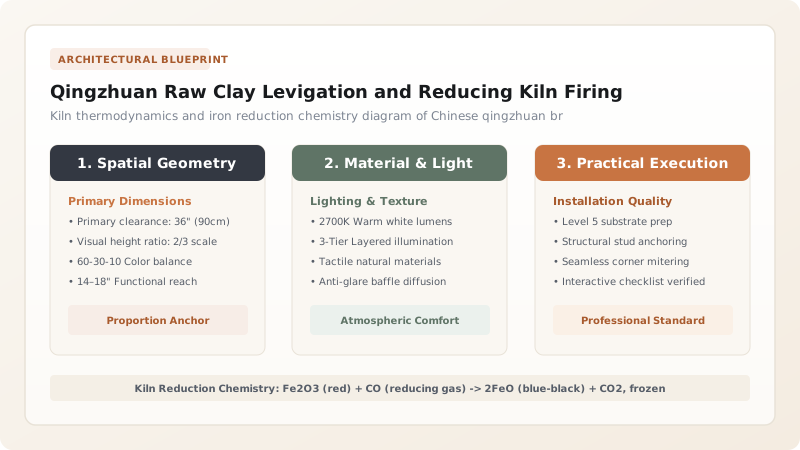
1. Clay Processing: Multi-Stage Levigation and Buffalo Treading
The flawless carving quality of Qingzhuan begins in the mud pits. Coarse quarry clay cannot be used. Masons collect fine alluvial silt from river basins, dumping it into a series of three cascading settling tanks (shui-tao chi).
Stirred vigorously with water, heavy sand grains and pebbles sink instantly to the bottom of the first pool. The suspended muddy water flows into the second and third pools, depositing an ultra-pure, talcum-smooth clay slurry. The dewatered clay is then trodden repeatedly by barefoot teams or water buffalo for days to align the microscopic kaolinite clay platelets and squeeze out every last air bubble.
2. Kiln Atmosphere: The Chemical Magic of Reduction
When bricks are fired with open flues and abundant air, oxygen combines with iron in the clay to produce ferric oxide (Fe2O3), which imparts the familiar terracotta red color of common brick.
For Qingzhuan, once the kiln reaches peak temperature (approx. 980°C to 1,050°C), the kiln master shovels wet pine boughs and coal into the fireboxes and completely seals the air intake dampers with wet clay. Starved of oxygen, the combustion generates high concentrations of carbon monoxide (CO) gas. The carbon monoxide strips oxygen atoms directly out of the red iron oxide: Fe2O3 + CO → 2FeO + CO2, turning the iron into dark ferrous oxide and crystalline black magnetite.
3. Yin-Yao: Steam Quenching the Burning Kiln
The defining technological moment of Chinese brickmaking is yin-yao (drinking water / quenching). At the peak of reduction, a shallow pool built on the flat brick roof of the kiln is filled with water, and small clay plugs are removed.
Water trickles down through the burning hot brick stacks. The water flashes instantly into superheated steam (H2O → H2 + O). This steam reaction rapidly cools the bricks while maintaining the reducing atmosphere, permanently freezing the iron in its reduced blue-gray state and depositing fine carbon soot deep into the open pores, resulting in an impervious, glass-hard structural brick.
Chinese Brick Firing: Oxidizing Red Brick vs. Reducing Qingzhuan
Use this reference table to calculate exact physical dimensions, ratios, and specifications before purchasing:
| Technical Parameter | Common Red Brick (Hongzhuan) | Traditional Blue Brick (Qingzhuan) | Impact on Carving Performance |
|---|---|---|---|
| Kiln Firing Atmosphere | Oxidizing (Excess atmospheric O2) | Reducing (Oxygen-starved CO gas) | Red Fe2O3 vs. Blue-Black FeO / Fe3O4 |
| Cooling Method | Slow air cooling through open doors | Yin-Yao water steam quenching from top | Freezes crystal phases; densifies pores |
| Clay Processing | Crude screening (< 1mm) | Multi-stage water levigation (< 50µm) | Qingzhuan has zero gritty sand pockets |
| Compressive Strength | 10 - 15 MPa (Moderate) | 25 - 35 MPa (High density) | Carves cleanly like dense soapstone |
| Freeze-Thaw Durability | Prone to spalling in cold climates | Immune to freeze-thaw; 500+ yr life | Preserves microscopic relief details |
Industrial & Environmental Constraints
Every successful decoration project must account for physical and environmental constraints:
Coal Smoke Regulations
Traditional wood and coal-fired reducing kilns produce dense black smoke plumes, now restricted to designated heritage conservation zones in China.
Extreme Water Consumption
Yin-yao steam quenching consumes thousands of liters of clean water per kiln firing cycle.
Protocol for Sifting, Molding, and Steam-Quenching Qingzhuan
Execute this professional sequence to achieve flawless results without backtracking:
Alluvial Clay Settling & Sieving
Suspend river silt clay in settling pools; allow coarse sand to drop out; pass creamy suspended clay slip through 100-mesh silk screens.
Buffalo Foot-Treading & Ageing
Tread drained clay beds with buffalo hooves for 48 hours; wrap clay in damp canvas; age in cellar for 6 months (sour ageing).
Precision Timber Box Pressing
Throw aged clay into wooden mold frames; compress with wooden tampers; slice top surface with taut brass cutting wire.
Shaded Air-Drying & Kiln Stacking
Dry green bricks slowly under thatched sheds for 45 days; stack inside dome kiln in open checkerboard honeycomb arrays.
Firing to 1,000°C & Damper Sealing
Fire kiln for 7 days until pyrometric cones indicate 1,020°C; seal fireboxes and chimney flues completely with wet clay mud.
Yin-Yao Water Steam Quenching
Flood rooftop water reservoir; allow water to trickle down into hot brick chamber for 3 days; allow kiln to cool slowly before opening.
Common Mistakes & Countermeasures
Avoid these costly errors that compromise aesthetics, ergonomics, and budget:
Allowing air leaks into the kiln during the yin-yao quenching stage
Using clay contaminated with calcium carbonate (limestone nodules)
Project Execution Checklist
Track your physical progress. Checkboxes persist automatically on this device:
Frequently Asked Questions
Why do Chinese blue bricks ring like a bronze bell when struck?
The combination of high-temperature reduction firing (1,020°C) and steam quenching vitrifies the silica into an interlocking crystalline matrix containing magnetite. The absence of internal micro-voids allows acoustic vibration to travel without damping, producing a high-pitched, metallic ringing tone that confirms dense structural integrity.
How old is the oldest standing building made of Qingzhuan blue bricks?
The Songyue Pagoda in Henan province, constructed in 523 AD during the Northern Wei dynasty, is built entirely from blue-gray clay bricks laid in lime mortar; it has survived earthquakes, wars, and weather for over 1,500 years without collapsing.


