
Chinese Brick Carving Bas-Relief Friezes and Filigree Tiles represent the extreme technical pinnacle of East Asian subtractive ceramic art. Working on dense, fine-grained blue-gray bricks, master carvers deploy three hierarchical techniques: shallow surface incising (qian-fu-diao), deep high-relief modeling (gao-fu-diao), and openwork hollow piercing (tou-diao). By carving entirely through hollow interior chambers, artisans create multi-tiered spatial dioramas where pavilions, pine trees, and mythical dragons float across three independent spatial planes inside a single 80mm thick brick.
At a Glance: Key Takeaways
- Three-Tier Relief Hierarchy: Shallow incising, deep high-relief, and completely pierced openwork filigree.
- Tou-Diao Hollow Piercing: Piercing through negative space so ambient daylight shines through the stone web.
- Auspicious Visual Rebuses (Xiangrui): Clever visual puns encoding wishes for wealth, bureaucratic promotion, and long life.
- Multi-Block Modular Assembly: Carving multi-meter panoramic narrative scenes across dozens of interlocking numbered bricks.
- Specialized Micro-Chisels: High-carbon tool steel scrapers, angled parting gouges, and curved hollow slicers.
- Preservation Without Synthetic Sealers: Natural blue brick mineral density resisting weathering without plastic coatings.
1. The Three Hierarchical Carving Disciplines
Master brick carvers organize their work into three distinct depth hierarchies:
- Qian-Fu-Diao (Shallow Bas-Relief): Carved 2mm to 5mm deep, used for delicate background clouds, water waves, and brocade border patterns.
- Gao-Fu-Diao (Haut-Relief): Carved 20mm to 50mm deep, creating rounded, three-dimensional muscular volumes for figures, horses, and lion dogs.
- Tou-Diao (Openwork Hollow Piercing): The supreme test of master craftsmanship. The carver drills and chisels completely through the brick, hollowing out the space behind foreground figures. The entire composition reads as a multi-tier diorama with up to four distinct spatial planes floating within a single brick block.
2. Auspicious Visual Rebuses (Xiangrui Yuyan)
Every element in a Chinese brick relief is a sophisticated linguistic rebus (visual pun). Because the Chinese language is rich in homophones, imagery conveyed auspicious blessings:
- Peony and Vase (Ping'an Fugui): A vase (ping = peace) holding a peony (fugui = wealth and honor) blesses the household with peaceful prosperity.
- Monkey on a Horse (Mashang Fenghou): A monkey (hou) riding a horse (ma) translates phonetically to 'May you immediately be promoted to the rank of marquis'—an auspicious blessing for imperial civil service examinations.
- Pine and Crane (Songhe Changchun): Evergreen pine trees and Manchurian cranes symbolize eternal youth and venerable old age.
3. Modular Multi-Block Assembly Mechanics
Monumental lintel friezes and screen wall panels spanning 3 to 6 meters in length could not be made from a single giant brick. The master artist divided the full-scale cartoon across 12 to 40 individual blue bricks.
The bricks were clamped together on the workshop bench and carved simultaneously as a unified composition. Before disassembly, matching Chinese numerical characters (Tian, Di, Xuan, Huang) were incised into the concealed rear faces. On site, masons assembled the numbered blocks like a giant puzzle, joining them with hairline joints of lime and sticky-rice slurry so seamlessly that the entire multi-meter frieze appears carved from a single monolithic stone.
Chinese Brick Carving Chisel Tooling Array
Use this reference table to calculate exact physical dimensions, ratios, and specifications before purchasing:
| Tool Typology | Chinese Term | Cutting Edge Profile | Tool Steel Specification | Sculptural Function |
|---|---|---|---|---|
| Broad Flat Chisel | Da-Bian-Zao | 30mm straight bevel edge | T10 High-carbon tool steel | Rough volumetric blocking & background clearing |
| Narrow Parting Chisel | Tiao-Zao | 3mm - 6mm pointed chisel | Forged spring steel | Fine contour outlining & figure separation |
| Hollow Gouge | Yuan-Zao | 6mm - 12mm curved U-profile | Water-quenched carbon steel | Carving rounded drapery folds & cloud eddies |
| Piercing Auger / Saw | Tou-Zao / Si-Ju | Miniature tungsten coping wire | Tempered wire blade | Hollowing openwork tou-diao background cavities |
| Leaf Scraping Knife | Gua-Dao | Curved scraper blade | High-carbon razor edge | Final skin burnishing & removing chisel ridges |
Artistic & Handling Constraints
Every successful decoration project must account for physical and environmental constraints:
Irreversible Material Loss
Subtractive brick carving cannot be patched; an accidental break of an eye or finger requires carving an entirely new brick.
Site Transport Fragility
Deeply pierced tou-diao bricks are delicate; transport to the building site requires custom foam-padded wooden boxes.
Protocol for Executing an Openwork (Tou-Diao) Carved Brick Panel
Execute this professional sequence to achieve flawless results without backtracking:
Brick Block Gang-Clamping
Clamp 6 water-saturated blue bricks together face-up on rigid timber workbench using heavy screw clamps; verify flush coplanar surface.
Full-Scale Rebus Cartoon Pouncing
Align full-scale paper cartoon over clamped bricks; pounce pierced lines with fine charcoal bag; trace guidelines with waterproof ink.
Background Void Piercing
Drill pilot holes through negative space using bow-drill; insert wire coping saw; saw out hollow background cavities (tou-diao).
Multi-Plane Relief Carving
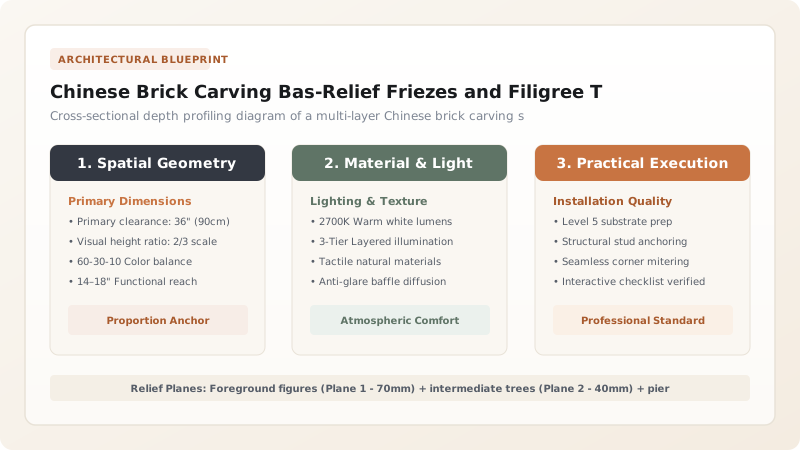
Carve foreground figures with broad chisels; step back 20mm to carve intermediate tree branches; carve rear landscape at 5mm relief.
Fine Foliate Veining & Facial Features
Detail dragon whiskers, scholar robes, and peony petals using miniature 2mm chisels; lubricate stone with fine water spray.
Rear Index Numbering & Disassembly
Incise Chinese registration characters on rear of each brick; unclamp blocks; clean carved facets with soft badger-hair brush.
Common Mistakes & Countermeasures
Avoid these costly errors that compromise aesthetics, ergonomics, and budget:
Applying heavy mallet strikes when carving delicate openwork bridges (< 3mm thick)
Allowing dust slurry to dry inside deep pierced cavities
Project Execution Checklist
Track your physical progress. Checkboxes persist automatically on this device:
Frequently Asked Questions
How do you clean air pollution and soot off historic outdoor carved brick panels?
Conservators use low-pressure warm water misting and soft natural-bristle brushes, occasionally combined with ammonium carbonate poultices to draw gypsum crusts out of the brick pores without eroding the delicate carved reliefs.
Why did wealthy Huizhou merchants compete to have the most intricate brick carvings?
Under Ming and Qing sumptuary laws, merchants were legally forbidden from building palaces with gold leaf, royal yellow roofs, or monumental marble columns (which were reserved for the Emperor and imperial nobility). Merchants bypassed these laws by channeling their immense fortunes into extraordinarily intricate, labor-intensive brick and wood carvings on their private mansions.


