
The geometric precision of Dougong relies on the interlocking relationship between two primary elements: the dou (square bearing block with cross-mortises) and the gong (bow-shaped horizontal cantilever arm). Governed by the Yingzao Fashi, these components interlock using half-lap splines, juan-sha end curves, and 0.5mm slip tolerances that permit load distribution across multi-tiered corbel clusters.
At a Glance: Key Takeaways
- Luodou Capital Block: The master base block (typically 32 fen square) receiving the first perpendicular cantilever arms.
- Kou Cross-Mortises: Precise cross-shaped grooves routed 4 fen deep into the upper faces of dou blocks.
- Juan-Sha Curved Profiles: Elegant elliptical or stepped chamfers terminating the ends of horizontal gong arms.
- Orthogonal Interlocking: Alternate tiers projecting 90° to one another, distributing forces across two horizontal axes.
- High Compression Grain: Grain orientation optimized to resist transverse crushing under heavy roof loads.
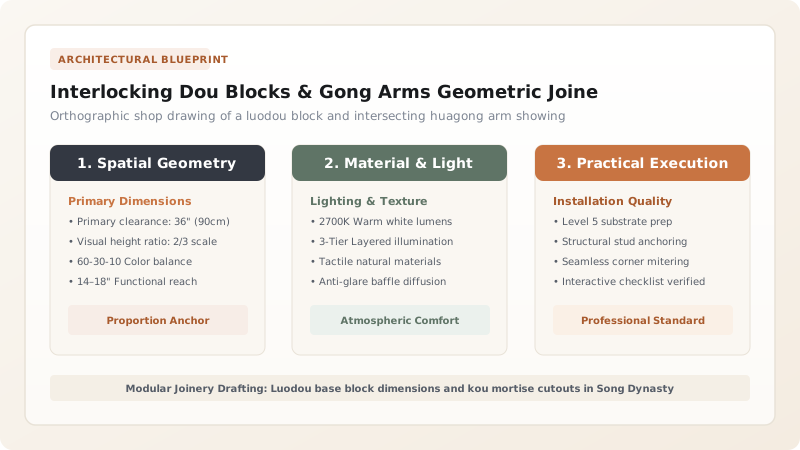
1. Anatomy of the Dou (Bearing Block)
The dou (斗) functions as a miniature structural column capital and load spreader. Named after the traditional square wooden grain-measuring vessel it resembles, the dou exists in several hierarchical variations:
- Luodou (栌斗, The Capital Block): The largest block, seated directly on the tenon of the column head. In Song standard, it measures 32 fen wide × 32 fen long × 20 fen high. A cross-shaped channel, the shizikou (十字口), is carved 4 fen deep into its top face to receive intersecting gong arms.
- Qidou (杞斗): Smaller blocks (16 fen × 14 fen × 10 fen) positioned at the ends of gong arms to support upper-tier cantilever arms.
- Jiaodou (交互斗): Specialized corner blocks that accommodate diagonal 45-degree corner rafters and hips.
2. Geometry of the Gong (Cantilever Arm)
The gong (栱) is the horizontal bow-shaped timber that bridges between dou blocks. Standard lengths are calibrated in fen modules:
- Huagong (华栱): Cantilever arms projecting perpendicular to the wall plane to carry roof eaves outward, typically measuring 62 to 72 fen in length.
- Niudaogong (泥道栱): Arms running parallel to the wall plane, sitting directly inside the luodou to establish longitudinal wall stability (length 62 fen).
- Guazigong (瓜子栱) & Linggong (令栱): Upper-tier intermediate and top-level arms supporting purlin bearing plates.
The underside of each gong arm is carved with the juan-sha (卷杀)—a series of 3 to 5 delicate stepped chamfers or smooth parabolic curves that soften the timber end and reduce dead weight while maintaining maximum shear depth at the central bearing point.
3. The Half-Lap Spline & Friction Tolerances
Where perpendicular and longitudinal gong arms intersect inside a single dou block, they interlock using a half-lap bridle joint. The upper arm is notched from underneath by half its depth (7.5 fen), while the lower arm is notched from above by the same amount.
Master carpenters do not plane these joints to a modern friction-tight cabinetmaker's fit. A deliberate clearance of 0.5mm to 1.0mm is maintained across all lap interfaces. When dynamic earthquake forces strike, this engineered clearance allows the joints to micro-rotate and slide, converting destructive kinetic energy into harmless heat friction without splitting the wood.
Song Dynasty Dougong Component Dimensions (Cai Module = 15 fen × 10 fen)
Use this reference table to calculate exact physical dimensions, ratios, and specifications before purchasing:
| Component Name | Length (fen) | Height (fen) | Width (fen) | Structural Function |
|---|---|---|---|---|
| Luodou (Base Block) | 32 fen | 20 fen | 32 fen | Seats on column head; receives initial cross-arms |
| Huagong (Cantilever Arm) | 72 fen | 15 fen | 10 fen | Projects perpendicular to wall to step eaves outward |
| Niudaogong (Wall Arm) | 62 fen | 15 fen | 10 fen | Runs parallel to wall; connects adjacent column bays |
| Qidou (Upper Block) | 16 fen | 10 fen | 14 fen | Sits on gong tips to receive next tier of cantilever arms |
| Linggong (Eave Arm) | 72 fen | 15 fen | 10 fen | Uppermost arm directly supporting eave purlin cushion (tīmù) |
Tolerances & Fabrication Constraints
Every successful decoration project must account for physical and environmental constraints:
Hand Tool Precision
Cutting dozens of identical interlocking blocks requires precision metal templates (Yangban) to ensure interchangeability.
Tung Oil Curing
Oiled timber components must cure for at least 14 days before assembly to allow the tung oil to fully polymerize.
Fabrication Protocol for Dou and Gong Components
Execute this professional sequence to achieve flawless results without backtracking:
Cai-Fen Module Calibration
Determine temple building rank; calculate 1 fen measurement in millimeters (typically 1 fen = 14mm for First Rank).
Luodou Block Carving
Square the solid hardwood block to 32 × 32 × 20 fen; rout the cross-shaped shizikou mortise 4 fen deep with router planes.
Huagong Cantilever Shaping
Saw timber blanks to 72 fen length; transfer juan-sha end curve profiles from wooden templates to both ends.
Half-Lap Mortise Cutting
Cut center half-lap notches 10 fen wide by 7.5 fen deep using fine pull-saws and paring chisels.
Slip Tolerance Verification
Test-fit perpendicular gong arms inside the luodou block; verify uniform 0.5mm gap using brass feeler gauges.
Mineral Tung Oil Impregnation
Submerge finished timber pieces in heated raw tung oil for 48 hours to seal against moisture and insect attack.
Common Mistakes & Countermeasures
Avoid these costly errors that compromise aesthetics, ergonomics, and budget:
Machining joints with zero tolerance (press-fit cabinetmaker joint)
Cutting gong arms from plainsawn timber with grain running across the width
Project Execution Checklist
Track your physical progress. Checkboxes persist automatically on this device:
Frequently Asked Questions
How many individual pieces of wood are in a single Dougong cluster?
Depending on the building rank and number of tiers (pùzuò), a single corner Dougong cluster can contain between 60 and 120 interlocking wooden pieces, all fitting together without a single nail or drop of glue.
What is the purpose of the curved profile (juan-sha) on the ends of gong arms?
The juan-sha curve reduces dead weight at the cantilever tip where bending stresses are lowest, while maintaining full timber depth at the center where shear and bending forces are concentrated, optimizing timber structural efficiency.


