
Kuang-jing (框景, 'framed scenery') is the sophisticated spatial and scenographic technique in classical Chinese garden design that treats architectural openings—moon gates, open pavilion windows, and colonnade bays—as physical picture frames. By aligning the circular void with carefully positioned Taihu limestone scholar rocks, weeping bamboo, and water reflections, garden masters create living, changing landscape paintings (shanshui) that transform the viewer's experience as they move through space.
At a Glance: Key Takeaways
- Design Discipline: Kuang-jing (framing) and Jie-jing (borrowing scenery from distant landscapes)
- Primary Rock Medium: Lake Tai limestone (Taihushi) with natural water-carved cavities
- Botanical Partners: Phyllostachys nigra (black bamboo), weeping willow, and Japanese maple
- Treatise Authority: Ji Cheng's Yuanzhi (The Craft of Gardens, published 1631)
The Living Picture: Moving Beyond Static Landscape
In traditional Chinese aesthetics, architecture and nature are never treated as separate entities. In a scholar's garden, the building does not simply sit within the landscape; rather, the building is an optical instrument designed to perceive the landscape.
Kuang-jing operates on the realization that human perception is easily overwhelmed by continuous, unbordered vistas. By enclosing a dynamic scene within the crisp, dark circular border of a moon gate, the garden designer concentrates visual attention, heightening emotional resonance and turning ordinary branches, rocks, and clouds into deliberate poetic brushstrokes.
The Four Virtues of Taihu Scholar Rocks: Shou, Zhou, Lou, Tou
Directly aligned in the primary focal axis of a moon gate, designers place a Taihushi (太湖石)—a limestone boulder naturally carved over millennia by acidic water currents in the depths of Lake Tai. A master rock must embody four codified aesthetic criteria:
Shou (瘦, Slenderness): The rock must stand tall, upright, and elegant, resisting heavy earthbound clumsiness. Zhou (皱, Wrinkles): Its surface must be deeply furrowed with textured ridges. Lou (漏, Channeling/Grooves): It must contain labyrinthine vertical fissures where rain flows naturally. Tou (透, Translucence/Passages): It must feature through-holes that allow daylight, wind, and smoke to pass freely through the stone, signifying the emptiness (wu) of Taoist philosophy.
Botanical Layering: The Dialogue of Bamboo and Stone
A scholar's rock is rarely positioned in isolation. Chinese garden masters balance the timeless, unyielding permanence of stone with the delicate, ephemeral motion of living plants—a philosophical union of Yin and Yang.
Beside the rock, designers plant slender bamboos—such as Phyllostachys nigra (black bamboo) or Phyllostachys aurea (fishpole bamboo). Bamboo represents resilience, humility, and moral integrity, bending before winter gales without snapping. Behind the composition stands a clean, whitewashed wall (baimo qiang), which reflects indirect northern daylight, casting crisp, dancing shadow silhouettes of rustling bamboo leaves across the white plaster.
Sightline Geometry and the Cone of Perception
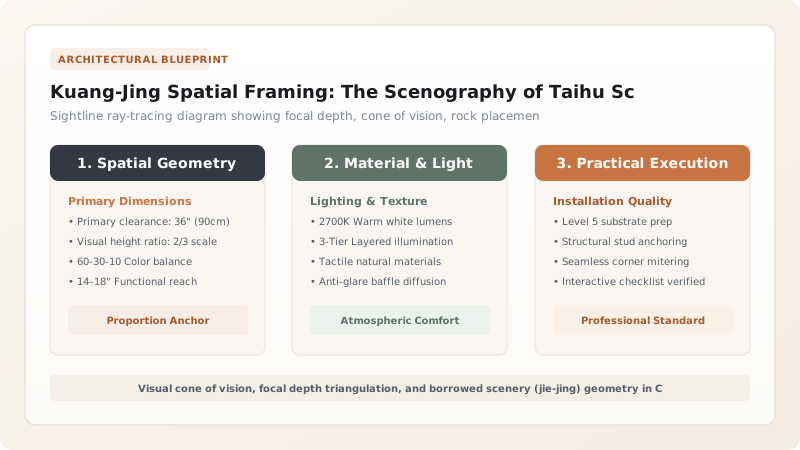
The spatial choreography of kuang-jing is calculated using precise optical triangulation. Designers position the primary viewing point along a covered walkway (lang) at a distance of approximately 4 to 6 meters from the moon gate.
The aperture diameter (typically 2.0 to 2.2 meters) establishes an optimal 30-degree cone of human vision. The scholar's rock is placed at a secondary focal distance of 3 to 5 meters behind the gate. As the viewer walks along the covered veranda, parallax creates dynamic visual shifts: the rock appears to rotate, holes align to reveal hidden water ponds, and tree branches re-frame the scene with every step.
Scholar Rock Types & Optical Characteristics for Garden Framing
Use this reference table to calculate exact physical dimensions, ratios, and specifications before purchasing:
| Rock Typology | Geological Origin | Aesthetic Character | Optimal Scenographic Role |
|---|---|---|---|
| Taihu Stone (Taihushi) | Water-eroded limestone from Lake Tai basin | Heavily perforated (lou/tou); pale grey-white color | Direct central focal axis framed within circular moon gates |
| Lingbi Stone (Lingbishi) | Dense, resonant limestone from Anhui province | Glossy black surface; metallic ring when struck | Intimate indoor tokonoma-style table stands and entry niches |
| Yingde Stone (Yingshi) | Weathered metamorphic rock from Guangdong | Deeply furrowed (zhou); dramatic jagged peaks | Miniature mountain massifs flanking secondary garden paths |
| Yellow Stone (Huangshi) | Coarse reddish-amber sandstone blocks | Angular, blocky, cubist geometric fractures | Heavy retaining walls, grottoes, and waterfalls |
Practical Constraints
Every successful decoration project must account for physical and environmental constraints:
Scarcity and high cost of authentic antique Lake Tai limestone boulders
Due to strict Chinese environmental protections prohibiting the dredging of Lake Tai, antique perforated boulders are exceedingly rare and expensive. Mitigation: Utilize ethically quarried karst limestone from nearby inland deposits, weathered and sculpted by traditional stone carvers using high-pressure water slurry tools.
Invasive underground running rhizomes of Phyllostachys bamboo varieties
Aggressive running bamboo rhizomes can invade adjacent courtyard flagstones, heave brick foundations, and disrupt subterranean drainage pipes within 3 years. Mitigation: Install heavy 80-mil high-density polyethylene (HDPE) rhizome root barriers buried 700 mm deep around all bamboo planting beds.
Execution Blueprint & Craftsmanship Sequence
Execute this professional sequence to achieve flawless results without backtracking:
Establishing the Primary Walking Sightline Axis
Stake out the main walking route through the covered veranda. Identify the exact focal station point where the viewer first perceives the circular moon gate.
Calculating Focal Distance and Aperture Ratio
Calculate distance from viewer to gate (4 to 5 m) and gate to rock (3 to 4 m). Ensure the circular aperture crops out adjacent service doors and utility structures.
Selecting the Taihu Scholar Rock by the Four Virtues
Examine candidate limestone boulders. Select a specimen exhibiting slenderness (shou), furrowed texture (zhou), deep fluting (lou), and open through-holes (tou).
Setting the Granite Sub-Plinth and Underground Footing
Cast a concrete foundation pad concealed below grade. Anchor a carved lotus or cloud-relief grey granite pedestal to elevate the rock 150 mm above courtyard paving.
Hoisting, Rotating, and Shimming the Rock
Hoist the stone with padded slings. Rotate the rock until its most dramatic perforations align directly with the moon gate sightline; bed in lead shims and lime mortar.
Planting Complementary Botanical Clusters
Plant a clump of 5 to 7 culms of black bamboo (Phyllostachys nigra) slightly behind and to the left of the rock, allowing feathery leaves to drape across the stone shoulder.
Whitewashing the Background Canvas Wall
Apply high-calcium slaked lime wash to the background courtyard wall, providing a bright, shadowless canvas that accentuates the dark silhouettes of rock and foliage.
Night Illumination and Shadow Calibration
Conceal a low-voltage warm 2700K spotlight behind the rock base pointing upward at the white wall, creating dramatic cast-shadow calligraphy during evening viewings.
Common Mistakes & Countermeasures
Avoid these costly errors that compromise aesthetics, ergonomics, and budget:
Centering the scholar rock symmetrically inside the moon gate like a bullseye
Overcrowding the background behind the rock with competing plant varieties
Project Execution Checklist
Track your physical progress. Checkboxes persist automatically on this device:
Frequently Asked Questions
What is the philosophical meaning of the holes in a Taihu rock?
In Taoist philosophy, the holes (tou) represent the void or emptiness (wu) from which all tangible reality emerges. The cavities allow cosmic breath (qi) and wind to circulate unobstructed, symbolizing an open, unattached, and tranquil human mind receptive to the universe.
What is the difference between kuang-jing and jie-jing?
Kuang-jing (framed scenery) refers specifically to capturing an immediate scene within an architectural aperture like a picture frame. Jie-jing (borrowed scenery) involves visually integrating elements outside the garden boundaries—such as a distant mountain peak, a Buddhist pagoda, or clouds—into the garden's perceived composition.
Can black bamboo survive in non-tropical climates?
Yes. Phyllostachys nigra (black bamboo) is remarkably cold-hardy down to roughly -18°C (USDA Zone 7). Its culms turn from olive-green to lustrous ebony-black over their first two seasons, providing exceptional year-round graphic contrast against snowy courtyard walls.
How did ancient scholars evaluate the acoustic properties of garden framing?
Scholars designed garden compositions to engage all senses, including sound (ting-jing). Designers placed banana trees (Musa basjoo) or lotus pools directly within the acoustic focus of the moon gate so that the soft patter of autumn rain on large leaves could be savored while seated in adjacent reading pavilions.


