
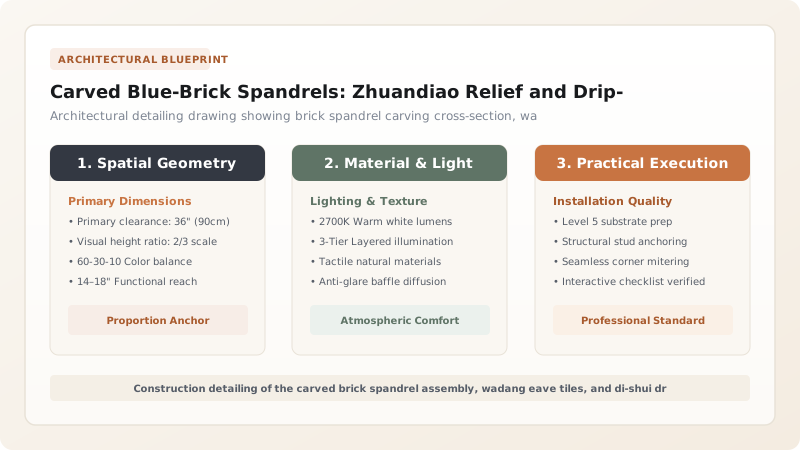
The architectural refinement of a classical Chinese moon gate is crowned by two artisanal details: carved blue-brick spandrels (zhuandiao) flanking the upper arch haunches, and a protective miniature tile canopy crowned with eaves tiles (wadang) and drip tiles (di-shui). Carved into fine-grained kiln-reduced clay bricks with microscopic gouges, the spandrels feature auspicious mythological motifs and calligraphic plaques, while the terracotta eaves canopy protects the wall from monsoonal rain.
At a Glance: Key Takeaways
- Decorative Carving: Zhuandiao (hand-carved bas-relief in dense grey-blue terracotta bricks)
- Canopy Coping: Miniature gabled or hipped canopy clad in grey clay pan and cover tiles
- Drainage Mechanics: Wadang (circular eave tile discs) and Di-shui (pointed drip spouts)
- Epigraphic Tradition: Carved calligraphic cartouche plaques (ebie) above the arch summit
Zhuandiao: The Art of Sculpting Fired Clay
While Western architecture frequently utilized soft limestone or marble for relief sculpture, traditional Jiangnan architecture mastered zhuandiao (砖雕)—the fine carving of fired terracotta bricks. Masons select jinzhuan (golden bricks) or dense, fine-grained grey bricks that have been fired slowly and water-cooled under vacuum reduction.
These bricks have no coarse sand grains, possessing a silky, homogenous density akin to fine slate. Master carvers use sets of thirty or more miniature steel chisels and rasps, executing deep undercut bas-reliefs of peonies, swirling auspicious clouds (xiangyun), and playful bats symbolizing good fortune (fu) with calligraphic precision.
The Epigraphic Cartouche (Ebie): Poetic Portals
Above the apex of the circular arch, set flush within the masonry or projecting slightly forward on carved corbels, sits a rectangular stone or brick cartouche known as the ebie (额匾). This plaque is inscribed with four classical Chinese characters written in flowing seal script (zhuanshu) or semi-cursive script (xingshu).
Authored by literati scholars, these inscriptions encapsulate the poetic atmosphere of the courtyard beyond. Common historic titles include 'Entering the Path of Tranquility' (Ru Jing), 'Reflecting the Cold Spring' (Han Quan), or 'Clouds Linger at Twilight' (Xia Qi). Reading the plaque prepares the visitor's psychological frame of mind before stepping through the circular threshold.
The Eaves Canopy: Miniature Ceramic Gables
Because Chinese courtyard walls are built from porous lime-plastered brick, they are vulnerable to vertical water penetration. The moon gate wall is therefore crowned by a functional miniature roof canopy consisting of curved rafters, wooden purlins, and layered terracotta roofing tiles.
At the lower edge of the eaves sit alternating rows of two specialized ceramic units: the wadang (瓦当) and the di-shui (滴水). The wadang is a circular cap tile that seals the ends of concave cover tiles, decorated with embossed lotus blossoms or dragon faces. The di-shui is a triangular pointed tile that extends beyond the eave line, channeling rainwater into clean dripping curtains that fall clear of the wall plaster.
Weathering Protection and Salt Efflorescence Mitigation
Carved blue-brick reliefs are delicate; exposure to torrential subtropical monsoons and winter frosts can erode intricate undercut foliage. To prevent weathering, master masons soak the finished carved brick panels in tung oil (tongyou) thinned with pine turpentine.
The tung oil polymerizes inside the microscopic clay pores, creating an invisible, breathable hydrophobic barrier that prevents rain absorption while preventing sub-surface salt migration from crumbling the delicate carved eyelids, bird feathers, and flower stamen details.
Chinese Eave Tile Components: Wadang vs Di-Shui vs Pan Tiles
Use this reference table to calculate exact physical dimensions, ratios, and specifications before purchasing:
| Tile Component | Geometric Profile | Functional Role | Decorative Iconography |
|---|---|---|---|
| Wadang (Roof Eave Disc) | Circular flat disc (120–150 mm diameter) sealing tile ends | Prevents wind-driven rain from entering beneath roof tiles | Four auspicious animals, lotus flowers, or seal-script blessings |
| Di-Shui (Drip Tile) | Pointed triangular drop lip extending 40–60 mm downward | Breaks surface tension; channels water runoff away from wall | Serrated water ripples, stylized phoenix tails, or cloud spirals |
| Banwa (Pan Tile) | Wide concave curved trough tile (200–250 mm length) | Acts as primary drainage channel along the roof pitch | Smooth unglazed kiln-reduced grey finish |
| Tongwa (Cover Tile) | Semi-cylindrical convex tile capping pan tile seams | Seals lateral joints between adjacent drainage troughs | Smooth overlapping curve bedded in lime-hemp mortar |
Practical Constraints
Every successful decoration project must account for physical and environmental constraints:
Typhoon and monsoon wind-uplift loads on lightweight wall canopies
Violent coastal typhoons in the Yangtze delta can rip loose clay eaves tiles off wall copings, destroying antique wadang discs. Mitigation: Tie every wadang and di-shui tile mechanically back to the structural timber rafters using concealed stainless steel or annealed copper wire anchors embedded in mortar.
Vulnerability of fine undercut relief carving to freeze-thaw spalling
Water trapped in deep 12 mm undercut relief crevices expands upon freezing, fracturing delicate petals and bird beaks. Mitigation: Ensure all carved spandrel crevices are slightly beveled to shed water, preventing stagnant pooling of winter rainwater.
Execution Blueprint & Craftsmanship Sequence
Execute this professional sequence to achieve flawless results without backtracking:
Selecting Defect-Free Blue Carving Bricks
Select dense, vacuum-reduced grey-blue bricks. Tap units with an iron wand; reject any brick that does not emit a clear, high-pitched metallic ring indicating absence of internal fractures.
Tracing Traditional Paper Cartoons onto Clay Face
Transfer auspicious brush drawings onto the planed brick surface using carbon paper or pricked pounce bags dusted with chalk powder.
Rough Chiseling and Background Evacuation
Using flat 15 mm chisels and a light wooden mallet, chop away negative background spaces to a depth of 12 mm, leaving the primary motifs standing in high relief.
Fine Micro-Carving of Foliage and Figures
Switch to miniature 2 to 4 mm V-gouges and curved scrapers. Carve delicate undercut feathers, peony petals, and facial expressions with smooth, continuous strokes.
Bedding Carved Spandrel Panels into Wall Haunches
Bed the finished carved brick tiles into the flanking triangular spandrel voids above the circular arch, using sticky lime-rice mortar and flush hairline joints.
Framing the Miniature Canopy Timber Rafters
Embed cantilevered cedar corbels into the upper brickwork. Lay longitudinal purlins and miniature rafter slats sloped at 28 degrees to shed rainwater.
Laying Pan Tiles, Wadang Discs, and Di-Shui Spouts
Bed alternating concave pan tiles and convex cover tiles in lime-hemp mortar. Anchor pointed di-shui drip tiles and circular embossed wadang discs along the eave perimeter.
Tung Oil Deep Saturation and Surface Polishing
Brush two coats of warm raw tung oil over the exposed carved brick surfaces. Allow oil to cure for 7 days, buffing lightly with a horsehair brush to produce a satin weather-tight finish.
Common Mistakes & Countermeasures
Avoid these costly errors that compromise aesthetics, ergonomics, and budget:
Installing roof tiles with inadequate eave overhang (less than 75 mm past wall face)
Applying thick modern polyurethane or epoxy clear coats over carved blue bricks
Project Execution Checklist
Track your physical progress. Checkboxes persist automatically on this device:
Frequently Asked Questions
What does 'wadang' mean and what are the classic designs found on them?
Wadang (瓦当) literally means 'tile head' or 'tile stopper.' Originating in the Qin and Han dynasties over 2,000 years ago, classic designs include the Four Mythological Animals (Azure Dragon of the East, White Tiger of the West, Vermilion Bird of the South, and Black Tortoise of the North) or auspicious four-character prayers for eternal longevity.
How do di-shui (drip tiles) break water surface tension?
Di-shui tiles terminate in a sharp downward triangular point. When rainwater sheets down the concave roof tile trough, it converges at the pointed tip of the di-shui. The sharp geometry prevents water from wrapping around the underside through capillary action, forcing water drops to detach cleanly into mid-air away from the wall.
Why is tung oil preferred over linseed oil for Chinese brick protection?
Tung oil—pressed from the seeds of the native Chinese tung tree (Vernicia fordii)—has been used in China for thousands of years. It cures significantly faster and harder than linseed oil, forms a more water-impervious molecular barrier, does not darken with age, and naturally resists mildew in humid subtropical climates.
Can historic zhuandiao brick carving techniques be restored if damaged?
Yes. Master brick carvers in Suzhou and Huizhou specialize in architectural restoration. Damaged sections can be carefully routed out with micro-chisels and replaced with dutchman patches of matching aged blue brick, hand-carved in-situ to restore broken scrolls, flowers, or calligraphic strokes seamlessly.


