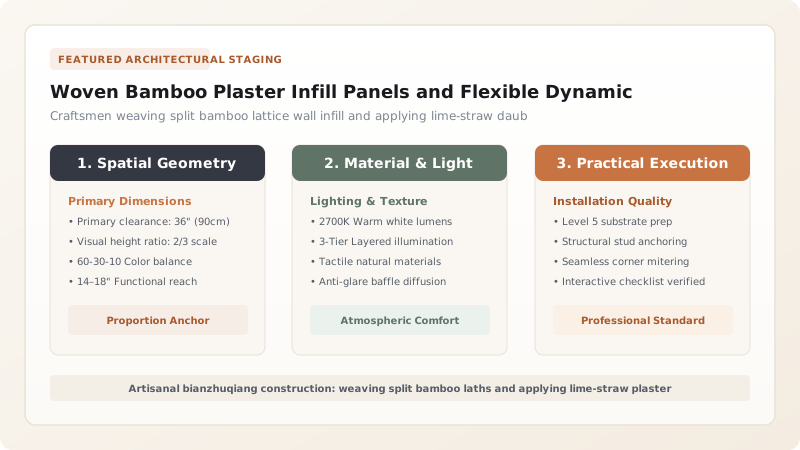
Woven bamboo plaster infill panels (bianzhuqiang / 编竹墙) and flexible dynamic seismic sway constitute the lightweight non-structural envelope and seismic energy-dissipation system of Chinese Chuandoushi architecture. Formed from flexible split-bamboo mats woven in basketweave patterns, the lath is sprung into grooves along the slender fir columns and coated on both faces with an earthen-lime daub composed of slaked lime, fine river silt, and chopped fermented rice straw. When severe earthquakes strike, these lightweight panels flex elastically with the swaying timber frame; under extreme ground accelerations, the brittle plaster cracks and sheds harmlessly, releasing inertial dead weight and allowing the ductile wooden frame to dissipate seismic shocks without progressive collapse.
At a Glance: Key Takeaways
- Wall Infill Typology: Woven Bamboo Daub Panel (Bianzhuqiang / 编竹夹泥墙)
- Woven Substrate: Split Moso or Nan bamboo strips (Zhubian / 15–20 mm wide)
- Plaster Matrix: Slaked lime, river silt clay, and fermented rice straw fibers (Dao-cao)
- Wall Areal Weight: 35 to 55 kg/m² (less than 15% the weight of brick masonry)
- Seismic Failure Mode: Sacrificial plaster shedding with 100% structural frame survival
The Lightness of Being: Why Infill Walls Dictate Seismic Safety
In structural dynamics, Sir Isaac Newton's second law of motion—Force = Mass × Acceleration (F = ma)—governs the survival of buildings during earthquakes. When tectonic plates fracture and shock waves travel through the earth, the ground accelerates rapidly. The lateral shear force tearing at a building is directly proportional to the building's own dead weight. A heavy building made of thick brick or stone masonry generates colossal destructive inertial forces that will tear it apart.
In the earthquake-prone mountains of Southwestern China, master carpenters solved this physical law through extreme lightness. While Northern Chinese homes used heavy fired grey bricks, the southern Chuandoushi architecture employed an ultra-lightweight, non-structural partition wall: bianzhuqiang (woven bamboo lath infill plaster). Weighing barely 35 to 55 kilograms per square meter—less than one-tenth the weight of a standard brick wall—the entire building envelope reduces lateral seismic forces to a tiny fraction of conventional masonry, creating an inherently earthquake-defying habitat.
Anatomy of the Bianzhu Lath: Weaving the Bamboo Hurdle
The foundation of this lightweight envelope is the zhubian (woven bamboo lath). China is the world's epicenter of bamboo diversity, and southern provinces possess vast groves of Moso bamboo (Phyllostachys edulis). Harvested at maturity, the hollow green culms are split radially into long, flexible ribbons measuring 15 mm to 20 mm wide and 2 mm thick. The strips are boiled in a mild lime bath to leach out soluble starches, immunizing the bamboo against wood-boring beetles.
The carpenter plows vertical grooves along the flanks of the slender round fir columns. The artisan then weaves the flexible bamboo ribbons into an open diagonal or orthogonal basketweave screen directly inside the timber bay. The ends of the bamboo strips are sprung under tension into the column grooves. Because the bamboo remains elastically flexible, the lath hurdle forms a resilient, tensioned diaphragm that cannot crack, shatter, or drop out under vibration.
Agrarian Daub Chemistry: Silt, Lime, and Fermented Rice Straw
The plaster applied over the woven bamboo is an ecological masterpiece combining mineral and agricultural byproducts. The binder is a blend of local subsoil clay loam and slaked lime (calcium hydroxide), which provides alkalinity, water resistance, and natural mold inhibition. But the true structural reinforcement is fermented rice straw (dao-cao).
Chopped rice straw is blended into the wet mud and allowed to ferment in shallow pits for several weeks. Natural anaerobic bacteria partially break down the outer waxy cuticle of the straw, releasing sticky plant polysaccharides while leaving the tough, silica-rich hollow cellulose stems intact. When plastered onto the bamboo from both sides simultaneously, the clay-lime paste oozes through the lattice openings, locking around the bamboo strips. As the wall cures, the millions of interlocking straw fibers act as a microscopic carbon-fiber mesh, absorbing drying shrinkage stresses and preventing the formation of macro-cracks.
The Sacrificial Valve: Why 'The House Does Not Fall'
The ultimate brilliance of bianzhuqiang infill reveals itself during a catastrophic earthquake. Under moderate ground tremors, the flexible bamboo lattice and straw-reinforced plaster deform elastically, riding out the shock waves alongside the swaying timber frame. But under violent, near-source ground shaking—such as occurred during the 2008 Wenchuan earthquake—the wall acts as an engineered sacrificial safety valve.
Under extreme lateral racking, the brittle plaster cracks and falls away from the flexible bamboo core in harmless small chunks. The loss of the plaster instantly strips thousands of kilograms of dead weight from the structure. Relieved of this inertial mass, the flexible Chuandou timber skeleton—anchored by its through-column chuanfang tie-beams—sways freely, dissipating seismic energy through joint friction without progressive collapse. The walls may crack, but the family inside is sheltered safely under an unyielding wooden sanctuary, fulfilling the ancient Chinese architectural promise: Fang dao wu bu dao.
Wall Infill Systems in Seismic Zones: Woven Bamboo Bianzhuqiang vs Fired Clay Brick vs Modern Gypsum Drywall
Use this reference table to calculate exact physical dimensions, ratios, and specifications before purchasing:
| Wall System Attribute | Woven Bamboo Lime-Straw Infill (Bianzhuqiang) | Unreinforced Fired Clay Brick (Zhuanqiang) | Modern Steel Stud & Gypsum Board |
|---|---|---|---|
| Areal Weight & Inertial Mass | Ultra-Lightweight (35–55 kg/m²); drastically minimizes lateral seismic inertial forces | Extremely Heavy (250–350 kg/m²); massive dead load amplifies seismic ground accelerations | Lightweight (25–35 kg/m²); low mass but fragile under out-of-plane wind loads |
| Seismic Behavior Under Dynamic Racking | Elastic Flexing & Sacrificial Shedding; panels deform elastically without structural damage | Brittle Shear Explosion; diagonal X-cracks cause violent collapse outward onto occupants | Brittle Tearing; gypsum boards shatter and tear away from screw fasteners during racking |
| Life Safety During Catastrophic Shaking | Exceptional; light bamboo and soft plaster crumble harmlessly without crushing inhabitants | Lethal; falling heavy bricks are the primary cause of fatalities in developing-world quakes | Moderate; light panels cause minor injury, but falling metal studs pose cutting hazards |
| Hygroscopic Moisture Buffering | Active; lime-clay-straw matrix breathes moisture, maintaining stable 50% indoor humidity | Moderate to Poor; fired bricks have low absorption capacity; surface condensation occurs | Zero; requires synthetic vapor barriers that trap condensation, fostering toxic black mold |
| Embodied Carbon & Local Sourcing | Carbon-Negative; local bamboo groves, agricultural rice straw, and field clay; 100% compostable | High; energy-intensive coal-fired brick kilns with heavy transportation emissions | High; industrial gypsum calcination, paper processing, and galvanized steel smelting |
Practical Constraints
Every successful decoration project must account for physical and environmental constraints:
Biological Vulnerability of Bamboo to Fungal Mildew in Humid Climates
Subtropical mountain humidity can cause black mildew on damp woven bamboo lath before plaster dries. Mitigation: Add 5% slaked lime directly into the initial soaking water of the bamboo to impart antimicrobial alkalinity.
Plaster Shrinkage Micro-Cracking Around Flexible Bamboo Strips
As the clay-lime daub dries, differential shrinkage between wood and plaster can cause hairline cracking. Mitigation: Incorporate high volumes of chopped fermented rice straw (up to 30% by volume) to act as a micro-reinforcing tensile web.
Execution Blueprint & Craftsmanship Sequence
Execute this professional sequence to achieve flawless results without backtracking:
Bamboo Harvesting and Splitting
Harvest mature 3-year-old Moso or Nan bamboo culms from local hillside groves during late autumn. Split the round culms radially into thin, flexible longitudinal ribbons measuring 15 mm to 20 mm wide and 2 mm thick.
Starch Leaching and Lime Immersion
Submerge the split bamboo strips in a shallow tank containing a 2% slaked lime solution for 7 days. The alkaline bath leaches out soluble starches and sugars, permanently immunizing the bamboo against wood-boring powder-post beetles.
Column Grooving and Lath Guide Framing
Plow a continuous 15 mm deep vertical groove along the opposing flanks of adjacent fir columns using a specialized grooving plane. If bay width exceeds 1.5 meters, frame an intermediate vertical timber stud (qiang-jin).
Basketweave Lattice Weaving (Bianzhu)
Weave the flexible bamboo strips into a dense, open diagonal or orthogonal basketweave lattice directly inside the wall bay, springing the ends of the strips deep into the column grooves to form a taut, self-supporting lath screen.
Earthen-Lime Daub Formulation
Combine 2 parts subsoil clay loam, 1 part slaked lime putty, and 1 part clean sand in a mud pit. Mix in fermented rice straw (dao-cao) chopped to 100 mm lengths, treading with bare feet until an adhesive, fibrous dough forms.
Two-Sided Simultaneous Daubing
Two workers stand on opposing sides of the bamboo screen. Throwing handfuls of wet daub simultaneously, they press the fibrous paste into the bamboo lattice voids, completely encapsulating the bamboo strips to a thickness of 40 mm.
Straw Reinforcement and Scratch Keying
While the basecoat is damp, comb the surface with a bamboo scraper to create horizontal mechanical keys. Allow the wall to dry slowly under shade for 14 days; the fermented straw fibers arrest all shrinkage cracks.
Lime Whitewash Finish
Apply a final 5 mm skim coat of pure slaked aerial lime paste blended with fine marble dust. Burnish with a wooden float and coat with a sacrificial lime whitewash, yielding a brilliant white, water-resistant, breathable finish.
Common Mistakes & Countermeasures
Avoid these costly errors that compromise aesthetics, ergonomics, and budget:
Replacing flexible woven bamboo infill with rigid modern concrete block or fired brick
Applying pure Portland cement render over raw woven bamboo lath
Failing to water-leach the bamboo strips before weaving into wall panels
Project Execution Checklist
Track your physical progress. Checkboxes persist automatically on this device:
Frequently Asked Questions
How did bianzhuqiang walls perform during the devastating 2008 Wenchuan earthquake?
In the catastrophic 8.0-magnitude Wenchuan earthquake in Sichuan, modern unreinforced masonry brick buildings suffered widespread, catastrophic collapse, resulting in tens of thousands of deaths. In stark contrast, historic Chuandoushi dwellings with woven bamboo plaster walls (bianzhuqiang) exhibited astonishing survival rates. While some plaster cracked and fell away, the lightweight bamboo panels flexed safely, and the timber frame remained standing with zero life-threatening structural collapses.
Why is fermented rice straw (dao-cao) mixed into the plaster?
Rice straw is an agricultural byproduct rich in natural biogenic silica. When soaked and fermented in mud pits for several weeks, microbial action partially breaks down the cellulose, releasing natural sticky organic hemicellulose gums while leaving the high-tensile silica fibers intact. The straw creates an internal three-dimensional tensile micro-mesh that binds the plaster together, preventing large cracks as the wall dries.
What happens if an earthquake causes the plaster to fall off the bamboo wall?
The shedding of plaster during an extreme earthquake is actually a life-saving structural safety valve. Plaster weighs roughly 40 kg/m²; when it shakes loose and drops off, the building instantly loses thousands of kilograms of dead weight. This drastically reduces the lateral inertial forces acting on the timber frame, allowing the lightened wooden skeleton to sway more freely and safely through the remainder of the ground shaking.
How does a bianzhuqiang wall breathe in the humid Sichuan climate?
The combination of natural split bamboo, cohesive subsoil clay, fermented rice straw, and slaked lime creates an open-pored, highly hygroscopic building membrane. In the notoriously foggy, humid Sichuan basin (where relative humidity exceeds 85% for months), the clay-straw wall absorbs excess airborne moisture without feeling damp. On dry days, the absorbed moisture evaporates harmlessly into the breeze, naturally regulating indoor comfort.