Through-column piercing tie-beam (chuanfang) joinery is the core mechanical connection of Chinese Chuandoushi timber architecture. Unlike western post-and-beam construction where beams rest on top of posts or are joined with blind tenons, the chuanfang tie-beam penetrates cleanly through the entire diameter of the continuous round column (zhu) via a hand-chiseled rectangular through-mortise. The protruding tenon tongue is secured on the far side with a hand-carved hardwood wedge (xie). This creates a semi-rigid joint that maintains axial compressive column integrity while providing rotational friction damping that dissipates lateral seismic energy during earthquakes.
At a Glance: Key Takeaways
- Joint Typology: Through-Column Piercing Mortise-and-Tenon (Chuan-Dou Tou-Sun)
- Column Profile: Solid round Southern Fir poles (140 mm to 180 mm diameter)
- Tie-Beam Dimensions: Rectangular Chuanfang: 60–80 mm wide × 140–180 mm deep
- Wedge Mechanism: Tapered hardwood locking wedge (Mu-Xie / 木楔)
- Rotational Ductility: Semi-rigid moment connection (rotational slip: 0.02 to 0.05 rad)
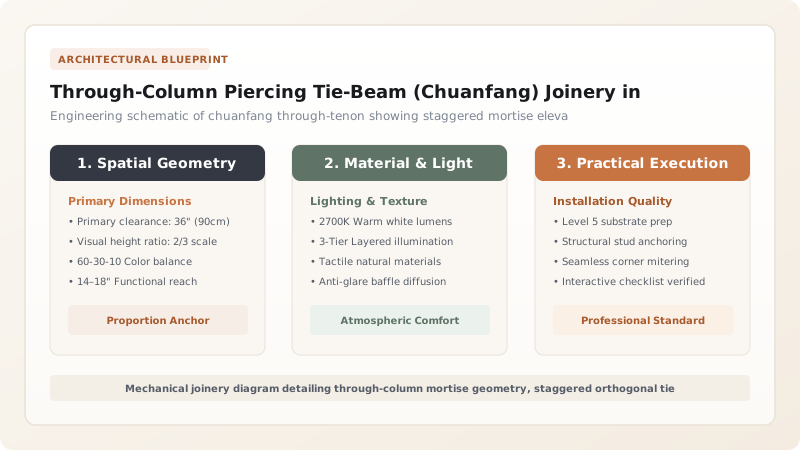
The Mechanical Core of Chuandou: Piercing Rather Than Resting
In the global history of timber carpentry, the intersection of a vertical column and a horizontal beam represents the most critical structural node. In Western framing and Northern Chinese Tailiang architecture, beams sit on top of posts (trabeated framing) or are slotted into shallow mortises with blind tenons. In the mountainous south of China, master carpenters devised a fundamentally different mechanical philosophy: through-column piercing joinery (chuan-dou tou-sun).
In this system, the horizontal tie-beam—the chuanfang—does not terminate inside the post. Instead, a rectangular slot is chiseled entirely through the solid cylindrical core of the vertical tree trunk. The chuanfang passes through the column, emerging on the opposite side where its protruding tongue is locked with a hand-carved hardwood wedge. This through-penetration transforms the post and beam into a monolithic, interlocked structural grid where load is transferred across the entire diameter of the column through double-shear friction.
The Staggered Geometry Rule: Preserving the Column Core
A critical engineering challenge in Chuandoushi architecture is maintaining column strength. If horizontal mortises are cut in multiple directions at the same level—for instance, where transverse bents intersect longitudinal tie-beams—the intersecting voids would sever the cross-sectional grain of the column completely, causing the pole to buckle under axial roof loads.
To prevent this, Southern Chinese master carpenters developed the strict rule of staggered mortise elevations (cuo-wei kai-kong). The primary transverse tie-beams (which form the load-bearing gable trusses) penetrate the column at one elevation. The secondary longitudinal tie-beams (which connect adjacent bents down the length of the building) are offset vertically by at least 150 mm to 200 mm. This vertical separation ensures that a continuous, unbroken cylinder of vertical wood grain runs uninterrupted between the mortises, preserving the column's axial compressive capacity.
Rotational Friction Damping: The Physics of Seismic Survival
Extensive shake-table tests conducted at Tongji University and international earthquake engineering laboratories have verified the extraordinary seismic mechanics of chuanfang joinery. In an earthquake, the ground shakes violently, attempting to deform the rectangular framing bays into angled parallelograms.
In a modern welded steel or bolted frame, these cyclic deformations induce severe stress concentrations that snap bolts and tear welds. In a Chuandou frame, the wooden through-tenon acts as a semi-rigid rotational spring. As the building sways, the tenon rotates slightly (up to 0.05 radians) inside the mortise pocket. The intense friction between the smooth pine wood surfaces acts as a mechanical brake, absorbing and dissipating kinetic energy with every sway cycle. The building sways gracefully, absorbing the earthquake's fury without suffering structural damage.
The Tapered Hardwood Wedge: Maintenance and Reversibility
The fastener that holds this entire dynamic assembly together is the mu-xie—a hand-carved, tapered hardwood wedge. Split from dense, slow-grown oak or zelkova, the wedge possesses a gentle 1:15 slope. When driven through the mortise slot in the protruding tenon tongue, the wedge pulls the tenon shoulder into tight, air-tight compression against the column flank.
This wedge connection provides unparalleled lifecycle adaptability. In the humid subtropical climate of Southern China, timber inevitably expands in humid summers and shrinks in dry winters. When a traditional house develops slight creaks after years of seasonal cycling, the homeowner does not need complex power tools or chemical epoxies; they simply walk the bents with a wooden mallet, tapping the wedges back into tight compression. Furthermore, should a beam ever sustain rot or termite damage, knocking out the wedges allows the beam to be extracted and replaced in hours, preserving the historic timber skeleton across centuries of continuous family occupation.
Timber Frame Beam-to-Column Joints: Chuandoushi Through-Tenon vs Western Mortise-and-Tenon vs Modern Bolted Plate
Use this reference table to calculate exact physical dimensions, ratios, and specifications before purchasing:
| Connection Parameter | Chuandoushi Piercing Chuanfang (Through-Tenon) | Western Blind Mortise-and-Tenon | Modern Steel Gusset Plate & Bolts |
|---|---|---|---|
| Load Transfer Mechanism | Double-shear friction bearing across entire column diameter; semi-rigid rotational spring | Single-shear bearing inside shallow mortise pocket; vulnerable to tenon withdrawal under tension | Point bearing on steel bolt shanks; high localized stress concentrations in wood |
| Seismic Energy Dissipation | Exceptional; frictional sliding along mortise cheeks absorbs seismic waves without fiber breakage | Low to Moderate; blind tenon can pull out of mortise pocket when building sways laterally | Poor; rigid steel transfers shock waves directly into timber, causing bolt hole splitting |
| Column Structural Continuity | 100% Continuous; column runs unbroken from stone base to roof purlin, eliminating splice joints | Interrupted; columns are frequently spliced at floor levels, creating vulnerable hinge points | Interrupted; requires heavy steel moment splices that rust and require regular inspection |
| Tooling & Assembly Speed | High; requires simple chisels and augers; frames can be dry-assembled on ground and reared in hours | Moderate; requires complex stopped mortising and drawboring | Low; requires factory steel plate fabrication, hole drilling, and torquing wrenches |
| Material Durability & Life | 300+ years; self-tightening wedges can be tapped in periodically as timber seasons | 150–250 years; vulnerable to tenon rot if water enters closed pocket | 30–50 years; differential condensation between steel and wood triggers hidden bolt rust |
Practical Constraints
Every successful decoration project must account for physical and environmental constraints:
Friction Binding When Sliding Long Chuanfang Beams Through Multiple Columns
A single tie-beam passing through 4 or 5 columns can bind and seize due to subtle grain misalignments. Mitigation: Taper the tenon tongue slightly (2 mm over 200 mm) and lubricate the wood with natural beeswax or mutton tallow.
Longitudinal Splitting of Protruding Tenon Tongues Under Wedge Pressure
Driving the locking wedge with excessive force can split the end of the tenon along its grain. Mitigation: Leave a minimum 60 mm of solid wood beyond the wedge slot (end-distance) and radius the rear mortise corners.
Execution Blueprint & Craftsmanship Sequence
Execute this professional sequence to achieve flawless results without backtracking:
Column Axis Scribing (Mo-Xian)
Snap longitudinal ink reference lines down the four quadrants of the round fir pole. Measure and mark the exact vertical elevations of all through-mortises using a wooden story pole (zhang-gan).
Mortise Boundary Scribing and Pilot Boring
Scribe the rectangular mortise boundaries (typically 50 mm wide × 160 mm high) centered on the column axis. Bore three overlapping 45 mm pilot holes through the column shaft using a hand T-auger.
Chiseling Parallel Mortise Cheeks
Using a heavy forged mortise chisel (bédane-style zao), chop out the waste wood. Pare the internal mortise cheeks dead-parallel and smooth, ensuring a tight sliding fit for the incoming tie-beam.
Chuanfang Tie-Beam Milling and Tenon Shaping
Saw the chuanfang tie-beams from straight-grained Southern fir. Plane the beam to matching cross-sectional dimensions, cutting square shoulders on both sides of the through-tenon tongue.
Wedge Slot Chiseling (Xie-Kong)
On the protruding end of the tenon tongue that will extend past the far face of the column, chisel a vertical tapered slot (xie-kong) designed to receive the locking hardwood wedge.
Threaded Insertion Through Multiple Columns
Lay the 3 to 5 columns of the bent flat on the ground. Thread the long chuanfang tie-beam through the successive column mortises from one side, tapping the beam end with a heavy wooden beetle until all shoulders seat flush.
Hardwood Wedge Driving (Da-Xie)
Insert a tapered wedge carved from dense hardwood (such as oak or zelkova) into the tenon slot. Drive the wedge home with a wooden mallet; the wedge pulls the tenon shoulder into tight compression against the column flank.
Multi-Tier Orthogonal Pinning
Repeat the process for all intermediate vertical tie-beam tiers. Stagger orthogonal longitudinal tie-beams (chuan-fang) 150 mm higher, completing a rigid, interlocking 3D timber grid.
Common Mistakes & Countermeasures
Avoid these costly errors that compromise aesthetics, ergonomics, and budget:
Cutting through-mortises that occupy more than one-third of the column diameter
Aligning intersecting transverse and longitudinal mortises at the exact same vertical level
Gluing or nailing the through-tenon permanently inside the column mortise
Project Execution Checklist
Track your physical progress. Checkboxes persist automatically on this device:
Frequently Asked Questions
How does the through-tenon joint dissipate earthquake energy?
When an earthquake shakes a Chuandoushi building, lateral forces try to rack the rectangular framing bays into parallelograms. In a rigid bolted joint, this causes severe stress concentrations that fracture the wood. In a chuanfang through-tenon, the tenon rotates slightly (2 to 3 degrees) inside the mortise pocket. The intense friction generated as the wooden surfaces slide against each other converts violent kinetic seismic energy into harmless friction heat, acting like a built-in shock absorber.
What is the typical thickness of a Chuanfang tie-beam compared to the column?
In traditional Sichuan and Guizhou carpentry, the width of a chuanfang tie-beam is typically 30% to 35% of the round column's diameter (e.g., a 50 mm to 60 mm thick beam penetrating a 160 mm diameter column). The depth of the beam is much greater—typically equal to or slightly larger than the column diameter (160 mm to 180 mm)—providing high vertical bending stiffness while preserving column core strength.
Why are the wedges (mu-xie) tapered rather than straight pins?
A tapered wedge (typically possessing a gentle 1:15 slope) allows for dynamic adjustability. As timber seasons and shrinks over its first few years in a humid southern climate, joints naturally develop minor looseness. With a tapered wedge, a homeowner or carpenter simply taps the wedge deeper with a hammer to restore absolute, air-tight joint tightness instantly without disassembling the frame.
Can broken tie-beams be replaced in an existing historic Chuandou building?
Yes. One of the greatest virtues of the through-wedge system is reversibility. By knocking out the hardwood wedges from the protruding tenons, a damaged tie-beam can be backed out through the column mortises and replaced with a newly carved timber without demolishing the roof or neighboring bays.