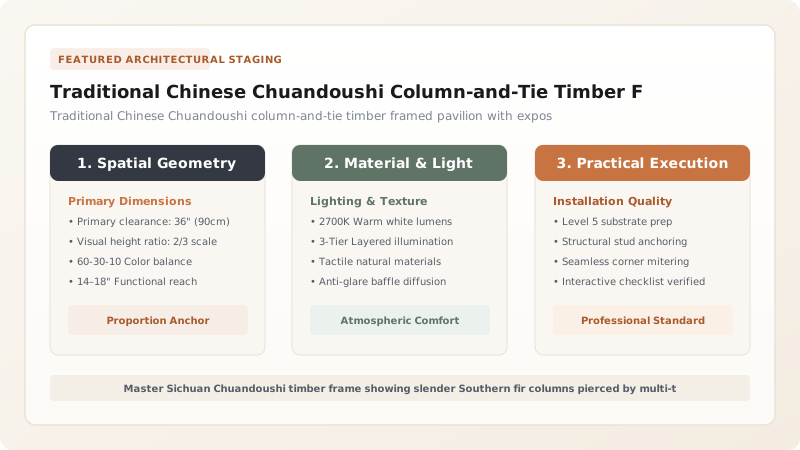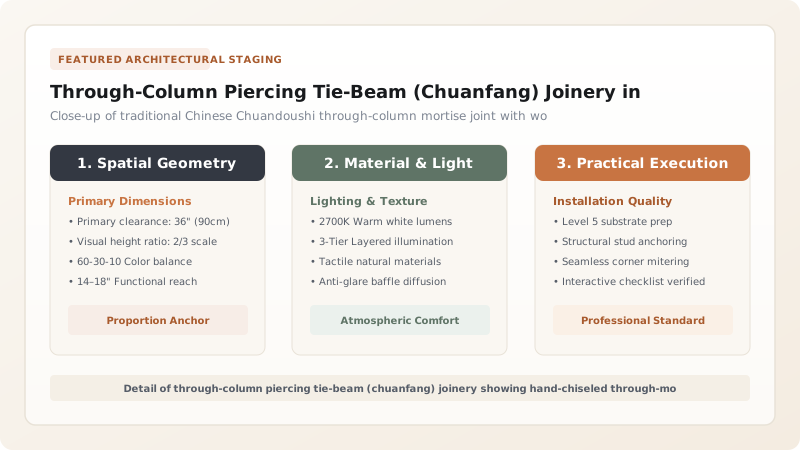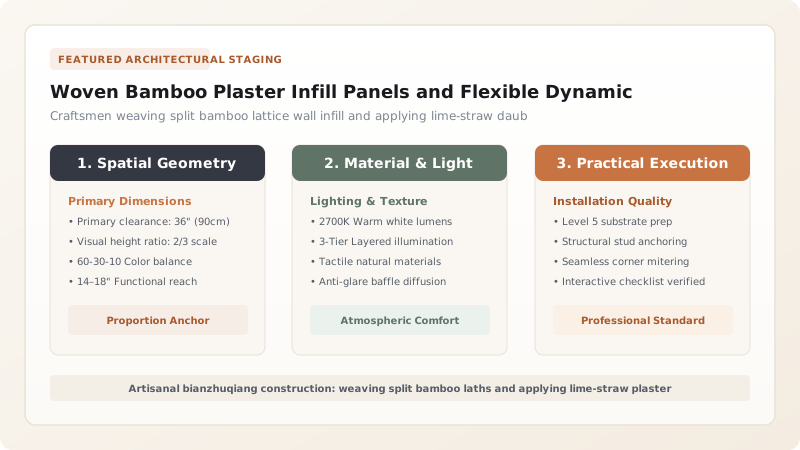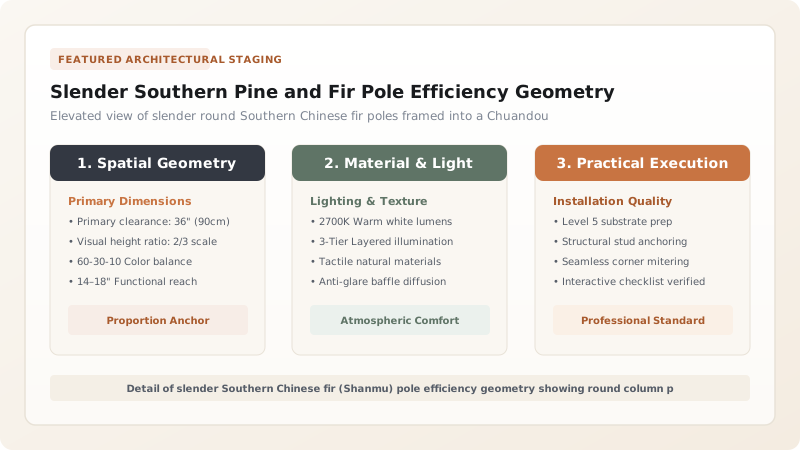
Slender Southern pine and fir pole efficiency geometry is the foundational ecological and structural principle of Chinese Chuandoushi architecture. While northern Tailiang construction required massive old-growth timber trunks (400 mm to 800 mm diameter) to support heavy bending lintels, Chuandoushi was engineered to maximize structural performance using locally abundant, small-diameter round poles of Southern Chinese fir (Cunninghamia lanceolata / Shanmu) and Masson pine (Pinus massoniana) measuring barely 120 mm to 180 mm in diameter. By placing columns directly beneath every roof purlin line and bracing them with multi-tiered through-tie-beams, the system eliminates bending moments, utilizing timber almost entirely in pure axial compression.
At a Glance: Key Takeaways
- Primary Timber Species: Southern Chinese Fir (Cunninghamia lanceolata / Shanmu)
- Secondary Timber Species: Masson Pine (Pinus massoniana / Ma-wei-song)
- Pole Diameter Range: 120 mm to 180 mm (small-diameter natural tree trunks)
- Structural Mode: Pure axial compression (zero transverse bending moments)
- Timber Volume Savings: 40% to 60% less timber volume than Northern Tailiang framing
The Forestry Divide: Ecology Dictates Architectural Form
In architectural history, structural systems are frequently analyzed through the lens of style, politics, or religion. In classical China, the fundamental structural divide between the northern post-and-lintel (Tailiangshi) and the southern column-and-tie (Chuandoushi) was dictated by forest ecology. The northern plains, home to the imperial dynasties of the Yellow River valley, historically possessed massive old-growth forests of pine (Pinus tabuliformis) and cedar, allowing builders to fell gigantic trees measuring nearly a meter in diameter to span monumental palace halls.
South of the Yangtze River, in the rugged mountainous terrain of Sichuan, Guizhou, and Fujian, the landscape was entirely different. The subtropical slopes were covered with dense, rapidly growing stands of Southern Chinese fir (Cunninghamia lanceolata / Shanmu) and Masson pine. These trees grow tall, straight, and slender, but rarely achieve the colossal girth required for heavy horizontal lintels. Rather than attempting to copy northern methods, southern master carpenters created an architecture tailored to their ecology: an ultra-lightweight structural system composed of slender, small-diameter poles.
The Direct Purlin Principle: Eliminating Bending Stresses
The core structural breakthrough of Chuandou geometry is the direct purlin principle. In Northern Tailiang architecture, a few massive columns support heavy horizontal beams, which in turn carry secondary posts that support tertiary beams, creating a tiered hierarchy of massive horizontal bending members. Wood, like stone, is relatively weak in cross-grain bending and shear, requiring massive cross-sections to prevent excessive deflection under heavy terracotta roof tiles.
Chuandoushi eliminates bending stress almost entirely. Instead of using horizontal beams to span between distant columns, the southern carpenter places a slender vertical column directly beneath every single roof purlin line. The round purlin (lin) drops directly into a semicircular concave saddle (dou-kou) carved into the head of the column. As a result, 100% of the heavy roof load is transferred straight down the vertical axis of the tree trunk in pure, direct axial compression—the mechanical state in which wood exhibits its absolute maximum structural strength.
Taming the Slenderness Ratio: Multi-Tier Buckling Control
While placing slender poles in pure compression is structurally efficient, it introduces a severe mechanical danger: buckling. According to classic structural mechanics, when a slender column is subjected to axial compression, it will not crush; it will suddenly buckle and snap outward sideways if its effective unsupported length is too great.
Chuandoushi tames buckling through its multi-tiered chuanfang tie-beams. In a typical two-story Sichuan dwelling, a slender 150 mm diameter column may reach a total height of 6 meters. If unsupported, it would buckle instantly under roof loads. But the carpenter ties the column horizontally every 1.5 to 1.8 meters using through-tenon tie-beams. These intermediate ties provide rigid lateral restraint in the plane of the bent, dividing the tall column into four short, stout segments. The effective buckling length is reduced by 75%, multiplying the column's compressive capacity sixteen-fold and allowing tree poles no thicker than a human thigh to carry multi-tiered tile roofs safely.
Material Efficiency and Zero-Waste Biomass Utilization
The ecological consequence of this geometry is extraordinary timber efficiency. In modern sawmills or northern timber framing, squaring round tree trunks into rectangular beams wastes up to 45% of the tree's volume in bark, slabs, and sawdust. Furthermore, squaring wood severs the continuous longitudinal grain along the outer growth rings, where the densest, highest-tensile wood fibers are concentrated.
Chuandoushi utilizes timber in its natural round form (yuan-mu). The bark is stripped with a hand drawknife, leaving the dense outer sapwood and cambium layer completely intact. Every single cubic centimeter of the tree's natural biomass is deployed structurally. Because Southern fir regenerates rapidly on 20-to-25-year coppice cycles, a rural village could cultivate its own building materials in mountain woodlots directly behind the homestead, creating a regenerative, carbon-negative building tradition that harmonized human settlement with the natural rhythms of the subtropical forest.
Timber Framing Material Economics: Southern Chuandou Fir Poles vs Northern Tailiang Hardwood vs Modern Sawn 2x Lumber
Use this reference table to calculate exact physical dimensions, ratios, and specifications before purchasing:
| Forestry & Structural Parameter | Southern Chuandou Fir Poles (Shanmu) | Northern Tailiang Heavy Timber | Modern Sawn Softwood 2x Dimensional Lumber |
|---|---|---|---|
| Tree Rotation Harvest Age | Fast 20 to 30 years; rapid natural regeneration in southern mountain plantations | Slow 150 to 300+ years; requires ancient old-growth virgin forests | Fast 25 to 35 years; commercial clear-cut plantation monocultures |
| Primary Structural Stress State | Pure Axial Compression; columns carry roof directly without bending lintels | Severe Bending & Shear; massive transverse beams span wide column bays | Bending, Shear, & Compression; light-gauge studs spaced 400 mm on center |
| Timber Processing Kerf Waste | Near Zero (<5%); debarked round logs utilized whole without sawmill squaring | Extremely High (40%–50%); squaring giant round trunks produces vast waste slabs | High (20%–30%); milling logs into rectangular profiles yields significant sawdust |
| Natural Rot & Insect Immunity | High; Southern fir heartwood naturally rich in aromatic cedrol oils and fungicides | High; old-growth pine and cedar heartwood saturated in dense natural resins | Very Low; young plantation wood requires toxic chemical pressure treatments (ACQ/copper) |
| Ecological & Embodied Carbon | Super Carbon-Negative; continuous sustainable coppice and replanting rotations | Negative historically, but caused widespread deforestation across northern China | Moderate; energy-intensive industrial sawmills, kiln drying, and transport logistics |
Practical Constraints
Every successful decoration project must account for physical and environmental constraints:
Natural Axial Taper of Small-Diameter Tree Trunks
A natural tree pole tapers roughly 10 mm per 3 meters of height, complicating uniform joint layout. Mitigation: Orient all poles with root butts at the base, and reference all mortise depths from a snapped centerline rather than the irregular outer bark.
Flexural Buckling Tendency Under Extreme Axial Compression
Slender 140 mm columns reaching 6 meters in height can buckle under heavy terracotta roof tile loads. Mitigation: Install multi-tier horizontal chuanfang tie-beams every 1.5 to 1.8 meters vertically, dividing the column into short, unbucklable segments.
Execution Blueprint & Craftsmanship Sequence
Execute this professional sequence to achieve flawless results without backtracking:
Silvicultural Selection and Harvesting
Select straight, slow-grown Southern Chinese fir (Shanmu) trees aged 25 to 30 years from highland agroforestry groves in Sichuan or Guizhou, felling during dry winter dormancy.
Manual Debarking (Bao-Pi)
Debark the round poles immediately after felling using curved drawknives (gua-dao). Remove the outer bark while preserving the continuous, high-tensile cambium and sapwood fibers beneath.
Freshwater Pond Leaching
Submerge the debarked logs in clean mountain river ponds or dedicated water tanks for 4 to 6 months. This traditional leaching process washes away soluble starches, sugars, and sap, immunizing the timber against wood-boring insects.
Controlled Shadow Air-Drying
Stack the leached poles horizontally on timber stickers under open-sided drying sheds for 3 to 6 months until moisture content drops below 15%, rotating monthly to prevent differential drying warping.
Diameter Grading and Sorting
Sort the dried poles by diameter: assign 160 mm to 180 mm poles to tall central ridge columns (zhongzhu), and deploy 120 mm to 140 mm poles for secondary intermediate posts and eave columns.
Centerline Scribing (Mo-Xian)
Snap plumb reference chalk lines down the axial center of each round pole. Use these centerlines to calculate all through-mortise locations, completely bypassing natural trunk taper and surface irregularities.
Purlin Saddle (Dou-Kou) Carving
At the head of each column, chisel a semicircular concave saddle matching the radius of the round roof purlin (lin). The purlin will drop directly into this saddle, transferring roof loads in pure axial compression.
Multi-Tier Tie Assembly
Tie the slender columns together at vertical intervals of 1.5 to 1.8 meters with horizontal chuanfang tie-beams. This dense grid reduces the effective column length, eliminating all danger of structural buckling.
Common Mistakes & Countermeasures
Avoid these costly errors that compromise aesthetics, ergonomics, and budget:
Squaring round fir poles into rectangular timbers with sawmill blades
Spacing columns widely apart and adding heavy horizontal lintels to span the distance
Using un-cured, sap-rich green pine in unventilated wall cavities
Project Execution Checklist
Track your physical progress. Checkboxes persist automatically on this device:
Frequently Asked Questions
Why is Southern Chinese fir (Shanmu) the supreme timber for Chuandou framing?
Southern Chinese fir (Cunninghamia lanceolata / Shanmu) is an indigenous evergreen conifer celebrated for over two millennia in Chinese forestry. It grows straight, tall, and with minimal taper; it seasons rapidly without violent checking or warping; and its heartwood is saturated with natural fragrant essential oils (cedrol) that make it naturally immune to subterranean termites and wood-rotting fungi without chemical treatments.
How does using round poles save wood compared to square timbers?
In conventional sawn carpentry, converting a round tree trunk into a square beam wastes 35% to 45% of the total wood volume in discarded slab wood and sawdust. Furthermore, the strongest, densest wood fibers are concentrated in the outer annual rings. By using the timber in its natural round form (yuan-mu), 100% of the tree's biomass is utilized, and the intact outer fibers provide maximum flexural and compressive resistance.
What is an Euler buckling limit and how does Chuandou overcome it?
In structural mechanics, Euler's formula states that a slender column subject to axial compression will buckle (bow outward sideways) at a critical load that decreases with the square of its length. A slender 140 mm fir pole spanning 6 meters would buckle easily under heavy roof tiles. In Chuandoushi, horizontal chuanfang tie-beams intersect the column every 1.5 meters, effectively cutting the unsupported length by 75% and increasing its buckling resistance by a factor of sixteen.
How fast does a Shanmu fir tree grow to structural size in Southern China?
In the warm, rainy subtropical climate of Southern China, Chinese fir is an exceptionally fast-growing timber species. A plantation stand can reach a structural pole diameter of 150 mm to 180 mm and a height of 15 meters within 20 to 25 years. This rapid renewal cycle allowed rural communities to maintain self-sufficient village timber reserves, harvesting trees sustainably for every new generation of homebuilders.