Exterior wall envelopes in Chongqing Diaojiaolou architecture are crafted from woven split-bamboo laths (Zhu-ba) plastered with an organic bio-composite of river clay, chopped rice straw, and slaked lime. Lightweight and highly flexible, these panels slide into grooves along timber frame columns without adding deadweight to cliff cantilevers. The breathable walls, combined with slatted lattice transoms and overhanging verandas, harvest cool thermal updrafts from river gorges, providing unpowered microclimate cooling in humid subtropical heat.
At a Glance: Key Takeaways
- Woven Core (Zhu-ba): Split Moso Bamboo strips (Cleft 20 mm wide × 3 mm thick)
- Weaving Pattern: Twill Herringbone or Open Hexagonal Basket Weave
- Daub Composite: Alluvial River Clay (40%), Sand (40%), Lime & Chopped Straw (20%)
- Wall Deadweight: Under 35 kg/m² (80% lighter than solid brick nogging)
- Passive Cooling: Continuous convective updraft ventilation off river gorge
The Lightness Imperative in Cliffside Wall Construction
When constructing a multi-story building that cantilevers four meters outward over a rocky river abyss, every kilogram of building deadweight matters. Filling timber wall bays with solid fired clay brick (weighing 180 to 220 kg per square meter) would place catastrophic bending stresses on the Shanmu cantilever beams.
Southwestern Chinese master builders solved this through the supreme material lightness of Zhu-ba (woven split-bamboo laths). By utilizing giant native Moso bamboo (Phyllostachys edulis), carpenters created continuous woven wall screens that weigh less than 35 kg per square meter—over 80% lighter than masonry—while providing outstanding tensile elasticity that flexes harmoniously with the Chuan-Dou timber skeleton.
Riving and Weaving the Zhu-Ba Lattice
Fabricating the bamboo core begins in winter when sap sugars are low. Long Moso bamboo culms are split lengthwise into flexible ribbons measuring roughly 20 mm wide and 3 mm thick, maintaining the hard silica-rich outer green skin (Zhu-qing) for maximum tensile strength.
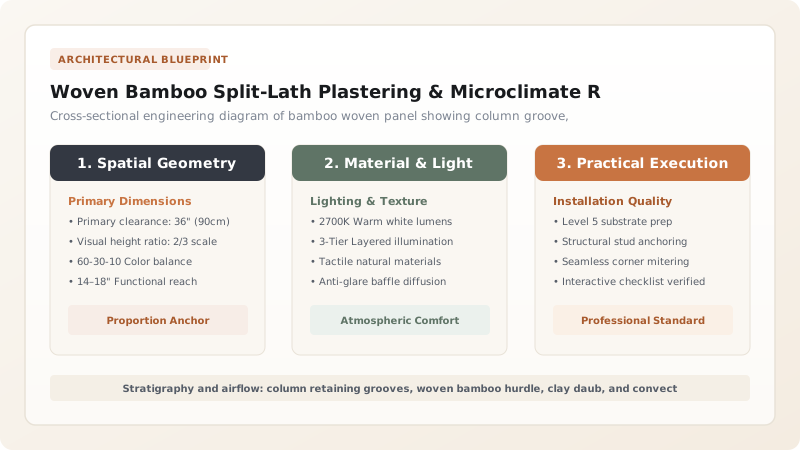
The artisan cuts vertical guide grooves (20 mm wide) into the columns of the timber frame. Flexible bamboo staves are inserted into these grooves, and horizontal bamboo ribbons are woven in an alternating twill or herringbone basket-weave pattern. The spring tension of the bent bamboo locks the hurdle securely inside the frame grooves without a single metal nail, creating a flexible diaphragm that absorbs wind shear.
The Earthen Daub: River Clay, Rice Straw, and Pit Lime
Once the bamboo hurdle is woven, it is plastered from both sides with an empirical bio-composite daub. The formulation balances workability, adhesion, and breathability:
- Alluvial River Clay: Harvested from river sandbars; rich in fine silt platelets that form the cohesive binder.
- Chopped Rice Straw (Dao-cao): Cut to 50–80 mm lengths. The straw fibers intertwine with the bamboo lattice, forming a continuous tensile fleece that bridges drying shrinkage.
- Pit-Slaked Lime: Added at 15% to 20% by volume. Lime accelerates drying, inhibits insect and mold infestation, and improves water repellency.
- Application: Two workers apply the daub simultaneously from inside and outside, pressing the mud through the bamboo voids until the weave is completely encapsulated in a solid 45-mm core.
Microclimatic Aerodynamics in the Yangtze River Gorges
Chongqing's summer climate is famously stifling, with high humidity and stagnant mountain basin air. Diaojiaolou architecture functions as a passive aerodynamic heat pump that harvests the natural microclimate of the river canyon.
During hot afternoons, solar radiation heats the rock cliff faces above the city. The warmer air rises rapidly along the cliff, creating a localized convective updraft that pulls cooler air from the shadowed water surface below. Because Diaojiaolou cantilevers outward over the river, this cool mountain-river airstream flows continuously through slatted floor vents, across shaded verandas, and exhausts through open bamboo transoms beneath overhanging eaves, dropping interior temperatures by 4°C to 6°C without mechanical fans.
Wall Enclosure Comparison: Woven Bamboo Daub vs Fired Brick vs Modern Drywall
Use this reference table to calculate exact physical dimensions, ratios, and specifications before purchasing:
| Wall System | Weight per m² | Flexibility with Timber Frame | Vapour Breathability | Seismic Safety on Cliffs |
|---|---|---|---|---|
| Woven Bamboo Daub (Zhu-ba) | 30 kg to 40 kg/m² (Ultra-light) | Exceptional; flexes elastically without cracking | 100% Breathable; regulates humid river air | Maximum; cannot fall outward in lethal blocks |
| Fired Grey Brick Nogging | 180 kg to 220 kg/m² (Very Heavy) | Poor; rigid bricks debond from timber frames | Moderate; requires lime mortar pointing | Dangerous; heavy bricks can tumble off cliff |
| Modern Gypsum Drywall | 25 kg to 35 kg/m² (Lightweight) | Brittle; cracks along joints under sway | Zero; paper facing molds in 95% humidity | Poor; disintegrates during water leaks |
| Tongue-and-Groove Fir Planks | 45 kg to 60 kg/m² (Moderate) | Good; moves with frame seasonal expansion | High; natural wood breathability | High; ductile, fully demountable |
Practical Constraints
Every successful decoration project must account for physical and environmental constraints:
High Atmospheric Humidity Slowing Daub Drying
In foggy river gorges with 90% humidity, thick clay daub can take over 6 weeks to dry fully Mitigation: Increase the proportion of slaked lime (up to 25%) to accelerate carbonation and improve initial wet strength
Severe Wind Buffeting on Projecting Veranda Wall Panels
Gorge wind funnels exert high cyclical pressure and suction on exterior walls Mitigation: Incorporate intermediate horizontal wooden battens (Heng-dang) wedged into the frame to brace the bamboo weave
Execution Blueprint & Craftsmanship Sequence
Execute this professional sequence to achieve flawless results without backtracking:
Bamboo Harvesting and Boiling Treatment
Harvest mature 4-year Moso bamboo in winter. Boil split ribbons in mild borax or lime water to leach out starches and prevent beetle attack.
Column Groove Channelling
Plow continuous 20 mm × 25 mm vertical grooves down opposing flanks of Shanmu framing columns using grooving planes.
Zhu-Ba Bamboo Hurdle Weaving
Insert vertical bamboo staves into top and bottom beam slots. Weave 20-mm split bamboo ribbons horizontally in twill basket patterns.
Clay, Straw, and Lime Daub Pugging
Tread river clay, sharp sand, chopped rice straw, and slaked lime on a mixing tarp with water until it forms a stiff, cohesive paste.
Simultaneous Two-Sided Daub Application
Throw and press fist-sized daub lumps into the bamboo lattice from both sides simultaneously, keying through all bamboo openings.
Surface Leveling and Key Scratching
Float daub flat with wooden trowels, recessing panel faces 10 mm behind the timber frame. Scratch diamond keys for plaster coat.
Air Drying and Shrinkage Monitoring
Allow daub to dry naturally in shaded river breezes for 3 to 4 weeks, filling minor perimeter shrinkage gaps with fine clay-fiber slip.
Slaked Lime Whitewash Finishing
Apply three coats of pure slaked pit lime wash blended with 1% tung oil to waterproof exterior faces while preserving full breathability.
Common Mistakes & Countermeasures
Avoid these costly errors that compromise aesthetics, ergonomics, and budget:
Using un-treated green bamboo cut during summer sap flow
Plastering bamboo hurdles with modern dense Portland cement mortar
Nailing bamboo strips to column faces instead of slotting them into grooves
Project Execution Checklist
Track your physical progress. Checkboxes persist automatically on this device:
Frequently Asked Questions
How long do woven bamboo daub walls last in a rainy climate?
When protected by overhanging eaves and coated with breathable lime wash every 4 to 6 years, traditional bamboo-daub walls easily last 60 to 80+ years. If a section ever sustains damage, it can be patched locally with fresh clay-straw mud without replacing the entire wall.
Why is tung oil added to the exterior lime wash?
Tung oil (Tong-you) is an indigenous drying oil native to Southwest China. Adding 1% to 2% boiled tung oil to slaked lime wash introduces water-shedding lipophilic fatty acids that repel driving rain without sealing the micro-pores or destroying vapor breathability.
Are bamboo walls safe against burglar intrusion or fire?
The dense weave of tough silica-rich bamboo fibers, combined with a 45-mm solid mineral clay core, creates a tough barrier that cannot be cut with a knife. For fire protection, the mineral clay encapsulates the organic bamboo, preventing oxygen from reaching the fibers and resisting flame penetration for up to an hour.
How do bamboo walls keep rooms cool in summer?
The porous clay-straw matrix acts as a natural evaporative cooler: during humid mornings, it adsorbs microscopic water vapor; during hot afternoons, as river canyon breezes blow across the wall, this moisture slowly desorbs, absorbing ambient heat and cooling the interior living space.