Multi-layer camphor wood relief and pierced undercutting (tongdiao) constitute the supreme technical achievement of Chaozhou woodcarving. Working on solid planks of aromatic, insect-repellent camphor wood (Cinnamomum camphora), master carvers excavate up to three to six distinct spatial depths within a single piece of timber. Through a disciplined sequence of drafting, pilot drilling, roughing-out (dapei), and deep pierced undercutting (loukong), artisans create floating three-dimensional tableaux—such as battle scenes, pavilions, and aquatic fauna—where figures are completely detached from the background yet structurally united.
At a Glance: Key Takeaways
- Core Technique: Tongdiao: multi-layer pierced openwork and 360° undercutting (loukong)
- Spatial Depths: 3 to 6 distinct relief layers excavated from a single solid timber block
- Primary Timber: Aromatic Camphor wood (Cinnamomum camphora, naturally insect-repellent)
- Chisel Arsenal: Over 30 specialized chisels: flat (pingzao), curved (yuanzao), oblique (xiedao)
- Structural Tolerance: Connecting timber bridges between floating figures as slender as 2–3 mm
The Philosophy of Tongdiao: Space as Narrative Canvas
In the hierarchy of Chinese decorative arts, relief woodcarving is traditionally categorized into three grades: shallow bas-relief (qian futiao), deep high relief (shen futiao), and pierced openwork (tongdiao or loukong diao). While most regional schools practiced bas-relief on architectural panels, the master carvers of Chaozhou pushed the physical boundaries of the medium to create three-dimensional spatial worlds carved from single, solid blocks of camphor timber.
Tongdiao is not merely an ornamental technique; it is a profound philosophical statement on the relationship between solid matter (shi) and void (xu). By piercing completely through the wooden matrix, the artisan liberates the figures from the tyranny of the flat background. Light and air flow freely through the carving, illuminating figures from behind and casting complex, shifting shadows. Characters from classical Chaozhou opera, historical epics, and folklore are depicted in dynamic, floating spatial relationships, moving across bridges, peering through windows, and galloping across mountainous defiles in full three-dimensional realism.
Anatomy of the Camphor Matrix: Grain Mechanics
The execution of multi-layer pierced carving is a high-wire structural act that depends completely on the botanical properties of Cinnamomum camphora (zhangmu). When an artisan excavates three to five tiers of figures from a single plank, the volume of wood removed often exceeds 70% to 85% of the original timber blank. What remains is a delicate, gossamer-thin structural filigree.
Camphor wood is uniquely qualified for this extreme subtractive sculpting. Its interlocked grain structure exhibits high shear and tensile strength across multiple axes. Unlike straight-grained softwoods like pine, which cleave and split along radial annual rings when subjected to cross-grain chisel forces, camphor wood can be sliced with equal ease in any vector. Furthermore, its moderate density (approx. 550 to 650 kg/m³) provides the perfect balance: soft enough to yield cleanly to hand gouges without dulling cutting edges instantly, yet firm enough to hold razor-sharp, paper-thin structural details without crumbling under pressure.
The Chisel Arsenal: Specialized Tooling of the Chaozhou Master
A master Chaozhou woodcarver works with an arsenal of more than thirty to fifty hand-forged steel chisels, each custom-ground to execute specific spatial operations. The primary workhorses are the pingzao (flat chisels) and yuanzao (curved gouges), ranging in width from monumental 50 mm roughing gouges to microscopic 1 mm detailing tools.
However, the true virtuosity of undercutting relies on specialized, compound-angled tools. The wanzao (spoon or bent gouge) features a curved shank that allows the cutting edge to reach around the back of a carved figure and scoop out wood from blind hollows without damaging the foreground. The xiedao (skew chisel), with its 45-degree angled cutting edge, is used to slice into razor-sharp acute corners and carve undercut drapery folds. The sanjiaodao (parting V-tool) incises fine linear details such as hair strands, pine needles, and dragon scales, cutting clean V-shaped grooves in a single fluid stroke.
The Engineering of Concealed Structural Bridges
The ultimate technical challenge in Chaozhou tongdiao is maintaining structural integrity across multiple floating tiers. A poorly engineered carving will sag, vibrate, or snap during transport, lacquering, or gilding. Master carvers solve this challenge through the sophisticated placement of concealed structural bridges (an qiao).
When composing the narrative scene, the artisan deliberately designs natural points of contact between the different spatial layers. A warrior's spear in the foreground may touch a courtyard tree branch in the midground; a maiden's flowing silk sash may connect to a pavilion column; a leaping carp's tail may merge into a swirling water eddy in the background. These contact points are not accidental; they are meticulously calculated structural struts that anchor the floating figures back to the rigid outer perimeter frame. By aligning these bridges with the longitudinal grain direction of the camphor wood, the artisan creates an immensely strong, self-bracing three-dimensional truss disguised entirely as dramatic narrative art.
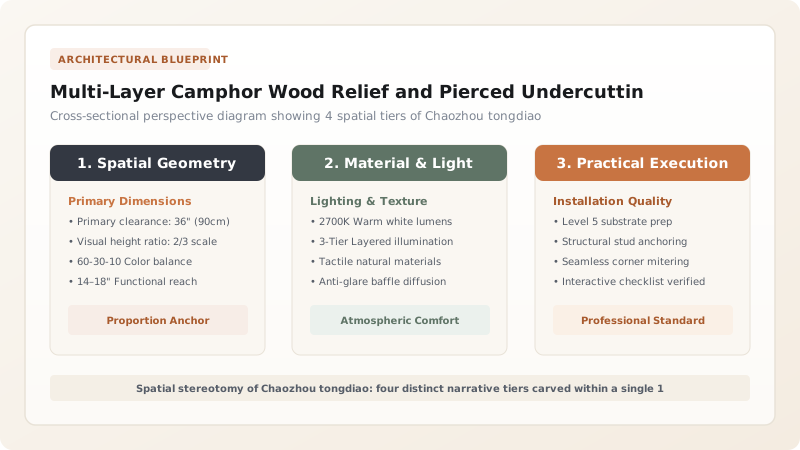
Chaozhou Woodcarving Spatial Layers: Depth and Tooling Sequence
Use this reference table to calculate exact physical dimensions, ratios, and specifications before purchasing:
| Spatial Layer | Depth Range | Subject Matter | Primary Tool Used | Structural Duty |
|---|---|---|---|---|
| Layer 1 (Foreground) | 0 to 25 mm depth | Primary actors, opera generals, crawling crabs, creeping vines | Fine oblique knives (xiedao) and micro-gouges | Self-supporting cantilevered relief; high visual focus |
| Layer 2 (Midground) | 25 to 60 mm depth | Pavilions, balustrades, courtyard trees, secondary attendants | Medium curved gouges (yuanzao) and flat chisels | Connects foreground figures to structural timber frame |
| Layer 3 (Background) | 60 to 95 mm depth | Distant mountain ridges, soaring pagodas, drifting clouds | Deep bent gouges (wanzao) and fish-tail chisels | Receding perspective plane; anchored to outer frame |
| Layer 4+ (Void Cavity) | 95 to 120 mm depth | Pierced negative space; complete through-cut void | Hand augers, fret-saws, and narrow hollow chisels | Admits ambient light; separates front from back |
Practical Constraints
Every successful decoration project must account for physical and environmental constraints:
High Internal Growth Stresses in Wild-Harvested Camphor Timber
Relieving internal stresses during deep carving can cause the plank to bow or cup unpredictably. Mitigation: Clamp the timber blank in a rigid hardwood vise frame and relieve internal stresses symmetrically from both sides.
Extreme Fragility of 2 mm Undercut Bridges during Fine Chisel Detailing
Accidental heavy chisel impact can shatter an entire floating narrative tier. Mitigation: Support delicate undercut figures from behind with temporary wax blocks or damp felt cushions during carving.
Execution Blueprint & Craftsmanship Sequence
Execute this professional sequence to achieve flawless results without backtracking:
Timber Blank Dressing and Squaring
Dress a seasoned camphor wood plank (typically 80 to 120 mm thick) dead flat and square on all four faces using wooden hand planes, verifying grain orientation.
Axonometric Cartoon Transfer (Hua Gao)
Transfer the intricate multi-tiered cartoon onto the front face of the wood using Chinese ink and brush, color-coding the depths of each spatial layer.
Pilot Hole Drilling and Fret-Sawing
Drill clean perpendicular pilot holes through all major negative voids using a spiral hand auger, then thread a fine wire fret-saw through the holes to cut away bulk waste wood.
Primary Roughing-Out (Da Pei)
Using heavy flat chisels (pingzao) struck with wooden mallets, chisel away wood in stepped horizontal tiers, establishing the foreground, midground, and background planes.
Deep Undercutting (Loukong)
Using specialized curved gouges (yuanzao) and spoon chisels (wanzao), excavate wood from behind the figures, severing them from the background while leaving hidden structural bridges.
Intermediate Anatomical Modeling
Shape the three-dimensional anatomy of human figures, horses, and floral blossoms, ensuring that garments, armor plates, and tree branches overlap naturally in space.
Micro-Detail Chiseling (Xia Ke)
Using razor-sharp oblique finishing knives (xiedao), carve hair strands, facial features, fish scales, and pierced window lattices with sub-millimeter precision.
Structural Bridge Verification and Cleaning
Inspect every connecting bridge for structural stability, gently clearing out all loose wood chips and shavings from the deep pierced cavities using soft brushes and air bulbs.
Common Mistakes & Countermeasures
Avoid these costly errors that compromise aesthetics, ergonomics, and budget:
Carving delicate foreground figures before establishing background depths
Undercutting timber bridges across short-grain sections of camphor wood
Using dull chisels that compress and crush wood fibers rather than slicing cleanly
Project Execution Checklist
Track your physical progress. Checkboxes persist automatically on this device:
Frequently Asked Questions
How do Chaozhou carvers achieve multi-layer depth without assembling separate pieces of wood?
Chaozhou tongdiao is carved entirely from a single solid block of camphor wood. The artisan visualizes the composition as a three-dimensional matrix within the block. By boring pilot holes and working chisels horizontally beneath surface figures, the craftsman excavates the wood behind them, creating a second and third spatial layer behind the first. The figures remain structurally attached to each other and to the outer frame via ingenious, concealed bridges of living wood grain.
What is the famous 'Crabs in a Bamboo Basket' motif in Chaozhou carving?
The 'Crabs in a Bamboo Basket' (xie lou) is the iconic technical tour-de-force of Chaozhou woodcarving. Carved from a single camphor plank, it depicts an open-weave bamboo basket filled with live crabs and lobsters. The artisan carves the thin, woven bamboo slats of the basket as open filigree, while the crabs inside and outside the basket are fully sculpted with articulated joints, claws, and eyes, appearing to crawl freely through the woven mesh.
What specialized chisels are required for deep undercutting?
Artisans utilize over thirty distinct chisels. The most critical for undercutting are the wanzao (bent spoon chisels that can curve around and cut behind a figure), the xiedao (beveled skew knives that slice clean acute corners), the gouzao (dog-leg chisels for excavating deep blind pockets), and micro-parting V-tools (sanjiaodao) used for incising hair and armor patterns.
How is camphor wood prevented from splitting during deep carving?
Camphor wood must be slow-seasoned in shaded, well-ventilated drying sheds for at least two to three years until its moisture content stabilizes at 10% to 12%. During carving, artisans maintain balanced material removal across the piece to prevent localized moisture release, and work in humidity-controlled workshops protected from direct sunlight and dry seasonal winds.