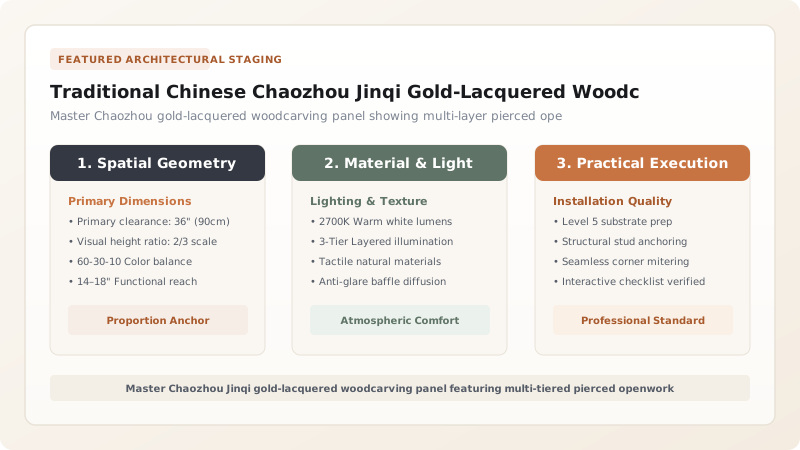
Chaozhou Jinqi gold-lacquered woodcarving (Chaozhou Jinqi Mu Diao) is a celebrated Chinese intangible cultural heritage craft originating from the Chaoshan region of eastern Guangdong. Renowned for its breathtaking multi-layered pierced openwork (tongdiao) that carves up to three to six spatial depths from single planks of seasoned camphor wood (Cinnamomum camphora), the art integrates structural timber architecture with fine sculpture. The intricately carved figures, pavilions, and aquatic fauna are primed with natural toxicodendron urushi lacquer and gilded with hammered 24-karat pure gold leaf, adorning ancestral shrine doors, screen transoms (huachuang), and cantilevered bracket sets (quecha).
At a Glance: Key Takeaways
- Regional Heritage: Chaoshan Region (Chaozhou, Shantou & Jieyang, Guangdong, China)
- Primary Timber: Aromatic Camphor wood (Cinnamomum camphora / zhangmu, insect-repellent)
- Carving Technique: Tongdiao: 3 to 6 spatial layers of continuous pierced openwork relief
- Lacquer & Gilding: Refined raw urushi lacquer (shengqi) + hammered 24K pure gold leaf (jinbo)
- Architectural Setting: Chaoshan courtyard estates (Si Dian Jin), ancestral shrines, and beam brackets
In-Depth Guides in this Directory
Explore specialized subtopic blueprints, technical dimensions, and execution checklists:
Multi-Layer Camphor Wood Relief and Pierced Undercutting in Chaozhou Carving
Technical guide to Chaozhou multi-layer woodcarving. Learn about camphor wood selection, spatial tier drafting, and pierced undercutting techniques (tongdiao).
Raw Urushi Lacquer Priming and Pure Gold Foil Application in Jinqi Finishes
Technical guide to Chaozhou Jinqi finishing: raw urushi lacquer priming (shengqi), bone ash putty leveling, gold-size adhesive timing, and 24K gold leaf gilding.
Shrine Doors, Screen Transoms, and Architectural Corbel Brackets of Chaoshan
Explore the architectural integration of Chaozhou woodcarving: ancestral shrine doors (citang men), openwork transoms (huachuang), and structural corbels (quecha).
The Golden Splendor of Chaoshan Clan Architecture
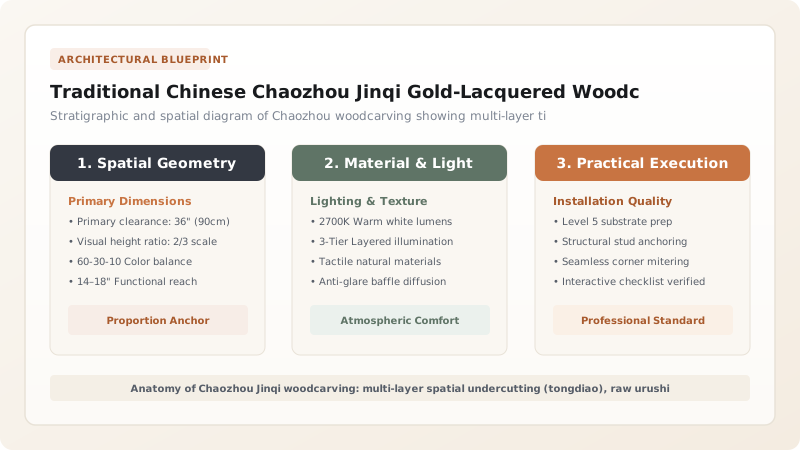
In the fertile coastal delta of the Han River in eastern Guangdong province, the Chaoshan cultural region developed a vernacular architectural tradition defined by aristocratic refinement and clan solidarity. In traditional Chaoshan courtyard mansions—such as the Si Dian Jin (Four Horses Dragging a Chariot) and the monumental ancestral shrines (citang) that anchored every village—the structural timber frame was transformed into a glittering golden pantheon through Chaozhou Jinqi Mu Diao (gold-lacquered woodcarving).
Arising during the Tang and Song dynasties and reaching its baroque zenith during the late Qing dynasty, Chaozhou woodcarving was fueled by the immense wealth of Chaoshan maritime merchants trading across Southeast Asia. Unlike the restrained, austere aesthetics of northern scholar-bureaucrats, Chaoshan architecture embraced radiant visual opulence. Every functional wooden member—from roof beam corbel brackets and screen transoms to monumental shrine doors—was lavishly carved and gilded with pure gold leaf. In the dim, incense-scented interiors of ancestral halls, these golden carvings caught the flickering light of oil lamps, creating an ethereal, celestial realm that proclaimed the eternal prosperity, filial piety, and prestige of the lineage clan.
Camphor Wood: Botanical Foundation of Durability
The technical possibility of executing multi-tiered, paper-thin pierced carving depends entirely on the botanical characteristics of aromatic camphor wood (Cinnamomum camphora / zhangmu). Sourced from the mountainous interior of Guangdong and Fujian, mature camphor trees provide dense, fine-grained heartwood that possesses a unique combination of moderate hardness and exceptional dimensional stability.
Unlike coniferous softwoods that split easily along the grain, camphor wood exhibits a uniform, interlocked grain structure that cuts cleanly in any direction—whether working with the grain, across the end-grain, or along diagonal curves. Furthermore, the wood is naturally saturated with high concentrations of aromatic camphor oil and natural terpenoids. This pungent essential oil acts as a permanent, lifetime biological deterrent against subterranean termites, powder-post beetles, and fungal dry rot—an essential defensive quality in the hot, insect-ridden subtropical climate of Southern China.
The Virtuosity of Tongdiao: Multi-Layer Pierced Openwork
What elevates Chaozhou woodcarving above all other Chinese carving schools is its supreme mastery of tongdiao (pierced, hollowed-out multi-layer carving). While ordinary relief carving leaves the subject attached to a flat, solid wooden backing board, tongdiao cuts completely through the plank, hollowing out negative spaces and excavating up to three to six distinct spatial depths within a single piece of camphor wood.
Working from a single solid timber block often 10 to 15 centimeters thick, the master carver (mu-diao shifu) uses hundreds of specialized gouges, chisels, and curved knives. The composition is arranged like a theatrical stage set: in the deepest background layer, distant mountains and pagodas recede into the void; in the middle ground, intricate pavilions with functioning lattice doors and courtyard balustrades are hollowed out; in the foreground, heroes from Chaozhou opera, celestial maidens, or lifelike crabs tangled in woven bamboo baskets appear to float completely in mid-air, connected to the structural frame only by microscopic, concealed bridges of living wood.
Urushi Lacquer and 24K Gold Leaf: Alchemy of Eternity
The transformative final phase of the craft is the application of Jinqi (gold lacquering). The carved woodwork is never painted with modern synthetic pigments or imitation bronze powders, which would tarnish and peel under coastal humidity. Instead, the wood is sealed with multiple coats of refined raw urushi lacquer (shengqi), the harvested sap of the Toxicodendron vernicifluum tree.
The lacquer undergoes an enzymatic curing process, cross-linking into an indestructible, waterproof, and acid-resistant natural polymer shell that locks out all atmospheric moisture. Once primed and smoothed with a ground paste of calcined bone ash, the carving is coated with a specialized gold-size lacquer adhesive (jinqi jiaoshui). When the adhesive reaches the exact tacky state, the gilder applies gossamer-thin sheets of hammered 24-karat pure gold leaf (jinbo). Pressed into every undercut recess and burnished to a mirror sheen, the gold foil forms an impenetrable metallic envelope that reflects light with transcendent brilliance, preserving these architectural masterpieces for centuries without fading.
Chinese Architectural Woodcarving Traditions Compared
Use this reference table to calculate exact physical dimensions, ratios, and specifications before purchasing:
| Tradition | Primary Wood Species | Carving Depth & Layers | Surface Finish | Dominant Themes |
|---|---|---|---|---|
| Chaozhou Jinqi Mu Diao | Aromatic Camphor (zhangmu) | 3 to 6 layers of pierced openwork (tongdiao) | Raw urushi lacquer + hammered 24K gold leaf | Chaozhou opera scenes, crabs/lobsters in baskets, court drama |
| Dongyang Woodcarving (Zhejiang) | White linden, elm, camphor | Multi-layer high relief (mostly un-pierced) | Natural wax, clear shellac, or light lacquer | Historical legends, landscape vistas, architectural friezes |
| Huizhou Woodcarving (Anhui) | Pine, fir, and local camphor | Deep bas-relief and openwork bracket sets | Dark natural aging or black/red lacquer | Confucian moral allegories, clan family virtues, auspicious flora |
| Jianchuan Woodcarving (Yunnan) | Yunnan pine and boxwood | Multi-tiered lattice screens and pierced panels | Raw natural wood or dark brown tung oil | Bai ethnic motifs, Taoist eight immortals, dragon/phoenix crests |
Practical Constraints
Every successful decoration project must account for physical and environmental constraints:
High Coastal Subtropical Humidity Exceeding 85% in Chaoshan Summers
Excessive humidity can accelerate or bloom urushi lacquer curing, causing blushing and loss of gloss. Mitigation: Cure lacquered pieces in controlled dark drying chambers (mushi) maintained at 70%–75% RH and 22°C–25°C.
Extreme Fragility of Multi-Tiered Pierced Wood Filaments during Transport
Vibrations can snap paper-thin undercut camphor wood figures and architectural bridges. Mitigation: Pack carvings in custom double-boxed wooden crates isolated with non-static high-density polyethylene foam.
Execution Blueprint & Craftsmanship Sequence
Execute this professional sequence to achieve flawless results without backtracking:
Aromatic Camphor Heartwood Selection
Select straight-grained, defect-free camphor wood logs seasoned for a minimum of 24 months, sawing them into solid planks of uniform thickness (50 to 120 mm).
Full-Scale Compositional Cartoon Drafting
Draft the complex multi-layer narrative (such as 'Gathering of Generals' or 'Crabs in a Bamboo Basket') on tracing paper, marking depths for 3 to 5 spatial tiers.
Roughing-Out and Void Piercing (Tongdiao)
Drill vertical pilot holes through negative spaces and saw away voids, then rough-out the spatial tiers from front to back using heavy wooden mallets and flat iron chisels (zao).
Deep Undercutting and Micro-Figure Carving
Carve delicate figures, flowing robes, tree branches, and open lattice windows in suspended mid-air using curved gouges (yuanzao) and oblique knives (xiedao).
Raw Urushi Lacquer Priming (Shengqi)
Brush raw, filtered toxicodendron urushi lacquer into every deep recess of the carved camphor wood, allowing the sap to penetrate deeply and seal the wood pores against moisture.
Bone Ash Putty Leveling (Diqi)
Apply multiple micro-coats of lacquer putty compounded from refined urushi and calcined bone ash, sanding between coats to establish a glass-smooth substrate for gilding.
Gold-Size Adhesive Application (Jinqi Jiaoshui)
Coat the lacquered carving with a specialized gold-size lacquer mixed with boiled tung oil, waiting 4 to 6 hours until the film achieves an exact tacky, squeaking set.
Hammered 24K Gold Leaf Laying and Burnishing
Transfer gossamer-thin 24K gold foil sheets using bamboo tweezers and silk pads, pressing the gold into every carved undercut and burnishing with soft badger hair.
Common Mistakes & Countermeasures
Avoid these costly errors that compromise aesthetics, ergonomics, and budget:
Using modern green camphor wood with moisture content exceeding 15%
Applying metallic bronze or copper imitation gold powders instead of pure gold leaf
Applying gold leaf before the lacquer adhesive (jinqi jiaoshui) has reached the tacky stage
Project Execution Checklist
Track your physical progress. Checkboxes persist automatically on this device:
Frequently Asked Questions
Why is camphor wood (zhangmu) universally chosen for Chaozhou woodcarving?
Camphor wood (Cinnamomum camphora) possesses unique physical and chemical qualities that make it ideal for multi-layer openwork. It is rich in natural camphor essential oils, which act as a permanent, lifetime deterrent against termites and wood-boring beetles. Structurally, camphor wood has a dense, uniform grain that does not tear or splinter when cut across the grain, allowing artisans to carve ultra-slender, floating filigree elements without breakage.
What is 'tongdiao' and how does it achieve three-dimensional depth?
Tongdiao (pierced or hollowed openwork carving) is the crowning technique of Chaozhou woodcarving. Unlike standard relief carving that leaves a solid wooden background, tongdiao carves completely through the wood plank, creating three to six distinct spatial layers stacked behind one another within a single piece of wood. The foreground, midground, and background figures are completely undercut and separated in three dimensions, connected only by subtle, hidden bridges of timber.
What is the cultural and architectural role of Chaozhou Jinqi woodcarving?
In the traditional Chaoshan courtyard residence (known as Si Dian Jin, or 'Four Horses Dragging a Chariot') and ancestral lineage shrines (citang), gold-lacquered woodcarvings were the ultimate expression of clan prestige, filial piety, and wealth. Positioned prominently on ancestral shrine doors, screen transoms, and roof-truss bracket sets, the radiant gold reflected lantern light in dark halls, while the complex operatic narratives taught moral and historical lessons to successive generations.
How does authentic urushi lacquer differ from modern synthetic gold paints?
Authentic urushi is the natural sap of the Toxicodendron vernicifluum tree. When it cures via enzymatic polymerization, it forms an exceptionally tough, chemically inert, and waterproof polymer skin that resists acids, alcohol, and moisture. Modern spray paints or synthetic gold varnishes lack this depth, oxidize into green or dull brown within years, and peel under subtropical humidity, whereas authentic urushi-gilded carvings retain their brilliant golden luster for centuries.