Exterior alpine façade painting demands materials that can withstand sub-zero freeze-thaw cycles without trapping moisture. Authentic Bavarian Lüftlmalerei achieves this through buon fresco (painting on fresh slaked-lime intonaco) and Keim potassium silicate mineral paint (Wasserglas). Both systems rely on inorganic chemical crystallization rather than organic film formation: buon fresco converts slaked lime into insoluble crystalline calcium carbonate, while liquid potassium silicate undergoes silicification (chemical petrification) with the masonry substrate, yielding vapor-permeable, stone-like permanence.
At a Glance: Key Takeaways
- Fresco Medium: Pit-aged slaked fat lime (Sumpfkalk) + fine dolomite/quartz sand
- Silicate Medium: Liquid potassium silicate (Wasserglas / water glass) binder
- Active Working Window: 6 to 8 hours for buon fresco intonaco (giornata)
- Chemical Reaction: Carbonation (fresco) & Silicification / Petrification (Keim paint)
- Vapor Permeability: sd < 0.01 m (unrestricted microporous vapor transpiration)
The Chemistry of Slaked Fat Lime: Sumpfkalk Aging
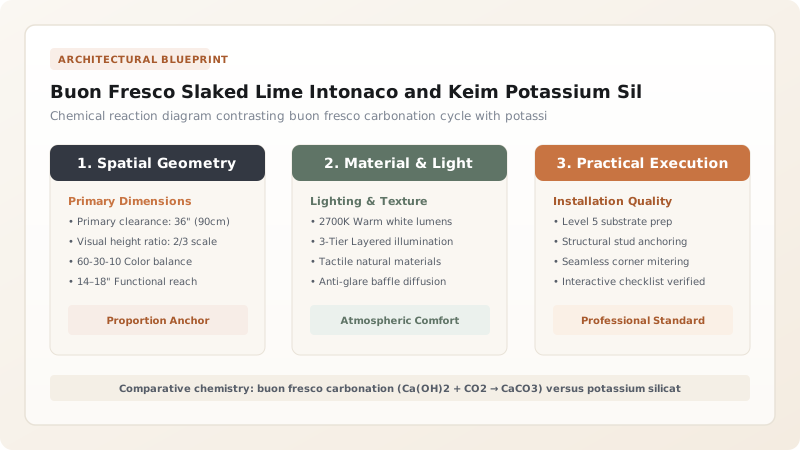
In the technical lexicon of traditional Bavarian masonry, the cornerstone of exterior fresco painting is Sumpfkalk (pit-aged slaked fat lime). Sourced from high-purity limestone (>98% pure calcium carbonate), the stone was burned in wood kilns at 900°C to drive off CO2, creating quicklime (calcium oxide, CaO). When slaked with excess water, the quicklime violently reacts, releasing intense heat to form calcium hydroxide (Ca(OH)2).
Rather than using this lime immediately, master craftsmen transferred the creamy slurry into underground masonry pits (Kalkgruben), where it was aged beneath water for three to five years—and sometimes for decades. During this prolonged aging, the calcium hydroxide crystals fracture into microscopic, hexagonal platelet colloids. This aging process dramatically increases plasticity, water retention, and chemical reactivity, producing an intonaco plaster that trowels like whipped butter and provides a brilliant, translucent white crystalline bed for mineral pigments.
The Daily Patch: Master of the Giornata
Because true buon fresco can only be executed while the intonaco remains actively damp and chemically receptive, the façade cannot be plastered in one monolithic operation. The composition must be divided into discrete daily working segments known as giornate (day's work).
A master Lüftlmaler examines the full cartoon and determines how much area can be painted with complete artistic finish within a single six-to-eight-hour window—such as a single saint's face, an illusionistic column capital, or a pair of trompe-l’œil window shutters. At the end of the working day, any unpainted intonaco must be carefully sliced away at a 45-degree angle with a sharp spatula along natural shadow contours or architectural joints, so that the next morning's fresh intonaco patch can be seamlessly dovetailed into the cured work.
The Silicification Revolution: Keim's Mineral Invention
While buon fresco reigned supreme in the 18th century, the late 19th century witnessed a breakthrough in alpine mineral paint technology. In 1878, Bavarian researcher Adolf Wilhelm Keim, commissioned by the art-loving King Ludwig I of Bavaria, patented a permanent mineral coating based on liquid potassium silicate (Wasserglas / water glass).
Unlike organic oil or acrylic paints, Keim silicate paint does not dry by film formation. When sprayed or brushed onto mineral plaster, sandstone, or concrete, the liquid potassium silicate reacts with both the calcium carbonate in the substrate and atmospheric CO2, undergoing a process known as Verkieselung (silicification or petrification). The paint transforms chemically into an insoluble, micro-porous matrix of quartz crystals, chemically fusing into the masonry substrate with identical thermal expansion and total UV permanence.
Vapor Permeability and Moisture Dynamics in Freezing Climates
The ultimate performance metric for any exterior finish in the European Alps is vapor permeability (expressed mathematically as the equivalent air layer thickness, sd). In winter, indoor heated air creates high vapor pressure that drives moisture outward through exterior masonry walls. If the exterior surface is coated with a synthetic paint (sd > 0.5 m), this vapor condenses into liquid water behind the plastic skin.
When temperatures plummet to -20°C, the trapped water freezes, expands by 9% in volume, and generates massive hydrostatic pressures (exceeding 200 MPa) that shatter the wall surface. Both buon fresco (sd < 0.01 m) and potassium silicate systems (sd < 0.02 m) possess an open, micro-porous crystalline structure. They allow vapor to transpire freely into the outdoor air without condensation, permanently preventing freeze-thaw delamination and ensuring that master Lüftlmalerei façades endure for centuries.
Chemical Mechanics: Buon Fresco vs Potassium Silicate (Wasserglas)
Use this reference table to calculate exact physical dimensions, ratios, and specifications before purchasing:
| Property / Parameter | Buon Fresco (True Fresco) | Potassium Silicate Paint (Keim) | Synthetic Exterior Acrylic |
|---|---|---|---|
| Plaster Substrate Condition | Fresh, wet intonaco applied that day | Fully cured, dry mineral plaster or stone | Dry plaster, masonry, or existing paint |
| Curing Reaction | CO2 absorption converts Ca(OH)2 to CaCO3 | K2SiO3 reacts with CO2 & mineral SiO2 to form quartz | Physical water evaporation leaves plastic polymer |
| Bond Strength | Pigments locked inside calcite crystal matrix | Covalent petrification directly into substrate | Mechanical surface adhesion (glued film) |
| Reversibility & Restoration | Irreversible stone; consolidated with lime water | Irreversible stone; can be recoated with silicates | Removable with toxic chemical strippers |
| Breathability (Vapor Diffusion) | Total; zero resistance to wall moisture | Total; identical to natural stone | Poor; traps vapor behind elastomeric membrane |
Practical Constraints
Every successful decoration project must account for physical and environmental constraints:
Narrow 6-Hour 'Giornata' Working Time on Exterior Scaffolding
Sudden alpine wind or heat can dry the intonaco prematurely before detailed figures are finished. Mitigation: Mist the plaster margins with fine atomized lime water and divide complex compositions into smaller giornate.
Corrosive Alkalinity of Fresh Slaked Lime and Potassium Silicate
High pH (12–13) causes chemical eye and skin burns and permanently etches glass window panes. Mitigation: Wear chemical safety goggles, mask all adjacent glass windows with plastic film, and keep neutralizing vinegar nearby.
Execution Blueprint & Craftsmanship Sequence
Execute this professional sequence to achieve flawless results without backtracking:
Basecoat Preparation and Masonry Hydration
Hydrate the cured lime arriccio basecoat with abundant clean water until suction is neutralized, preventing premature desiccation of the thin finish layer.
Intonaco Compounding and Mortar Kneading
Knead 1 part 3-year-old pit lime (Sumpfkalk) with 2 parts washed fine dolomite sand in a clean wooden trough until a buttery, lump-free plaster forms with zero water separation.
Applying the Giornata Intonaco Patch
Trowel a 4 mm layer of intonaco over only the surface area designated for that day's work, smoothing the face with a wooden float without over-troweling to preserve open capillary pores.
Incisione and Perspective Transfer
Transfer cartoon guidelines onto the wet plaster within 30 minutes of troweling by scoring reference lines with a blunt steel stylus (incisione) or pouncing charcoal powder.
Pigment Preparation in Saturated Lime Water
Grind pure dry mineral oxides (iron oxides, cobalt aluminate, green earth) on a porphyry slab with distilled water, thinning on the palette with clear saturated lime water (calcium hydroxide solution).
True Fresco Painting Execution
Paint while the plaster is cool, wet, and alkaline. The liquid color sinks into the mortar pores, where crystalline calcium carbonate begins to nucleate around each pigment particle.
The Giornata Joint Cut-Back
At the conclusion of the painting session, use a scalpel or bevel spatula to cut away all unpainted, dried intonaco, beveling the seam at a 45-degree angle following a natural contour line.
Potassium Silicate Application for Retouching or Dry Areas
For pre-existing dry façades, apply a 2-coat potassium silicate system (Wasserglas and mineral pigment), allowing 24 hours between coats for complete chemical silicification into quartz crystals.
Common Mistakes & Countermeasures
Avoid these costly errors that compromise aesthetics, ergonomics, and budget:
Adding hydraulic cement or rapid-setting binders into the fresco intonaco layer
Using water-glass potassium silicate over flexible synthetic or latex paint undercoats
Applying potassium silicate paint in direct blazing sunlight or during strong alpine foehn winds
Project Execution Checklist
Track your physical progress. Checkboxes persist automatically on this device:
Frequently Asked Questions
What is the chemical difference between 'slaked lime' and 'hydraulic lime' in fresco work?
Slaked lime (calcium hydroxide, Ca(OH)2), also called fat lime or air lime, cures purely by absorbing atmospheric carbon dioxide (carbonation). It remains workable for hours and creates the pure white, crystalline calcite matrix necessary for buon fresco. Hydraulic lime, by contrast, contains reactive silicates that set chemically with water like cement, setting too quickly and darkly for classical fresco intonaco.
How does Keim potassium silicate (Wasserglas) paint work on building exteriors?
Potassium silicate paint consists of liquid potassium water glass (K2SiO3) combined with inorganic mineral pigments and mineral fillers. When applied to bare lime plaster or masonry, it reacts with both the calcium carbonate in the plaster and atmospheric CO2, undergoing 'silicification' (Verkieselung). It forms an insoluble, chemically bonded potassium-calcium-silicate glass matrix that petrifies into the wall rather than forming a surface film.
Why can't organic pigments like alizarin crimson or indigo be used in fresco?
Wet slaked lime has an extremely high alkaline pH (around 12.5). This intense alkalinity rapidly attacks and hydrolyzes the organic chemical bonds of plant, insect, and synthetic organic dyes, causing them to bleach or turn brown within hours. Fresco painters must strictly use inorganic mineral pigments (such as iron oxides and cobalt) that are chemically impervious to alkaline attack.
What happens when rain strikes a fresh buon fresco?
If heavy rain strikes a fresco during its first 24 to 48 hours before initial carbonation has locked the pigment crystals, the unbound surface pigments will wash away in streaks. Masons protect fresh frescoes by tenting the scaffolding with waterproof canvas tarpaulins for at least two weeks until the plaster achieves water-resistant crystallization.