Lüftlmalerei is the famed Bavarian and Tyrolean vernacular tradition of trompe-l’œil exterior façade fresco painting that originated in Upper Bavaria (Oberbayern)—most notably in Oberammergau, Mittenwald, and Garmisch-Partenkirchen—during the 18th century. Pioneered by master painters such as Franz Seraph Zwinck, Lüftlmalerei transforms plain alpine masonry walls into illusionistic Baroque architecture using buon fresco techniques. Ground inorganic mineral pigments are applied onto fresh, wet slaked fat-lime plaster (intonaco), chemically bonding into weather-resistant crystalline calcium carbonate that endures sub-zero alpine blizzards and high-altitude UV radiation.
At a Glance: Key Takeaways
- Artisan Origin: Upper Bavaria (Oberammergau, Mittenwald, Garmisch-Partenkirchen; 18th Century)
- Fresco Technique: Buon Fresco (true wet-lime painting) & Keim mineral silicate (Wasserglas)
- Plaster Matrix: Pit-aged slaked fat lime (Sumpfkalk) & washed alpine dolomite/quartz sand
- Optical Illusion: Trompe-l’œil faux pilasters, molded architraves, balustrades, & cast shadows
- Weather Resistance: Microporous open vapor permeability surviving extreme alpine freeze-thaw
In-Depth Guides in this Directory
Explore specialized subtopic blueprints, technical dimensions, and execution checklists:
Buon Fresco Slaked Lime Intonaco and Keim Potassium Silicate Mineral Paint Chemistry
Technical guide to buon fresco lime plastering (intonaco) and Keim potassium silicate mineral paint chemistry for durable exterior alpine façade murals.
Optical Perspective Illusion in Lüftlmalerei: Window Surrounds, Pilasters, and Shadow Physics
Architectural guide to trompe-l’œil optical illusions in Bavarian Lüftlmalerei: anamorphic perspective, illusionistic pilasters, window surrounds, and shadow physics.
Alpine Freeze-Thaw Weather-Resistant Mineral Pigments and Vapor Permeability
Material science guide to weather-resistant mineral pigments and open-pore vapor permeability in alpine Lüftlmalerei: surviving sub-zero freeze-thaw cycles.
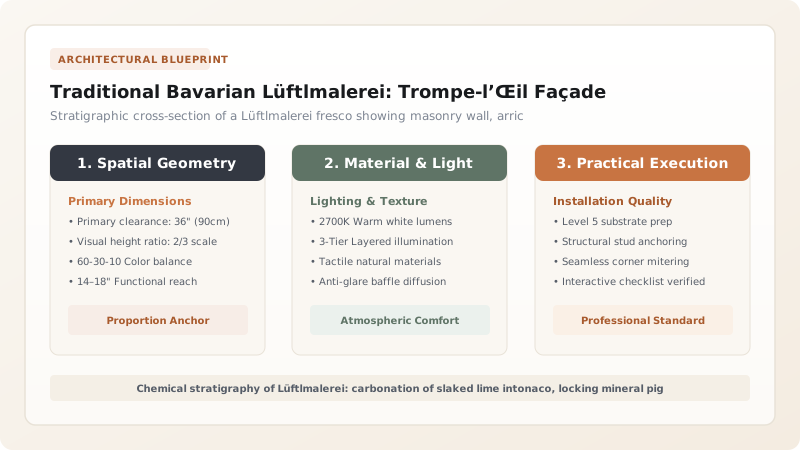
The Alpine Crucible: Origins of Lüftlmalerei in Oberbayern
Across the dramatic glacial valleys and craggy limestone massifs of Upper Bavaria (Oberbayern) and the Austrian Tyrol, the vernacular architecture of mountain farmhouses and merchant houses boasts one of Europe's most theatrical decorative expressions: Lüftlmalerei. Emerging in the mid-eighteenth century, this exterior fresco tradition transformed sturdy, plain alpine masonry structures into grand illusions of Italianate Baroque palaces and Catholic sacred theatres.
The cultural epicenter of the craft was the village of Oberammergau, nestled beneath the Kofel peak, alongside neighboring Mittenwald and Garmisch-Partenkirchen. Here, local master painter Franz Seraph Zwinck (1748–1792)—who lived in an ancestral house known locally as Zum Lüftl—perfected the art of translating monumental church ceiling frescoes to the exterior domestic streetscape. Masons and painters, working high upon wooden scaffolding in the brisk alpine air, became affectionately known as Lüftlmaler.
Chemical Foundations: The Buon Fresco Carbonation Cycle
The astounding longevity of authentic Lüftlmalerei—which endures over two centuries of severe alpine winters without peeling—is explained by classical inorganic lime chemistry. The wall is prepared using high-calcium fat lime (Sumpfkalk), slaked from pure limestone and aged in wet subterranean pits for a minimum of three to five years to achieve ultra-fine colloidal particle size.
When this slaked lime (calcium hydroxide, Ca(OH)2) is blended with washed quartz sand and troweled as the final thin painting ground (intonaco), it remains chemical open. The painter applies inorganic mineral pigments ground in pure water directly into the wet plaster. As the intonaco absorbs atmospheric carbon dioxide (CO2), water evaporates and the calcium hydroxide converts back into insoluble crystalline limestone (calcium carbonate, CaCO3):
Ca(OH)2 + CO2 → CaCO3 + H2O
The pigment grains do not form a surface film; they become encapsulated inside the crystalline limestone surface of the wall itself, creating an inorganic bond that can never peel, flake, or blister.
The Optical Theatre of Trompe-l’Œil Illusion
Lüftlmalerei is fundamentally an art of architectural deception (trompe-l’œil). In the 18th century, humble Bavarian alpine farmers could not afford imported Italian marble columns, carved sandstone balustrades, or ornate Rococo window pediments. The Lüftlmaler provided these aristocratic luxuries entirely through paint.
Using rigorous mathematical perspective and consistent shadow projection, painters rendered faux fluted Corinthian pilasters flanking building corners, molded architraves around simple window openings, recessed statues in trompe-l’œil niches, and realistic draped curtains billowing from painted balconies. When viewed from the village lane, these painted elements leap forward in convincing three-dimensional relief, tricking the eye into perceiving monumental sculptural architecture upon a dead-flat plaster wall.
Alpine Preservation, Keim Silicate Systems, and Modern Continuity
Façades in the northern Alps face brutal environmental stresses: deep sub-zero winter temperatures, driving blizzards, wind-driven rain, and intense summer UV radiation reflected off snowfields. Modern synthetic acrylic paints applied to historic alpine façades fail catastrophically because they form plastic vapor barriers; moisture trapped behind the film freezes, expands by 9%, and pops the paint and plaster off in massive sheets.
For this reason, historic Lüftlmalerei conservation and contemporary alpine commissions rely strictly on breathable mineral chemistry: traditional buon fresco or potassium silicate mineral paints (invented in Bavaria by Adolf Wilhelm Keim in 1878). These mineral systems maintain an open microporous crystalline lattice that allows building moisture to transpire freely while protecting historic masterworks as vibrant cultural jewels of alpine heritage.
Façade Mural Systems: Buon Fresco vs Silicate Mineral Paint vs Modern Acrylics
Use this reference table to calculate exact physical dimensions, ratios, and specifications before purchasing:
| Technical Parameter | Authentic Buon Fresco (Lüftlmalerei) | Potassium Silicate (Wasserglas) | Exterior Acrylic Latex |
|---|---|---|---|
| Chemical Binding Mechanism | Carbonation: Ca(OH)2 + CO2 → CaCO3 crystals | Silicification: K2SiO3 + substrate → potassium silicate glass | Coalescence: organic polymer plastic film formation |
| Vapor Permeability (sd value) | sd < 0.02 m (completely breathable, zero trapped vapor) | sd < 0.02 m (completely micro-porous, stone-like) | sd > 0.5–2.0 m (impermeable film; traps moisture) |
| Alpine Freeze-Thaw Resistance | Exceptional; no film to blister or peel off | Exceptional; petrifies permanently into mineral matrix | Poor; hydrostatic freeze pressure pops film in blisters |
| Ultraviolet (UV) Stability | 100% immune; natural mineral oxides never fade | 100% immune; inorganic crystalline bond | Poor to Moderate; organic binders chalk and yellow |
| Application Window | Demands strict 6–8 hour wet intonaco window | Can be applied onto cured dry mineral plaster | Fast and convenient; unsuited for historic preservation |
Practical Constraints
Every successful decoration project must account for physical and environmental constraints:
Severe Alpine Winter Temperature Swings (-25°C to +15°C Diurnal Freeze-Thaw)
Trapped interstitial liquid water expands by 9% upon freezing, shattering dense impermeable wall coatings. Mitigation: Maintain an open micro-porous slaked lime matrix that allows vapor to vent freely while shedding bulk exterior rain.
High Solar UV Radiation at High Mountain Altitudes (800m–1500m ASL)
Photochemical degradation fades modern organic pigments within 3 to 5 years. Mitigation: Specify solely calcined metal oxides (iron oxides, cobalt aluminates, titanium oxides) with ASTM D4302 lightfastness Category 1.
Execution Blueprint & Craftsmanship Sequence
Execute this professional sequence to achieve flawless results without backtracking:
Substrate Wetting and Lime Arriccio Application
Rake out decayed joints in the stone or brick wall. Saturate the masonry with water to prevent suction, then trowel a 15 mm rough scratch coat (arriccio) of 1 part pit-aged lime to 3 parts coarse alpine river sand.
Establishing Architectural Perspective Lines
Snap master chalk lines across the façade to align illusionistic cornices, pilasters, and window surrounds with the building’s real windows, roof eaves, and street vantage points.
Intonaco Application for the Daily Section (Giornata)
Trowel a 3 mm to 5 mm fine plaster layer (intonaco) formulated from 1 part aged slaked fat lime (Sumpfkalk) and 2 parts fine washed dolomite sand over only the area to be painted that day.
Cartoon Pouncing or Stylus Incision
Tape full-scale perspective cartoons onto the wet plaster. Trace contours with a bone stylus to leave subtle indented lines (incisione) or pounce charcoal dust through pricked pinholes.
Laying Transparent Mineral Underpaintings (Verdaccio / Grisaille)
Apply thin washes of green earth (terra verde) and raw umber diluted with lime water to establish shadowed relief zones, fluting depths, and anatomical contours while the plaster is fresh.
Building Trompe-l’Œil Volume and Light Modeling
Paint architectural molding highlights in titanium/zinc white and cast shadows in rich burnt umber, maintaining a uniform 45-degree virtual light source to create startling three-dimensional relief.
Executing Detailed Narrative Iconography
Render central medallions—such as St. Florian protecting from fire or St. George slaying the dragon—with saturated mineral pigments before plaster loses its alkaline moisture.
Carbonation Curing and Perimeter Seaming
Slice away unpainted intonaco borders at a 45-degree angle with a paletted spatula. Allow the fresco to carbonate naturally over 4 weeks, curing into crystalline insoluble limestone.
Common Mistakes & Countermeasures
Avoid these costly errors that compromise aesthetics, ergonomics, and budget:
Applying synthetic acrylic or elastomeric exterior house paints over alpine lime fresco grounds
Painting with organic dyes or non-lime-fast pigments (such as Prussian blue or organic lakes)
Painting on intonaco that has already begun to carbonate and dry
Project Execution Checklist
Track your physical progress. Checkboxes persist automatically on this device:
Frequently Asked Questions
What does the word 'Lüftlmalerei' mean and where did it originate?
The most widely accepted origin of Lüftlmalerei relates to Franz Seraph Zwinck (1748–1792), a master façade painter from Oberammergau who lived in a home known as 'Zum Lüftl.' Locals referred to his work as 'painting by the Lüftl,' which evolved into the Bavarian term for exterior fresco painting. Another poetic folk explanation is that artists worked high up on scaffolding in the fresh mountain air ('in the breeze' or 'in der Lüft').
Why does a true buon fresco not peel or flake like modern paint?
In true buon fresco, there is no separate paint film sitting on top of the wall. When mineral pigments mixed with water are applied to wet slaked lime plaster, the calcium hydroxide Ca(OH)2 in the plaster reacts with atmospheric carbon dioxide CO2 to form crystalline calcium carbonate (calcite). The pigment particles become physically locked inside the crystalline limestone surface of the wall itself.
How do painters create the illusion of three-dimensional architecture on flat walls?
Lüftlmalerei employs trompe-l’œil ('fool the eye') anamorphic perspective and consistent shadow projection. The artist establishes an imaginary single light source (conventionally 45 degrees from the upper left) and paints cast shadows, core shadows, and bright white highlights that correspond exactly with real physical architectural elements, making flat window frames and pilasters appear to project several inches out from the façade.
What is the connection between historic Lüftlmalerei and Keim mineral paint?
In 1878, Bavarian researcher Adolf Wilhelm Keim patented a liquid potassium silicate mineral paint (Wasserglas) at the request of King Ludwig I of Bavaria, who wanted the luminous durability of Italian buon fresco on cold German façades. Modern restorations and exterior murals in the Alps frequently utilize Keim silicate paint because it petrifies into the masonry, providing identical breathability and mineral permanence without requiring the narrow wet-plaster time constraints of buon fresco.