
Apply natural lime wash paint using a wide natural bristle masonry block brush in sweeping criss-cross 'X' strokes over a dedicated mineral primer. As the slaked lime reacts with atmospheric carbon dioxide, it petrifies into a durable, mold-resistant, chalky-matte limestone finish.
At a Glance: Key Takeaways
- Mineral Carbonation: Slaked lime literally turns back into solid stone on your wall by absorbing ambient CO2.
- High Breathability: Vapor-permeable structure allows moisture to escape, preventing blistering and mold growth.
- Natural High pH (12+): Highly alkaline mineral chemistry naturally kills bacteria, mildew, and airborne spores.
- Zero-VOC & Non-Toxic: 100% natural minerals (crushed limestone, clay, natural earth pigments, and water).
- Velvety Depth: Light refracts through crystalline calcium carbonate crystals, creating soft visual clouds.
In-Depth Guides in this Directory
Explore specialized subtopic blueprints, technical dimensions, and execution checklists:
Limewash Application: 5" Block Brushes & 'X' Stroke Movement
Master natural limewash painting techniques: 5-inch natural bristle block brushes, sweeping 'X' crosshatch strokes, maintaining wet edges, and mineral bloom drying physics.
Roman Clay Plaster: Stainless Trowels & Ultra-Matte Suede
Master Roman clay plaster application: stainless steel Venetian plaster trowels, thin skim coats (1mm thickness), multi-directional trowel movement, and suede matte finishes.
Lime Wall Breathability: High pH (12+) & Natural Mold Prevention
Master natural lime wall breathability and mold prevention: 12+ alkaline pH biochemistry, vapor-permeable drying physics, eliminating toxic synthetic biocide paints, and basement walls.
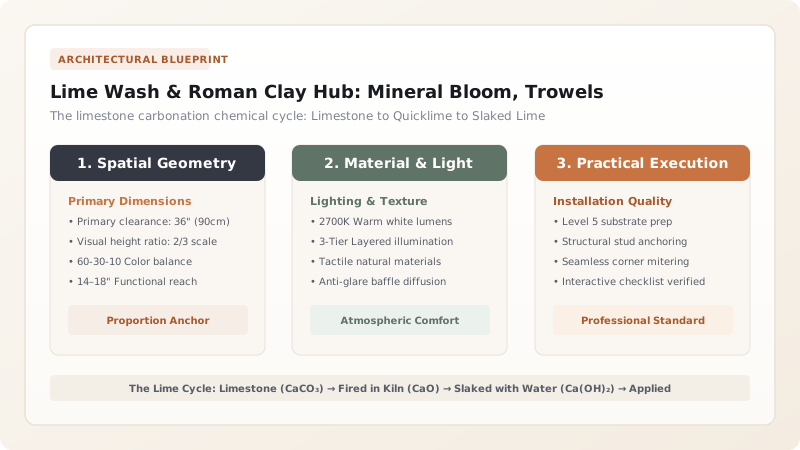
1. Chemical Physics: The Ancient Lime Carbonation Cycle
Standard modern latex paint creates a synthetic plastic film (acrylic polymer) that seals drywall in an impermeable rubber skin. In contrast, natural slaked lime wash paint (Calcium Hydroxide, \(\text{Ca(OH)}_2\)) is an ancient mineral medium used since Roman antiquity.
When applied to a wall, the wet slaked lime reacts chemically with carbon dioxide (\(\text{CO}_2\)) in the air through Carbonation:
$$\text{Ca(OH)}_2 + \text{CO}_2 \rightarrow \text{CaCO}_3 + \text{H}_2\text{O}$$
The paint literally crystallizes into a microscopic layer of genuine solid limestone rock (\(\text{CaCO}_3\)) fused directly to the wall.

Natural Mineral Wall Finishes Comparison
Use this reference table to calculate exact physical dimensions, ratios, and specifications before purchasing:
| Mineral Wall Finish | Application Tool | Texture & Sheen | Best Room Setting |
|---|---|---|---|
| Traditional Lime Wash | 5" Natural bristle masonry brush | Chalky-matte with cloud-like movement | Bedrooms, living rooms, dining rooms, historic homes |
| Roman Clay Plaster | Stainless steel Venetian trowel | Velvety smooth, ultra-soft matte marble feel | Powder rooms, primary suites, modern minimalist interiors |
| Venetian Plaster (Polished) | Japanese steel trowel + burnishing | High-gloss polished mirror stone | Luxury fireplace surrounds, dramatic grand entryways |
| Tadelakt Moroccan Plaster | Plastic trowel + olive oil soap stone | 100% Waterproof polished lime | Inside shower enclosures, wet bathrooms, steam rooms |
Unprimed Drywall Flaking Constraints
Every successful decoration project must account for physical and environmental constraints:
Limewash Flaking Off Smooth Latex Drywall Like Powder
Limewash cannot bond to smooth acrylic latex paint; strictly apply a specialized 'Mineral Acrylic Grip Primer' (like Bauwerk or Portola Primer) containing microscopic silica grit to give the lime a mechanical grip.
How to Apply Natural Lime Wash Paint
Execute this professional sequence to achieve flawless results without backtracking:
Apply Coarse Mineral Primer
Roll 1 coat of textured mineral grip primer over drywall and allow to dry 12 hours.
Dampen Wall with Water Mist
Lightly mist wall with water sprayer to slow drying and prevent premature chalking.
Apply First Coat in 'X' Crosshatch
Dip 5" masonry brush and apply in sweeping criss-cross 'X' motions maintaining a wet edge.
Let Dry 24 Hours
Allow first coat to carbonize and cure for 24 hours (color lightens by 40% as it dries).
Apply Second Thin Ghost Coat
Apply a second diluted coat to create rich, cloud-like tonal depth and depth of field.
Common Mistakes & Countermeasures
Avoid these costly errors that compromise aesthetics, ergonomics, and budget:
Applying Limewash with a Standard 9-Inch Paint Roller
Project Execution Checklist
Track your physical progress. Checkboxes persist automatically on this device:
Frequently Asked Questions
Can you wash or wipe down limewash walls?
Because limewash is an unsealed breathable mineral, scrubbing with wet soapy sponges can leave water marks. For high-traffic areas or behind bathroom sinks, apply a breathable 'Mineral Sealer' (like Bauwerk Prep Coat Sealer) that adds water repellency while preserving the chalky matte look.


