Carved teak saka posts and pegless mortise-tenon joints represent the artistic and mechanical core of Balinese wantilan architecture. Hewn from mature heartwood teak (kayu jati) or jackfruit wood (kayu nangka), the cylindrical columns are sculpted by master woodcarvers with elaborate low- and high-relief mythological motifs, including patra floral scrolls, karang boma monster masks, and naga serpents. The structural joinery functions entirely without metallic fasteners: horizontal tie-beams (sunduk and sesait) penetrate through-mortises in the columns, secured by tapered wooden keys and interlocked lap notches that expand and tighten under building dead weight while retaining ductile seismic flexibility.
At a Glance: Key Takeaways
- Column Timber: Mature teak (Tectona grandis) or jackfruit (Artocarpus heterophyllus)
- Carving Style: Pepatraan (floral arabesques), Karang Boma (demon masks), and Naga serpents
- Joinery Typology: Through-mortise and tenon (sunduk) locked with tapered wooden keys (pasak)
- Plinth Detail: Rounded andesite stone umpak base with shallow alignment pin; zero anchor bolts
- Fastener Philosophy: 100% pegless and nail-free; relies on gravity, friction, and wood wedges
The Soul of the Tree: Wood Selection & Undagi Rituals
In the spiritual taxonomy of Balinese woodcraft, trees are not treated as inert commercial timber, but as sacred living beings imbued with vital spiritual energy (prana). Before a master builder (undagi) fells a mature teak (kayu jati) or jackfruit tree (kayu nangka) for a community wantilan, an elaborate offering ceremony (upakara) is performed before the forest spirit (Banaspati Raja). The undagi asks forgiveness for taking the tree’s life, explaining that its physical body will be reborn into a sacred communal structure that serves the community and honors the gods.
The orientation of the tree is rigorously preserved throughout the milling and carving process. The base of the trunk—the 'root end' (bucu)—must always remain at the bottom of the finished column, while the upper trunk (muncuk) must face upward toward the heavens. Reversing this natural orientation is considered a severe spiritual transgression that invites structural misfortune and discord among the villagers. Once felled, the logs are seasoned in shaded drying sheds for months, allowing sap to evaporate naturally to ensure the timber will neither warp nor check when carved.
Iconography of the Post: Pepatraan, Boma & Naga Serpents
The ornamentation of a wantilan column is an intricate visual theological sermon carved in high relief. The column is divided vertically into three classical anatomical zones corresponding to the human body: the base (batang or foot), the shaft (awak or body), and the capital (tendas or head). The shaft is sculpted with flowing botanical arabesques known as pepatraan—intricately curling acanthus fronds, lotus leaves, and flowering vines that symbolize the fertile, abundant life force of the tropical earth.
At the capital, immediately beneath the structural tie-beams, the carver sculpts monumental mythological guardian figures. Most prominent is the Karang Boma, a terrifying yet benevolent chthonic deity depicted with wide, staring round eyes, curled boar tusks, and a leafy headdress of vegetation. In Balinese belief, Boma is the protector of sacred thresholds, swallowing and purifying negative energies (bhuta kala) before they can disrupt peaceful community gatherings. On the primary central columns, carvers often entwine the bodies of divine crowned serpents (Naga Anantaboga and Naga Basuki), whose scaly coils represent the subterranean powers that stabilize the tectonic foundations of the island.
The Mechanics of Pegless Joinery: The Sunduk and Pasak
While modern construction relies heavily on galvanized nails, threaded steel rods, and welded gusset plates, classical Balinese carpentry is completely metal-free. The entire horizontal structural matrix of the wantilan is assembled using interlocking mortise-and-tenon connections governed by the principle of sunduk and pasak.
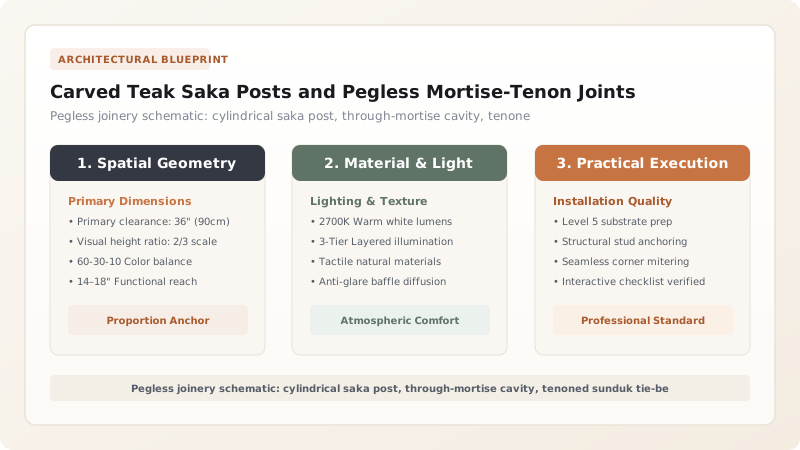
To join horizontal tie-beams (sunduk) to vertical columns (saka), the undagi bores and chisels a rectangular through-mortise directly through the center of the column. The horizontal beam is cut with a long, robust tenon that penetrates entirely through the post, protruding 50 to 80 millimeters on the opposing side. Through this protruding tenon tongue, the carpenter chisels a second, vertical tapered slot. A wedge-shaped key (pasak) carved from dense, unyielding ironwood (kayu ulin) is driven down through this slot. As the wedge is hammered with a wooden mallet, its angled face pulls the tenon shoulder with tremendous mechanical force against the column face, clamping the joint tight. This connection creates a powerful friction lock that resists heavy axial tension and compression, yet retains enough microscopic rotational compliance to flex elastically without splitting during violent seismic shaking.
Longevity & Preservation: Natural Botanical Oil Formulations
Exposed to equatorial ultraviolet radiation, monsoon downpours, and intense tropical humidity, exterior timber in Southeast Asia faces severe environmental degradation. Traditional Balinese woodcraft solves this preservation challenge through the ritual application of indigenous botanical finishes rather than modern synthetic polyurethanes or petroleum varnishes, which blister and peel when moisture vapor attempts to migrate out of the timber core.
Master carpenters formulate a natural wood preservative known locally as minyak kelapa cengkeh. Virgin, cold-pressed coconut oil is infused with crushed cloves (cengkeh), neem leaves (mimba), and camphor wood shavings. The mixture is gently warmed and massaged deep into the carved reliefs of the teak columns using soft coconut husks. The natural fatty acids of the coconut oil nourish the wood fibers, restoring moisture balance and preventing micro-fissures, while the concentrated eugenol from the cloves acts as a powerful, permanent biocide that repels subterranean termites (rayap), wood-boring beetles, and fungal spores. Over decades of annual oiling, the teak columns develop a deep, burnished bronze-mahogany patina with a silky, tactile sheen that exudes a subtle, spicy fragrance whenever warm monsoon breezes sweep through the pavilion.
Balinese Structural Joinery Connections & Mechanical Behaviors
Use this reference table to calculate exact physical dimensions, ratios, and specifications before purchasing:
| Joint Name | Components Connected | Joint Geometry | Mechanical Action | Seismic Performance |
|---|---|---|---|---|
| Sunduk-Saka Connection | Tie-beam through column | Through-mortise with wedged tenon key | Tension and compression lock; rotational freedom | High ductility; rotates without splitting post |
| Lambang-Saka Seat | Roof perimeter plate to post head | Bridle joint with tenon pin cap | Transfers vertical roof dead load directly to post | Gravity-locked; prevents horizontal rafter thrust |
| Sesait Interlock | Secondary crossing tie-beams | Halved lap joint with sliding dovetail | Ties perpendicular columns into rigid frame | Absorbs racking forces through friction |
| Umpak-Saka Foot | Column base to stone pedestal | Convex stone dome in concave wooden base | Pure compressive bearing; zero tensile anchor | Seismic base-isolation; slides and dissipates energy |
| Tumpang Pin Connection | Upper king post to collar beam | Stub tenon seated in blind mortise | Vertical load transfer; keeps upper tier centered | Self-centering under dynamic lateral oscillation |
Practical Constraints
Every successful decoration project must account for physical and environmental constraints:
Scarcity and high market cost of ancient, large-diameter old-growth teak logs in Indonesia
Procurement of matching 12-meter, 40-centimeter diameter flawless teak columns is logistically difficult. Mitigation: Utilize certified sustainably harvested teak from Perum Perhutani plantations or use jackfruit heartwood.
Intense tropical humidity cycles causing seasonal swelling and shrinkage across timber joints
Wooden locking keys can loosen during dry seasons and bind tightly during wet monsoon months. Mitigation: Taper locking keys by 5 degrees, allowing maintenance carpenters to tap wedges tighter annually.
Execution Blueprint & Craftsmanship Sequence
Execute this professional sequence to achieve flawless results without backtracking:
Log Selection & Grain Inspection
Inspect seasoned teak logs for straight grain, zero internal spiral twist, and absence of fungal dry rot, marking the natural growth orientation (root end to bottom).
Adze Hewing & Circular Turning
Hew the octagonal or cylindrical profile of the saka post using traditional Balinese adzes (patuk), truing the surface with hand planes to a subtle 2% upward taper.
Through-Mortise Layout & Boring
Scribe through-mortise openings at the engineered tie-beam height, drilling out the core with hand augers and chiseling the mortise walls razor-flat.
Tie-Beam (Sunduk) Tenon Profiling
Cut long, precision tenons on both ends of the horizontal tie-beams, ensuring the tenon passes through the column with a 50 mm protruding tongue.
Key Mortise (Pasak) Cutting
Chisel a vertical tapered slot through the protruding tongue of the tenon, positioned so that driving a wedge will pull the tenon shoulder tight against the post.
Mythological Relief Sculpting
Carve the sacred pepatraan floral motifs, Boma guardian masks, and spiraling naga dragons onto the upper capitals and bases using gouges and mallets.
Trial Dry-Fitting & Frame Erection
Assemble the posts and tie-beams flat on the ground to test joint tolerances, then raise the frame vertically onto the stone umpak pedestals.
Locking Key Driving & Botanical Oiling
Drive hardwood pasak wedges firmly through the tenon mortises to lock the frame, coating all carved surfaces with boiled coconut and clove oil.
Common Mistakes & Countermeasures
Avoid these costly errors that compromise aesthetics, ergonomics, and budget:
Driving steel nails or modern expansion lag bolts into historic teak joinery
Carving ornamental reliefs too deeply into the load-bearing center of the saka column
Project Execution Checklist
Track your physical progress. Checkboxes persist automatically on this device:
Frequently Asked Questions
What is the cultural significance of the Boma mask carved on Balinese columns?
Karang Boma (the head of Boma, son of the earth goddess Pertiwi and the god Wisnu) is a fierce guardian spirit depicted with bulging eyes, fangs, and flowing foliage hair. Carved at the top of primary columns and above entrances, Boma functions as an apotropaic guardian, absorbing and deflecting negative spiritual energies (bhuta kala) and protecting the communal gathering within.
Why are Balinese timber joints designed without metal nails or bolts?
Traditional Balinese carpentry eschews iron fasteners for both practical and philosophical reasons. Metal fasteners rust rapidly in the tropical maritime climate, causing surrounding timber to rot. Philosophically, a timber frame is considered a living harmonic entity that must expand, contract, and flex with the seasons. Pegless interlocking joints distribute stresses evenly across large wood surfaces, whereas iron bolts concentrate stresses at small points, causing timber to split under earthquake shear.
How do carpenters ensure columns remain plumb when resting unanchored on stone plinths?
Plumbness is maintained through structural triangulation and the interconnected network of horizontal tie-beams. The four central saka guru posts form a rigid box frame that holds all columns plumb collectively. Furthermore, the massive dead weight of the multi-tiered thatched roof presses down on the posts, seating them securely into the concave stone umpak plinths by gravity alone.